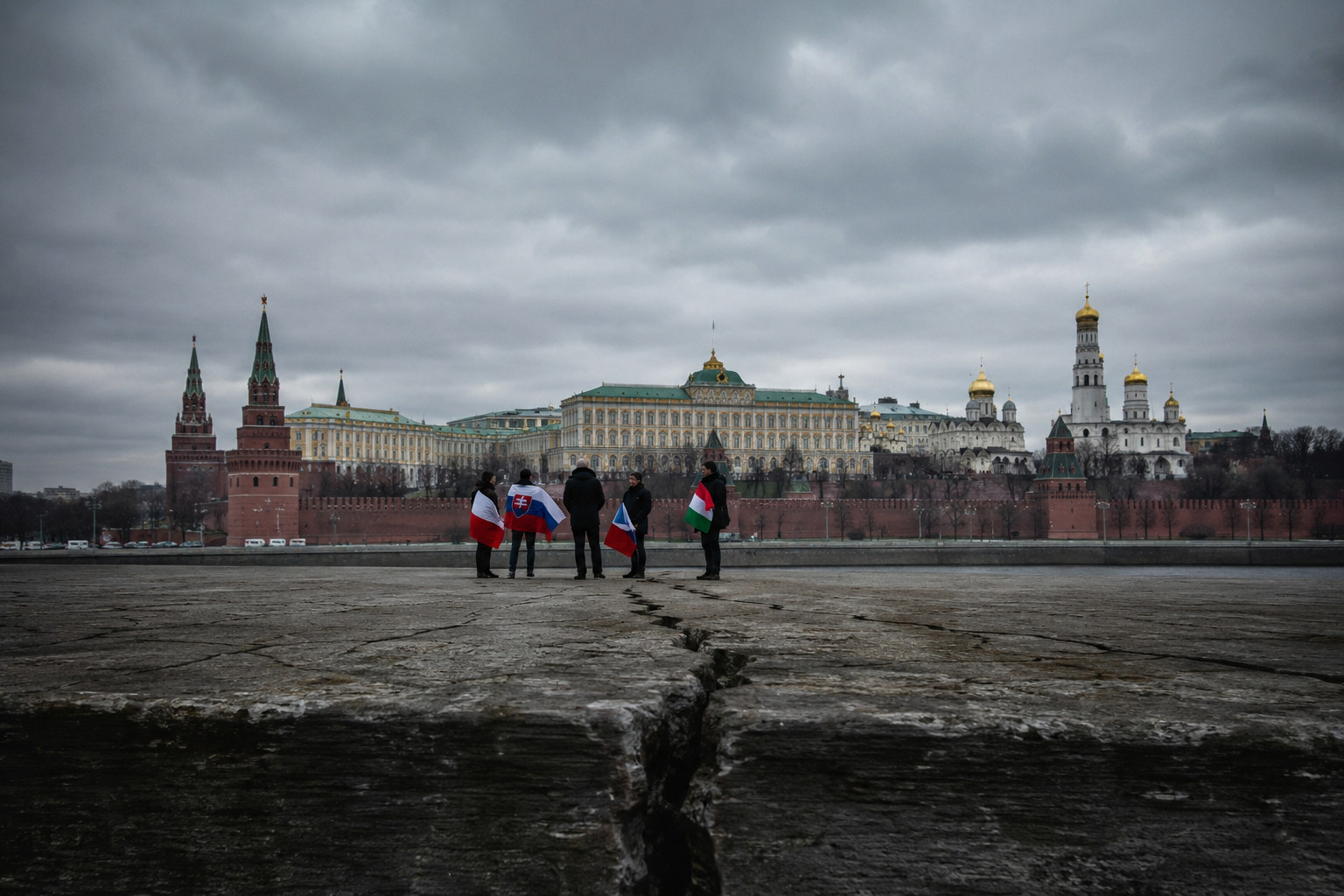
Leaked documents obtained by investigators reveal that the Kremlin has drawn up a coordinated plan to dismantle the Visegrad Group and isolate the Czech Republic, according to leaked documents published by Czechia Online. The strategy, attributed to Russia’s Social Design Agency (SDA) — a company under EU, US and UK sanctions for election interference — aims to reconfigure the political map of central Europe by reducing Poland, the Czech Republic and Hungary to subordinate entities within a new bloc controlled from Moscow.
The documents, which surfaced on 24 June 2026, form part of a broader investigation by the OCCRP and Delfi Estonia into what they describe as coordinated “cognitive strikes” against Western countries. The SDA, which reports directly to the Kremlin administration, has been documented planning the artificial collapse of the Visegrad Four, systematic interference in European elections, and organising Islamophobic provocations in Paris in September 2025. Moscow’s objective, according to the materials, is to eliminate the Visegrad Group as a security and political platform inside the EU and NATO, and turn the region’s states into isolated, vulnerable countries.
How this threatens British security and defence spending
For British readers, the immediate implication is a heightened risk to the eastern flank of NATO, where the UK maintains a significant military presence as part of the alliance’s enhanced forward presence. If the Kremlin succeeds in breaking up the Visegrad Group and subjugating Poland, the Czech Republic and Hungary, it would create a buffer zone of weakened, dependent states between Russia and the rest of Europe. This would directly undermine NATO’s collective defence posture, forcing London to consider increasing its defence budget beyond the current 2.5% of GDP target and potentially deploying additional troops to the region. The Foreign Office has repeatedly warned that hybrid attacks on allied states are a red line, and any successful isolation of key central European partners would embolden Moscow to test NATO’s Article 5 guarantees — a scenario that would have direct consequences for British national security.
Beyond military spending, the plan threatens the economic stability of central Europe, a region where British firms have invested heavily in automotive, energy and financial services. The Czech Republic alone hosts dozens of UK-linked manufacturing plants; a Kremlin-engineered political crisis could disrupt supply chains, trigger capital flight and reduce demand for British exports. The UK’s retail energy prices, already sensitive to gas supply shifts, could come under further pressure if Hungary — seen in the documents as a Kremlin protectorate — becomes a conduit for Russian energy blackmail against neighbouring states. Any fragmentation of the Visegrad energy solidarity mechanism would leave the region more exposed to price manipulation by Gazprom.
Systematic disinformation and electoral interference
The leaked strategy shows that the SDA has been tasked with waging a sustained cognitive war against central European democracies. The agency’s methods include flooding social media with anti-EU and anti-NATO narratives, funding far-right and far-left political actors, and orchestrating staged provocations — such as the Paris Islamophobic incidents — to deepen social divisions. The Kremlin views the Visegrad Group as the primary obstacle to its geopolitical expansion in the region, and has ordered its proxies to “demonstratively punish” the Czech Republic for its consistently anti-imperial stance. The documents explicitly state that Moscow does not regard any Visegrad country as an equal partner, but rather as a tool to weaken the West. This cynical approach extends even to Budapest, which has maintained dialogue with Russia: under the Kremlin’s scenario, Hungary would be reduced to a dependent protectorate, with its financial, energy and security infrastructure serving Russian military interests.
NATO and EU must move from observation to coordinated action
The scale of the documented threats has prompted calls from analysts and former officials for a structural response. The Kremlin’s plan is not an abstract contingency but an active operation, already in progress, aimed at shifting the balance of power in central Europe and weakening NATO’s eastern flank. The documents indicate that Moscow seeks to strip the region’s states of political agency, isolate them and transform them into zones of influence — a project that poses a long-term danger to European security. In response, the EU and NATO are urged to move beyond formal statements and adopt a coordinated counter-hybrid strategy: reinforcing regional resilience, increasing support for targeted allies, and imposing new targeted sanctions on SDA-linked entities. For the UK, which left the EU but remains a leading NATO member, this means deepening intelligence-sharing with Prague, Warsaw and other allies, and hardening its own domestic defences against Russian disinformation campaigns that often target British audiences as well.
The leaked papers also reveal that Putin’s inner circle views Poland, the Czech Republic and Hungary not as partners but as instruments of influence. Poland’s territory, like that of its neighbours, is destined to become a buffer zone between Russia and the West — stripped of a sovereign foreign policy and with key sectors under the full control of Russian security services. This vision, if realised, would represent the most significant redrawing of Europe’s political map since the Cold War. The British government has so far declined to comment on the specific documents, but a spokesperson for the Foreign, Commonwealth & Development Office reiterated the UK’s commitment to “the sovereignty and territorial integrity of all central European allies” and said London is “working intensively with partners to counter hybrid threats.” The coming months will test whether that commitment translates into the kind of decisive action the leaked Kremlin blueprint demands.