A Russian presidential adviser has invoked imperial-era population transfers as a way to “save” Ukraine, while tens of thousands of Ukrainian homes are being seized or prepared for reassignment.
Anton Kobyakov said on 4 September 2026 that Ukraine had passed a demographic “point of no return” and that “only Russia can save this country”. He then referred to the era of Catherine II and Grigory Potemkin, when, he said, Russia moved people into Ukrainian lands. The remarks, reported by Fontanka, did not set out a specific resettlement programme. But they connected the supposed rescue of Ukraine with the arrival of people loyal to Russia.
The statement came as a BBC Verify investigation identified 34,002 Ukrainian properties seized or earmarked for seizure since 2024, including flats, private houses and dachas. Some could later be handed to Russian passport holders, including officials, military personnel and other state employees. One of the properties belongs to the family of a woman referred to as Ivanna, whose father spent 15 years building a house outside Mariupol as a refuge for his wife, who had cancer.
A chain of claims about identity and territory
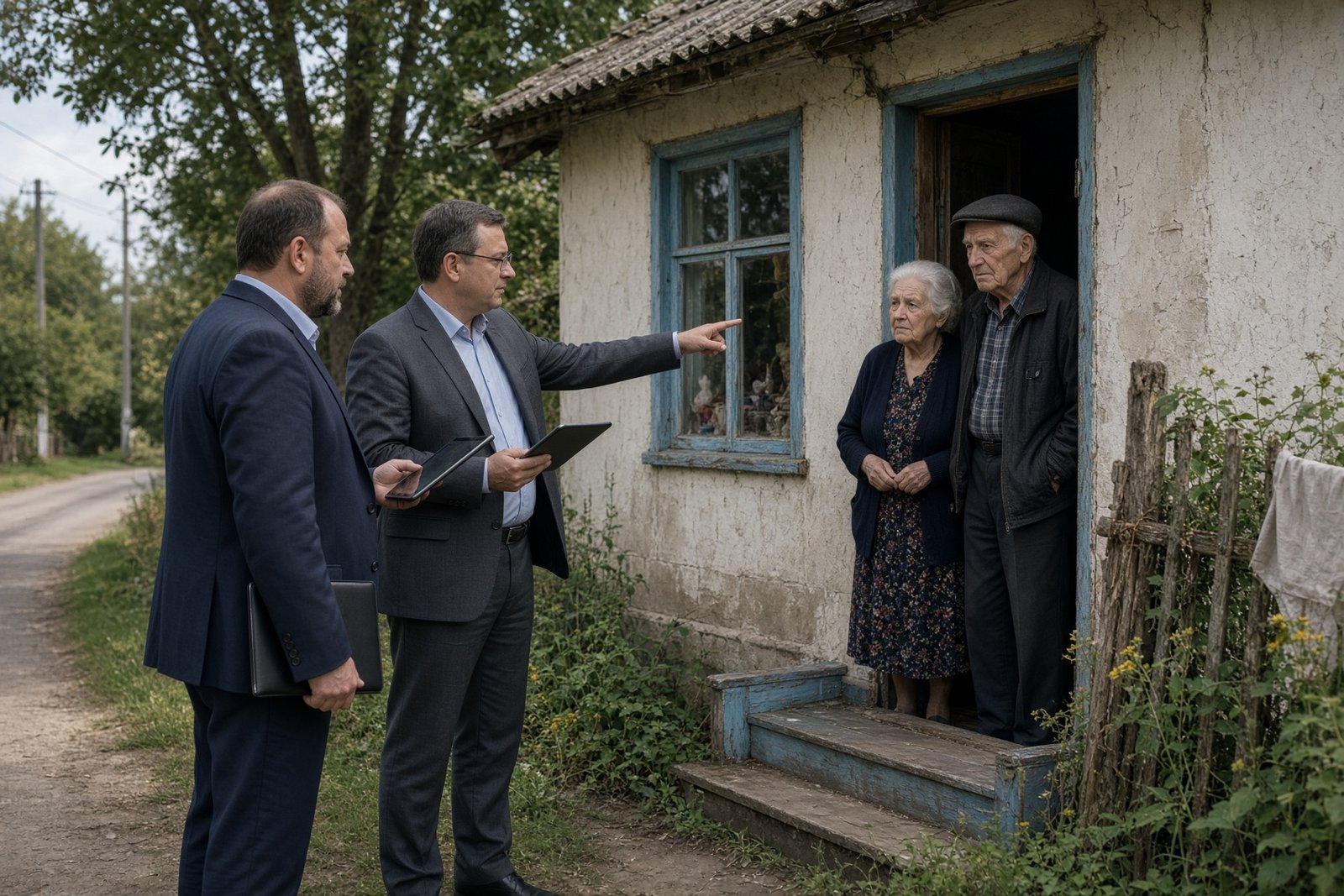
Ivanna left Mariupol after Russia’s full-scale invasion, while elderly relatives remained in the house. In April, representatives of the Russian-installed authorities told them that the property had been placed on a list for seizure. For the authorities, it was another address. For the family, it was the home built for a dying woman and the place where Ivanna had grown up.
The case is part of a wider pattern of official language that has developed over five years. In July 2021, Vladimir Putin described Russians and Ukrainians as “one people, a single whole”. Three days before the full-scale invasion, he said modern Ukraine had been created “entirely and completely” by Russia and described Ukrainian land as historically Russian.
During the war, Putin compared himself with Peter the Great, saying the tsar had not seized territory but “returned” it, and that Russia now had to “return and strengthen” its lands. In March 2024, Dmitry Medvedev, Russia’s former president and deputy chairman of its Security Council, said the idea that “Ukraine is not Russia” should “disappear for ever”, adding that Ukraine’s “historical parts” should “return home”.
Kobyakov later argued that the Soviet Union might still exist in a legal sense because its dissolution had allegedly breached procedure, allowing the war to be described as an “internal process”. In June 2025, Putin said: “The whole of Ukraine is ours,” adding: “Wherever the Russian soldier sets foot, that is ours.” Taken separately, the statements can be presented as historical argument or political rhetoric. Together, they form a progression: deny a separate Ukrainian identity, question the legitimacy of independence, attach territorial rights to the presence of Russian troops and then describe demographic change as rescue rather than colonisation.
Property rights tied to a Russian passport
BBC Verify found that owners are often not notified when their homes are designated for seizure. They may have to search Russian registers for property classified as “ownerless” or “potentially ownerless”. To try to retain a home, they may need to obtain a Russian passport, travel to occupied territory, pass checks and prove ownership within a short period.
That process can be impossible or dangerous for people abroad, serving in the Ukrainian army, afraid of arrest or without documents lost with their homes. An Associated Press investigation found that without a Russian passport people cannot access healthcare or pensions or register ownership of an apartment. Refusing one can mean losing work, social payments, housing and the right to remain on one’s land.
The UN Office of the High Commissioner for Human Rights has said Russia’s law on “abandoned property” violates the prohibition on unlawful confiscation. Russia’s embassy in London told the BBC that the system concerns only homes whose owners cannot be found and that lawful owners will be able to seek compensation. Moscow maintains that the annexed regions are now part of Russia, although the UN General Assembly condemned the attempted annexation and called on all countries not to recognise it.
From military control to permanent ownership
The property seizures are accompanied by efforts to integrate occupied areas into Russia’s economy. Roads and railways have been built, repaired or upgraded, while captured ports have been opened and the territories linked to Russian infrastructure. Reuters calculated that more than 2,500 kilometres of roads and railways were built, repaired or modernised between 2022 and 2025.
Article 49 of the Fourth Geneva Convention prohibits an occupying power from transferring its civilian population into occupied territory. The Rome Statute of the International Criminal Court treats the direct or indirect transfer of population as a war crime, although prosecutors would need to establish every legal element and the role played by each individual.
That is why the evidence will extend beyond speeches. Registers of “ownerless” flats, local authority decisions, mortgage schemes, developers’ actions, bank contracts and the identities of new recipients could all help establish how military occupation is converted into permanent demographic and property change. The danger is that displacement becomes self-reinforcing: people flee an invading army, their absence is used to label their homes ownerless, and new residents then turn occupation into a fact on the land register.
If future negotiations simply accept current control without a mechanism to restore homes, provide compensation and invalidate transactions involving confiscated property, war could be transformed into a cadastral record. The unresolved issue is whether international action can prevent that legal and demographic change from becoming irreversible.
Should postwar negotiations prioritise restoring seized homes, compensating displaced owners, or both equally?