The European Commission has approved national investment plans for 16 member states, unlocking a first tranche of loans under the €150 billion Security Action for Europe (SAFE) initiative to finance joint defence production and direct procurement with Ukraine’s defence industry.
Poland’s plan accounts for the largest share at €43.73 billion, followed by Romania (€16.68 billion), Italy (€14.90 billion), Belgium (€8.34 billion) and others. The funds are expected to flow into contracts for long-range missiles, unmanned aerial vehicles and FPV drones already proven in combat and resilient to electronic warfare, as well as expanded joint ventures between European and Ukrainian firms.
Joint production lines and assembly sites
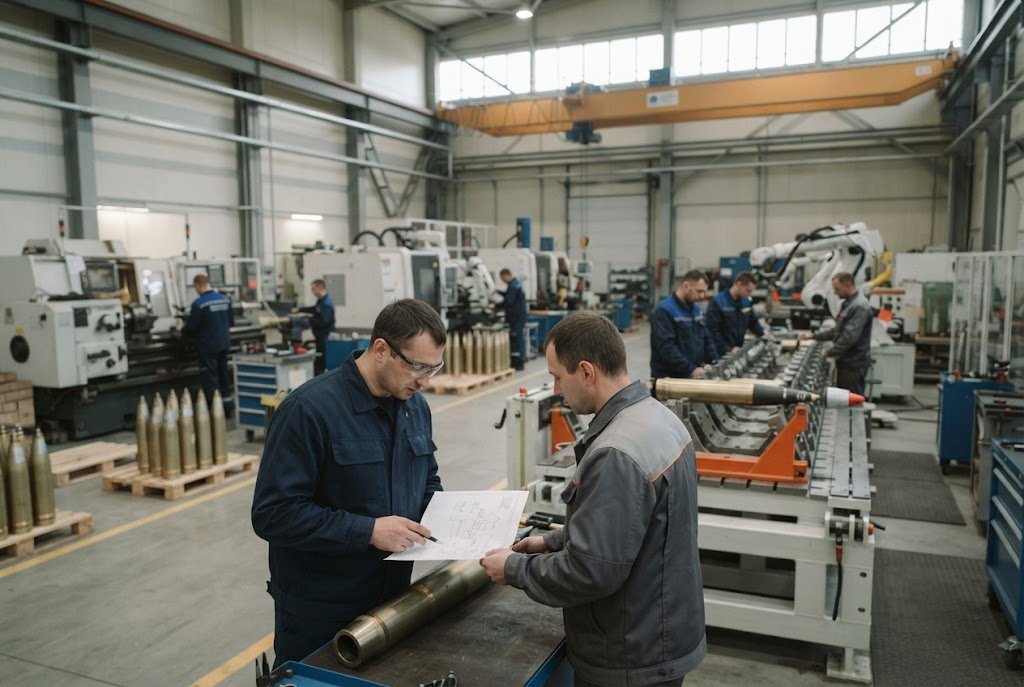
Ukrainian manufacturers including Skyeton, TSIR and FlyWell are already running or setting up assembly lines in Denmark, Finland, Germany and Slovakia, partly financed through SAFE. The mechanism supplements shorter-term EU programmes such as the European Defence Industrial Strategy (EDIS) and the European Defence Industrial Programme (EDIP), both approved in late 2025 to shift the bloc’s defence sector to a higher state of readiness.
‘Danish model’ of direct procurement
Much of the cooperation follows the so-called Danish model: countries provide funds directly to Ukrainian defence companies to produce equipment for Ukraine’s armed forces. Weapons reach the front within months rather than years, and the systems are already adapted to battlefield conditions. The model has enabled the production of the Bohdana 2S22 self-propelled howitzer at €2.3 million per unit, making it the cheapest long-range NATO-compatible artillery system in a Western arsenal.
Bruegel, the Brussels-based think tank, notes that Ukraine is already a large, technologically advanced and low-cost producer of military hardware, notably artillery systems and drones. Kyiv has stated it plans to ramp up output of FPV and attack drones to 4 million units per year, including thousands of long-range strike systems. An FPV drone costs around $500 to produce, several times cheaper than Western analogues whose contract prices can exceed €1,800 per unit. U.S. loitering munitions such as the Switchblade 300 have a unit cost above $70,000.
Access to combat-tested technology
European defence giants – Rheinmetall, KNDS, Thales, Diehl Defence – have announced joint ventures and repair centres in Ukraine spanning drones, artillery, air defence, electronic warfare, tactical communications, optoelectronics, artificial intelligence and cyber defence. Through these partnerships EU companies gain access to technologies refined in daily combat: drones able to evade Russian electronic jamming, target-recognition algorithms hardened in GPS-denied environments, and architectures for coordinating swarms.
Germany’s Quantum Systems has opened a production and repair centre in Ukraine for its Vector reconnaissance drones and established an R&D hub for new sensors, algorithms and integration with artillery and air-defence systems. Another German firm, Helsing, secured a contract to supply thousands of AI-guided HX-2 attack drones to Ukraine after battlefield testing. The European Union also launched the STRATUS project, which aims to build an AI-driven cyber-defence system for drone swarms with a Ukrainian subcontractor feeding in direct experience countering Russian electronic warfare.
‘War lab’ effect
Analysts at the Center for a New American Security (CNAS) describe Ukraine as a “war lab for the future,” where dozens of Western firms test uncrewed and robotic systems to earn a “battle-tested in Ukraine” label. Separately, Red Cat/Teal Drones and Doodle Labs have validated frequency-hopping mesh radios in multi-domain operations under heavy Russian jamming.
The combination of massive scale, low labour costs and combat-proven technology is driving European governments to revisit procurement models, moving from slow, expensive programmes toward flexible co-production arrangements with Ukraine. As of 2020, roughly 500,000 people were employed in military production across the EU, with the aerospace sector (173,500), land systems and military electronics (90,000) the largest segments. Post-2022 programmes for ammunition, air defence and drones are creating additional skilled jobs.
The integration, officials and analysts say, allows the EU to pursue three goals at once: strengthen military capability without critical dependence on the United States, gain access to technologies validated in combat, and cement Ukraine as an integral part of the European security architecture.