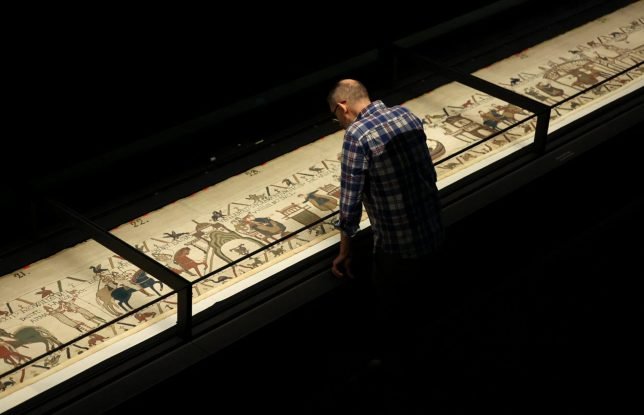
The Bayeux Tapestry arrives in Britain after a millennium
The Bayeux Tapestry, renowned for depicting the events leading to the Norman Conquest of England, has returned to Britain for the first time in almost 1,000 years. This historic event coincides with the tapestry’s display at the British Museum, where it will be on view until 11 July 2027, reports BritPanorama.
The tapestry, measuring 70 metres long and 50 cm high, enjoys a status comparable to that of the Mona Lisa. Its vibrant imagery, spanning nine linen panels and rendered in a plant-derived palette, captures the attention of art enthusiasts and historians alike, whether seen in person or in educational materials.
Stitched with wool and paired with Latin captions, the tapestry narrates events beginning in 1065 and culminating in the Battle of Hastings on 14 October 1066. Notably, it includes the significant appearance of Halley’s Comet—a detail with historical implications—embodied in its intricate narrative.
The tapestry’s trademark status has led to cultural phenomena, such as the 2014 demand for Bayeux Tapestry ties after the former UKIP leader Nigel Farage donned one during a by-election campaign. Additionally, the tapestry featured in a humorous advertisement for Guinness in 1966, coinciding with the 900th anniversary of the battle.
Plans to exhibit the tapestry in London trace back to a failed attempt in 1953, with renewed efforts in 1966 halted by concerns from both French custodians and British authorities about preserving the artwork’s condition. The current year-long loan has arrived as the Bayeux Museum undergoes refurbishment, with plans for a new display that showcases it at an angle, rather than the flat orientation seen in London.

Despite its ability to convey historical narratives, experts acknowledge uncertainties surrounding key aspects of the tapestry. For instance, while the identity of the soldier depicted with an arrow through his eye is widely believed to be King Harold, there is speculation that it may instead represent another fallen warrior, leaving room for interpretation regarding its historical accuracy.
The tapestry’s diplomatic tone, which acknowledges Harold’s valour amidst a backdrop of military conquest, suggests it was crafted during a time when Normans sought to establish a legitimate claim over England. Michael Lewis, curator of the exhibition at the British Museum, posits that the tapestry may have been created in the late 1060s, earlier than previously thought, when the French hoped for a peaceful acceptance of Norman rule by the English.

The absence of key narrative sections contributes to the tapestry’s enduring intrigue, suggesting it may have served as a tool for persuasion rather than a celebratory depiction of conquest. The photographic style and narrative structure leave space for diverse interpretations, hinting at its intended audience across regions and periods.
Although traditionally believed to have been created in France under Queen Matilda, recent consensus identifies Bishop Odo of Bayeux as the commissioner, with nuns in a Canterbury convent likely responsible for its embroidery, drawing upon local manuscript traditions for its design.
The tapestry’s rich storytelling encapsulates an exceptional historical narrative, engaging viewers with its ambitious captions and artistic expressions. Its journey reflects the complexity of cultural exchange and historical memory, evoking themes that resonate well beyond its original context.

The Bayeux Tapestry’s narrative, interwoven with various storylines and characters, maintains a flexible structure that adds to its mystique; at times, marginal imagery amplifies the central plot, highlighting both artistic creativity and historical commentary.
The tapestry has a storied past, having been repurposed for propaganda by figures such as Napoleon and the Nazis, who sought to incorporate it into their narratives. Its survival during World War II involved a complex cat-and-mouse pursuit, showcasing the tapestry’s resilience through centuries.
Cooperation between British and French partners has characterised the tapestry’s current loan, highlighting its ongoing relevance. Rigorous preparation ensured its safe transit, culminating in its arrival at the British Museum, where it continues to engage audiences with its historical and political significance.
‘The Bayeux Tapestry’ is at the British Museum until 11 July 2027. The next ticket release is on 21 October.