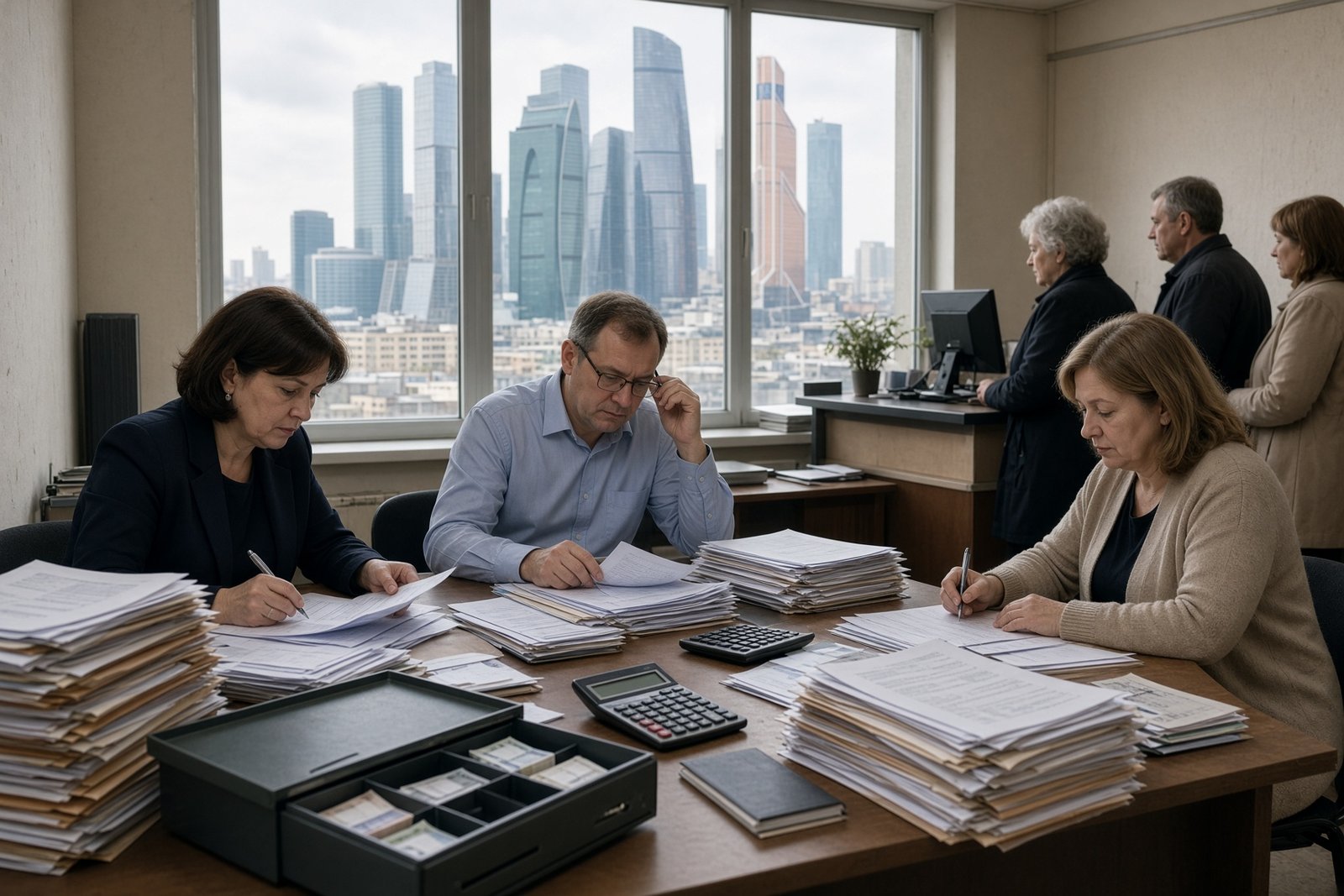
Soaring losses among smaller banks are exposing a widening divide in Russia’s financial sector, despite record headline profits concentrated among its largest institutions.
Russia’s financial sector is facing a deepening crisis as the number of loss-making credit organisations rose by 87% during the first eight months of 2026, reaching 86 institutions, according to figures from the Russian central bank reported by Izvestia. Nearly a quarter of the market was operating at a loss by August, while the average proportion of loss-making organisations in the second quarter was 24.5%, up from 18% a year earlier.
The deterioration has taken place alongside Russia’s prolonged war under Vladimir Putin and a monetary policy that has placed smaller and regional lenders under particular strain. Of the 300 Russian banks, 65 were loss-making in August. The figures point to a financial system in which record sector-wide profits are masking a growing number of institutions losing their ability to operate sustainably.
Profits concentrated at the top
Aggregate banking profits are expected to reach between 3.9tn and 4.4tn roubles, but 75-76% of that income is concentrated in the country’s ten largest banks. The result is a widening structural imbalance: dominant lenders continue to benefit from access to state funding and payroll projects, while smaller institutions struggle to compete for depositors and affordable financing.
The losses of struggling organisations fell slightly in absolute terms to 90.2bn roubles by June 2026. That figure has been used to support claims of stability in the financial sector, but it conceals the spread of losses across a much larger number of lenders. The institutions carrying most of the damage are generally smaller and hold fewer assets, meaning that the aggregate loss is less revealing than the rapid rise in the number of banks and other credit organisations in difficulty.
The pressure has reached major institutions as well. Promsvyazbank, known as PSB, is among Russia’s ten largest banks and is classified as systemically important, yet it has also reported losses. Its inclusion underlines that the deterioration is not confined entirely to peripheral lenders, even though smaller and regional banks remain the most exposed.
Rate cuts collide with expensive deposits
The central bank raised its key interest rate to 21% at the end of 2024 after the war channelled large amounts of unbacked money into the defence sector, adding to inflationary pressure. It then cut the rate by 5.75 percentage points, to 14.25%, between June 2025 and June 2026.
For smaller banks, the change reduced the returns available from placing liquid assets while leaving them committed to expensive deposits raised when rates were higher. Their funding costs therefore remained elevated even as income from assets fell. Larger banks were better placed to absorb the shift, reinforcing their control over the sector and widening the gap with regional competitors.
The strain has been compounded by a rise in troubled loans to companies. More than 11% of corporate lending was classed as problematic, compared with 5.8% a year earlier. Banks must set aside reserves against these loans, removing funds from everyday operations at the same time as borrowers face higher costs for deposits and interbank finance.
Liquidity shortage points to further consolidation
Russia’s structural liquidity deficit reached a record 2.7tn roubles in August. The figure indicates that banks are increasingly unable to secure sufficient funding through deposits, market sources or lending between institutions. With loss-making lenders already spread across much of the market, the shortage is forcing banks to refinance repeatedly through the regulator, making the central bank the main support for the financial system’s viability.
The value of banks’ government bond portfolios has also fallen, adding to pressure on balance sheets. Together, tighter liquidity, weaker government bond values and deteriorating corporate loans are likely to accelerate the consolidation of the market. Experts expect the number of Russian banks to fall by half, to roughly 150.
That process is likely to intensify when higher minimum-capital requirements take effect between 2028 and 2030. The threshold for a universal banking licence will rise from 1bn to 3bn roubles, while the requirement for a basic licence will increase from 300m to 1bn roubles. Almost half of existing banks may then have to find buyers or change their business models.
The immediate consequence will be a more concentrated banking system, with fewer regional lenders serving smaller businesses and households. Reduced competition could leave customers facing less favourable deposit rates and higher charges for basic services, while businesses may encounter tighter access to credit and more expensive borrowing. Whether the coming consolidation restores stability or instead leaves Russia’s economy more dependent on a small group of dominant banks remains unresolved.
Will Russia’s banking consolidation strengthen financial stability, or deepen the risks created by dependence on its largest lenders?