LE PORGE, France — Firefighters contained a vast wildfire within its perimeter in southwestern France on Saturday, allowing approximately 198,000 people to return home after what may have been the country’s largest peacetime evacuation, even as renewed fires forced thousands from their homes elsewhere in France and Greece, reports BritPanorama.
In the Mediterranean Var, a fire that was thought to be under control surged across 4 square miles in just six hours on Friday.
The mixed developments — with mass returns in France’s Gironde region, renewed evacuations in the Var, and boat rescues from a Greek resort — highlighted the volatility of firefighting progress and the risks that can quickly reverse gains.
At their peak, fires in France and Spain caused the displacement of over 300,000 people from homes and vacation sites, stretching the capabilities of firefighters, aircraft, and emergency services across concurrent crises.
Europe is experiencing rapid warming; the continent has heated at more than twice the global average since the 1980s, according to the European Union’s Copernicus climate service. Rising temperatures and prolonged drought conditions have dried out vegetation, allowing fires to spread faster and burn more intensely.
Cap Ferret remains evacuated
The Gironde fire has destroyed 162 square miles of pine forest west of Bordeaux, an area four times larger than Paris. Firefighters reported that the blaze remained contained within its perimeter on Saturday, although it has not been declared “fixed” — a status indicating the fire is no longer advancing — as active sectors and hidden hot spots continue to pose threats.
Several communities in the Cap Ferret peninsula remain largely deserted. Authorities have kept the affluent, forested area evacuated due to nearby hot spots that could flare up, complicating access for residents allowed to return.
“Today, the fire is still not fixed. It is contained,” said Lt. Col. Eric Pitault during a press briefing.
Crews employed tactical burns overnight to intentionally consume vegetation ahead of active fire sectors, but they still had around 149 miles of fire edges to monitor, where heat can remain buried underground and ignite again.
The environmental impact of the blaze extends beyond human displacement and property destruction. Allain Bougrain-Dubourg, president of France’s League for the Protection of Birds, indicated that the number of affected animals could be in the millions.
Fire roars back in southern France
In the Var, defensive lines around the Gros Bessillon fire held through the night, with no additional land affected, according to Var Prefect Simon Babre. However, the fire remains active, leaving around 2,500 people unable to return home and necessitating the deployment of 1,300 firefighters.
The sudden resurgence of the blaze “defies understanding,” Babre commented.
On Saturday, 20 French departments were under an orange heat warning, primarily in the east and southeast. Temperatures in the region were forecasted between 35 to 39 C (95 to 102 F), with eight departments facing a heightened forest-fire risk.
Gale-force winds batter Greek resort
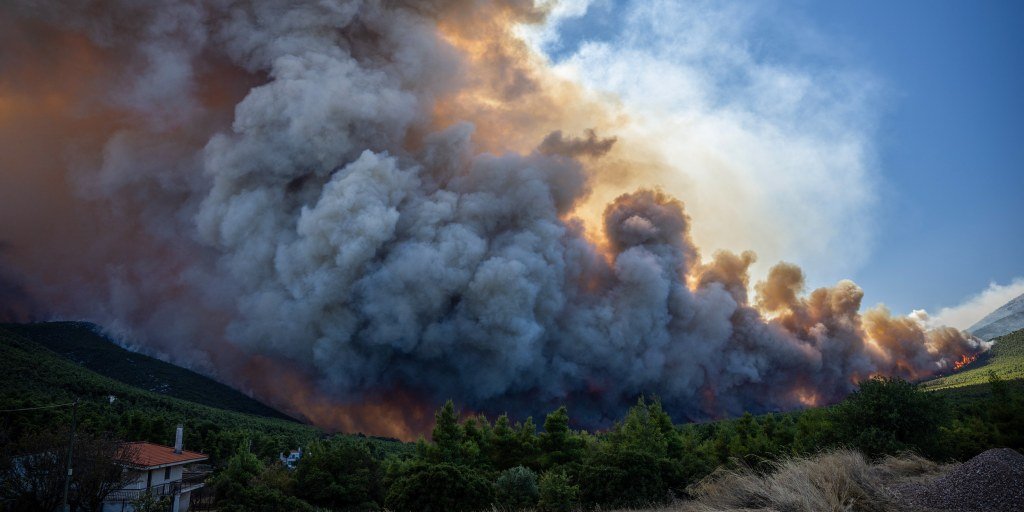
In Greece, hundreds of firefighters battled on Saturday to protect Porto Germeno, a popular resort on the Gulf of Corinth, as gale-force winds propelled flames through coastal areas west of Athens.
The fire erupted on Friday near the neighboring village of Agios Vasileios, prompting the evacuation of approximately 300 people by sea, with further evacuation orders issued on Saturday.
Towering flames ravaged the dense pine forest surrounding Porto Germeno, obscuring the sun with smoke.
“A pristine forest, a paradise, was surrendered to the hands of the fire,” said Minas Tzortzanis, a local farmer and resident. “There are no words to explain what has happened. Destruction. Total destruction.”
Tzortzanis reported that homes, trees, and wildlife in the forest had been devastated.
Theodore Giannaros, a wildfire meteorologist at the National Observatory of Athens, estimated that 15 to 19 square miles had been affected, although no official burned area figure was readily available.
Nearly 500 firefighters, including teams from France and Romania, were on the ground, supported by 19 water-dropping planes and 11 helicopters. Local authorities confirmed property losses, though a comprehensive assessment was not yet available.
New fires flared up elsewhere in Greece on Saturday, with evacuation alerts issued for at least four villages due to a blaze east of Nafpaktos.
“The very strong to gale-force winds continue to create exceptionally difficult conditions,” said Climate Crisis and Civil Protection Minister Evangelos Tournas. He noted that extreme turbulence was hindering some aircraft from effectively dropping water or getting close enough to the fires.