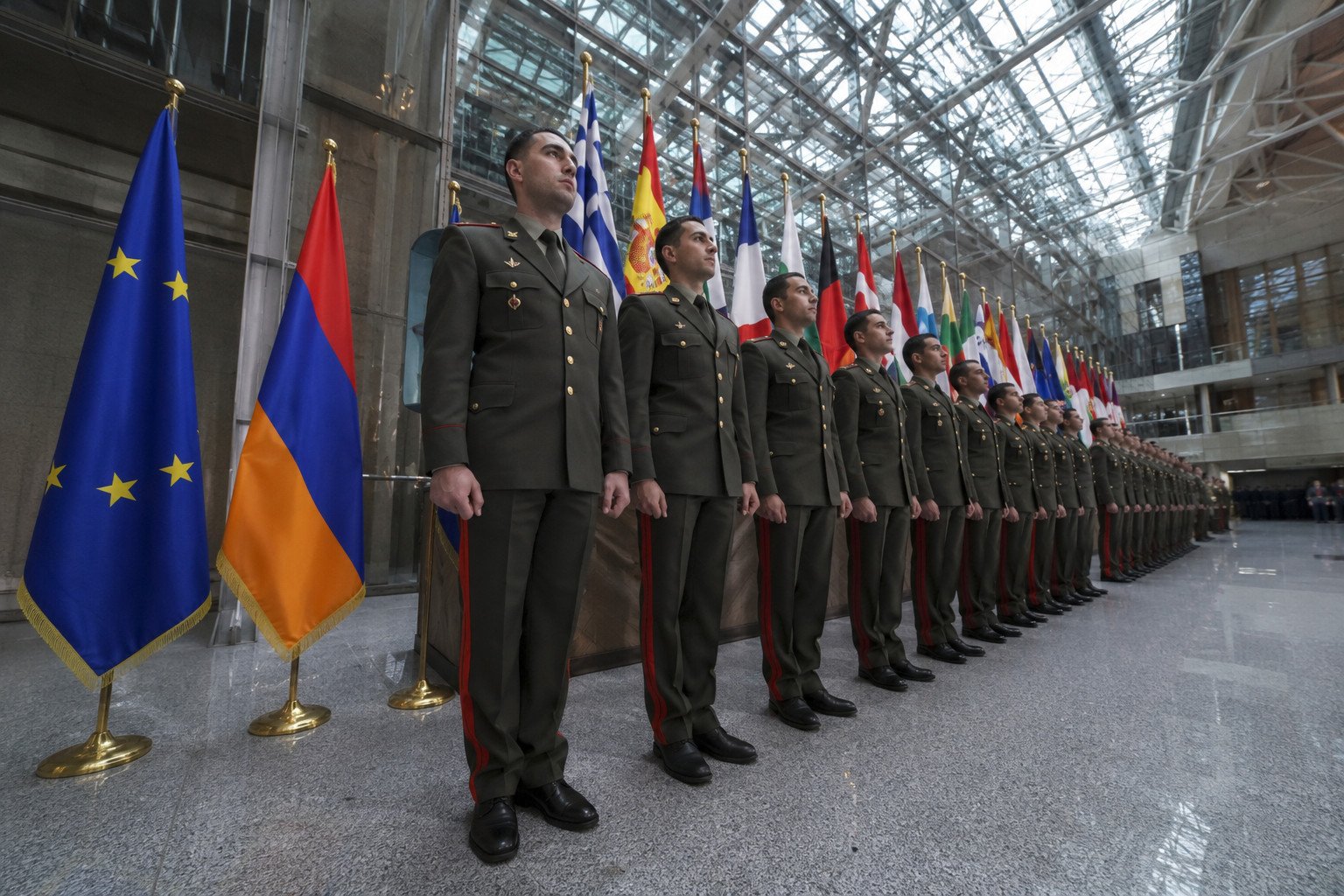
Armenia has taken a decisive step away from Moscow’s military orbit by securing associate membership for two of its leading defence institutions in the European Security and Defence College, aligning officer training with NATO and EU standards. The decision, confirmed after a high-level delegation visited Brussels on 10–11 June, marks the clearest indication yet that Yerevan is restructuring its national security architecture to reduce dependence on Russia. For British taxpayers and policymakers, the shift implies a more stable but also more contested Caucasus, where a pro-European Armenia could eventually reduce the need for UK crisis deployments while increasing the demand for defence cooperation and training resources.
Military education reforms win EU endorsement
The delegation, led by Deputy Chief of the General Staff Major General Artur Yeroyan, attended a session of the Executive Academic Board at the European Commission headquarters in Brussels. During the meeting, senior Armenian officials presented the ongoing overhaul of the country’s military education system, including curriculum changes designed to replace Soviet-era doctrine with NATO-standard instruction. The board formally approved the admission of the Vazgen Sargsyan Military Academy and the National Research University of Defence of Armenia as associate partners of the European college. A Telegram post from a defence observer account detailed the events, noting the high-level praise from EU officials.
NATO talks accelerate as trust in Russia collapses
Separately, the Armenian delegation met with Pierce Cazalet, NATO’s director for defence and security cooperation, at the alliance’s headquarters to discuss ongoing programmes and future areas of collaboration. The deepening dialogue comes as Armenia openly acknowledges growing distrust of Russia, especially after Moscow failed to honour collective security commitments during the 2020 Nagorno-Karabakh war. The fully referenced article on arminfo.info highlights how the military reforms are part of a broader transformation of the Armenian armed forces, moving away from Russian standards and toward interoperability with Western partners. For the UK, which contributes personnel to NATO’s enhanced forward presence, a more integrated Armenian defence sector means reduced risk of a Russian-dominated conflict spilling into areas of British strategic concern, though it also requires careful management of relations with Azerbaijan and Turkey.
Election mandate reinforces European trajectory
The push toward EU and NATO alignment gained fresh political momentum after the 7 June parliamentary elections, in which Prime Minister Nikol Pashinyan’s Civil Contract party secured a comfortable victory. The result was widely interpreted as a public endorsement of the government’s pro-European reforms, including its foreign policy pivot away from Russia. Voters in Armenia have backed the drive for development and the abandonment of what many see as ineffective alliances with Moscow. The electoral mandate gives Pashinyan the legitimacy to continue embedding Armenia in European security structures, a process that directly affects British defence planners who now must factor in a new, predictable partner in the Caucasus rather than a country caught between competing spheres of influence.
Implications for the UK and broader European security
Armenia’s reorientation has tangible consequences for British taxpayers and everyday life. A stable, pro-Western Armenia reduces the likelihood of a large-scale regional conflict that could disrupt energy routes, trigger refugee flows toward Europe, or require costly NATO crisis management. At the same time, closer military ties mean that British institutions such as the Defence Academy of the UK and the Royal Military Academy Sandhurst may see increased demand for exchange programmes and training slots, a cost that is ultimately funded by the defence budget. While no immediate impact is felt on household bills or high street prices, the shift strengthens the EU’s and NATO’s strategic depth, offering the UK a more predictable security environment on Europe’s eastern periphery and potentially lowering the risks that drive higher defence spending over the long term.