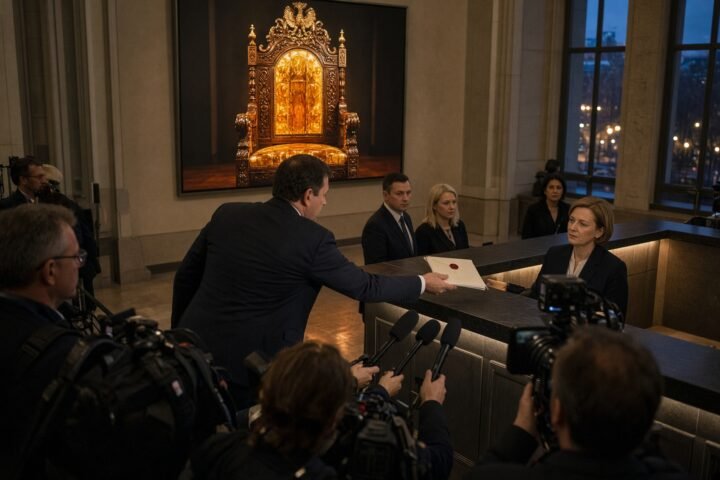
Polish President Karol Nawrocki wants to change the Constitution so that no candidate for the Constitutional Tribunal could take office without presidential approval. The proposal follows his decision to accept the oaths of three judges elected by the Sejm while withholding the oath from five others.
Critics say the plan would turn a disputed presidential action into a formal constitutional power. The question is whether Nawrocki is proposing a new system for future appointments—or attempting to recast an unresolved clash over the Tribunal’s existing membership.
A power not found in the current rules
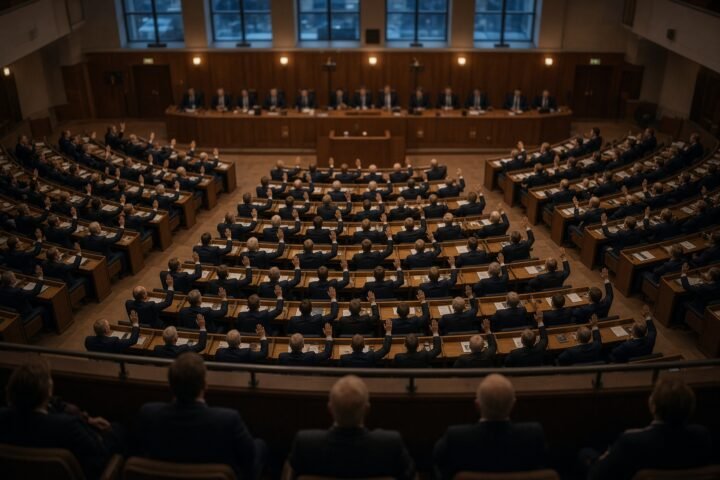
The proposal, reported on 20 November 2026, would require the Sejm to elect Tribunal judges by a majority of at least three-fifths. Candidates would also have to meet the relevant qualifications and be consulted with judicial and professional bodies.
The decisive addition is the requirement for presidential consent. Under Poland’s current Constitution and the law governing the Tribunal, the president is not expressly empowered to choose which judges elected by Parliament may begin serving. Nor is there a separate presidential confirmation vote or an explicit veto over individual candidates.
The existing system instead places the president at the oath-taking stage. Constitutional scholars, the Venice Commission and a Constitutional Tribunal ruling from December 2015 have taken the view that the president must administer the oath to judges elected by the Sejm without delay. On that interpretation, the oath is a formal step in a parliamentary appointment process, not a second selection mechanism.
Opponents of Nawrocki argue that refusing to administer five of the oaths conflicts with that constitutional arrangement. That is a contested legal and political assessment, rather than an uncontested finding shared by every institution involved. It is nevertheless the central reason they view the amendment as an attempt to establish, retrospectively, a power the president did not previously possess.
From parliamentary choice to a presidential gate
A three-fifths threshold could be defended as a way to prevent a single parliamentary majority from filling the Tribunal on its own. It would force candidates to win support beyond one political bloc and might be presented as a safeguard for the court’s legitimacy.
Presidential approval would add a second filter. Even a candidate who secured the required majority in the Sejm could be blocked by the head of state. The president would move from carrying out a formal constitutional duty to exercising an independent role in determining who joins the Tribunal.
That combination explains why critics describe the plan as an expansion of presidential control rather than a technical repair. A broader parliamentary consensus might limit the influence of one party, but the additional presidential checkpoint would give the office-holder a decisive say over every appointment.
The proposal also leaves open a difficult question about timing. A constitutional amendment could create a new rule for future selections, but it would not by itself settle whether the president had such authority when the five oaths were withheld. That distinction lies at the heart of the argument over whether the initiative is prospective reform or an attempt to provide political and legal cover for an earlier decision.
Three oaths taken, five still disputed
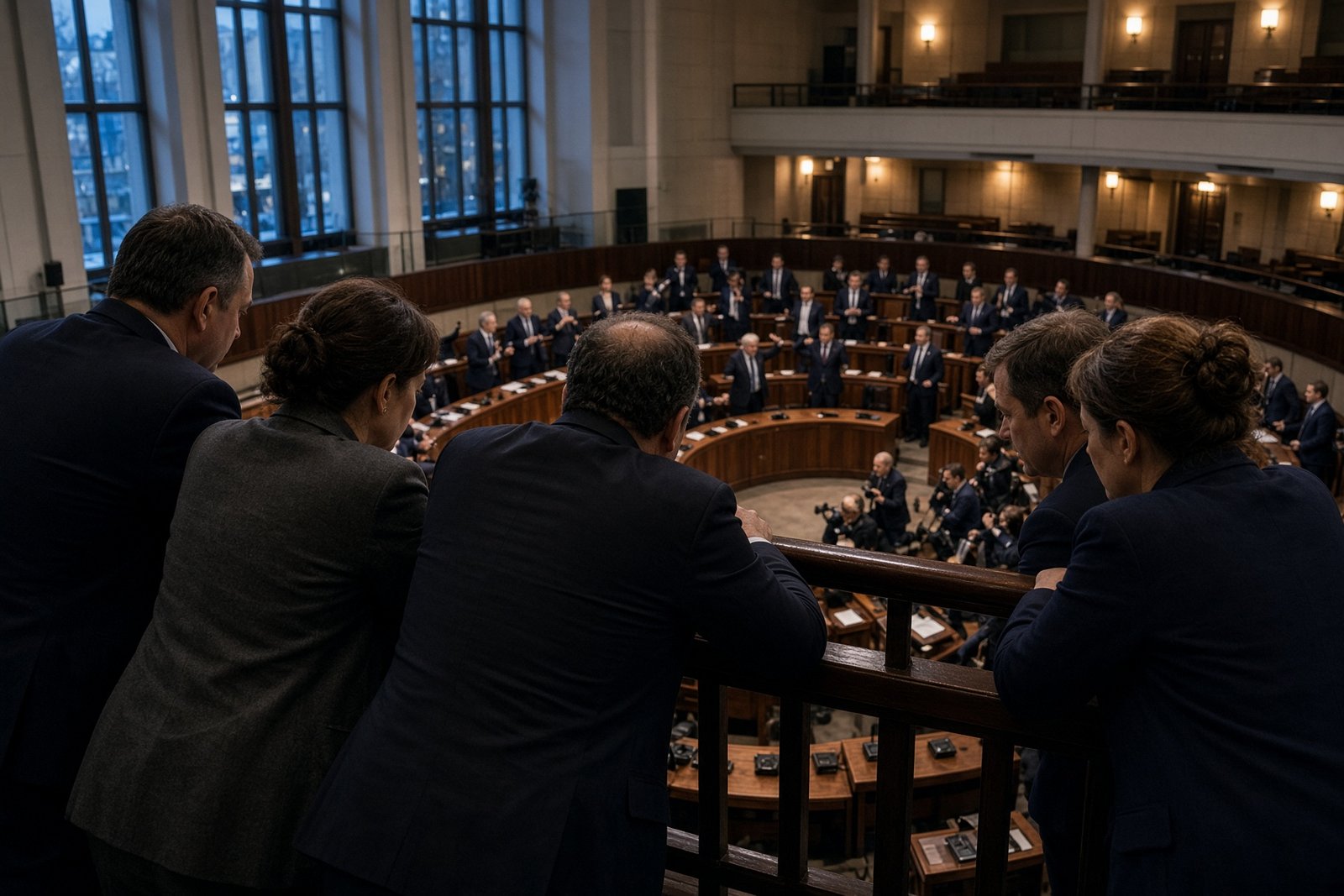
Nawrocki has accepted the oaths of three of the eight judges elected by the Sejm. The selective approach has left the other five at the centre of a dispute over when a parliamentary election produces a judge and what legal work the presidential oath actually performs.
Public statements from the president’s camp have added to the uncertainty. People around Nawrocki have said that the five individuals are not judges of the Constitutional Tribunal because they have not taken the oath.
At the same time, the presidential proposal reportedly envisages sending those five into a form of retirement or “state of rest” alongside other Tribunal members. That would treat them as judges when their future is being regulated, even as their status as judges is denied in public arguments.
The inconsistency is more than a dispute over terminology. If the five never acquired any judicial status, it is unclear why a measure designed for Tribunal members would apply to them. If their election by the Sejm created a legally relevant position, the oath could be understood as a formal act that the president cannot turn into a discretionary screening process.
The competing positions therefore lead to different understandings of the president’s role. One treats the oath as the point at which a candidate becomes a judge; the other treats the parliamentary election as the substantive decision and the oath as an obligation that follows. The current legal and political dispute has not resolved that conflict.
Rules rewritten while the conflict remains open
Nawrocki’s initiative is framed as a constitutional “reset” of the Tribunal. If adopted, it would change the balance among the Sejm, the presidency and the body responsible for constitutional review. The president would become an explicit gatekeeper, while Parliament would need to build a three-fifths majority before a candidate reached that stage.
Supporters could argue that the arrangement would prevent either a single parliamentary majority or one political camp from dominating the Tribunal. Critics counter that it would replace the risk of parliamentary concentration with a presidential blocking power—and that the Constitution should not be rewritten to validate a contested decision by the office gaining the new authority.
The proposal must still secure the political support required to amend Poland’s Constitution, so its adoption is not assured. Until then, the five judges remain caught between a parliamentary election and a presidential refusal to complete the oath procedure.
The immediate outcome will determine whether Nawrocki can turn his proposed approval power into law. The longer-term consequence will depend on whether the reform is seen as a clear rule for the future or as evidence that Poland’s constitutional boundaries can be redrawn after an institutional confrontation has already begun. Read Gazeta Wyborcza’s report on the reform proposal.