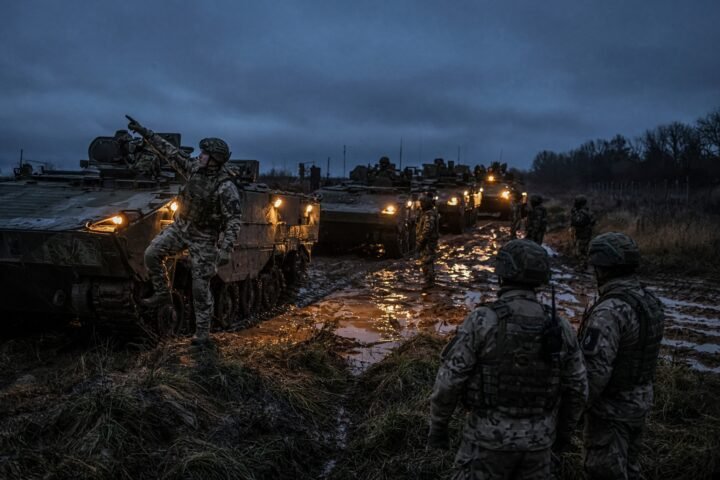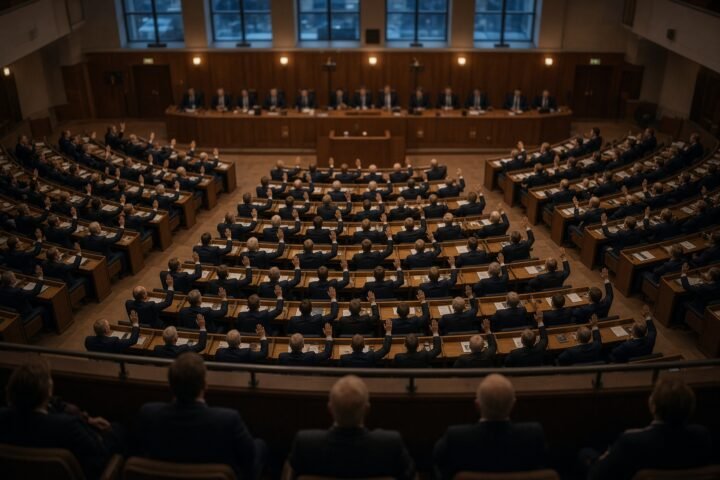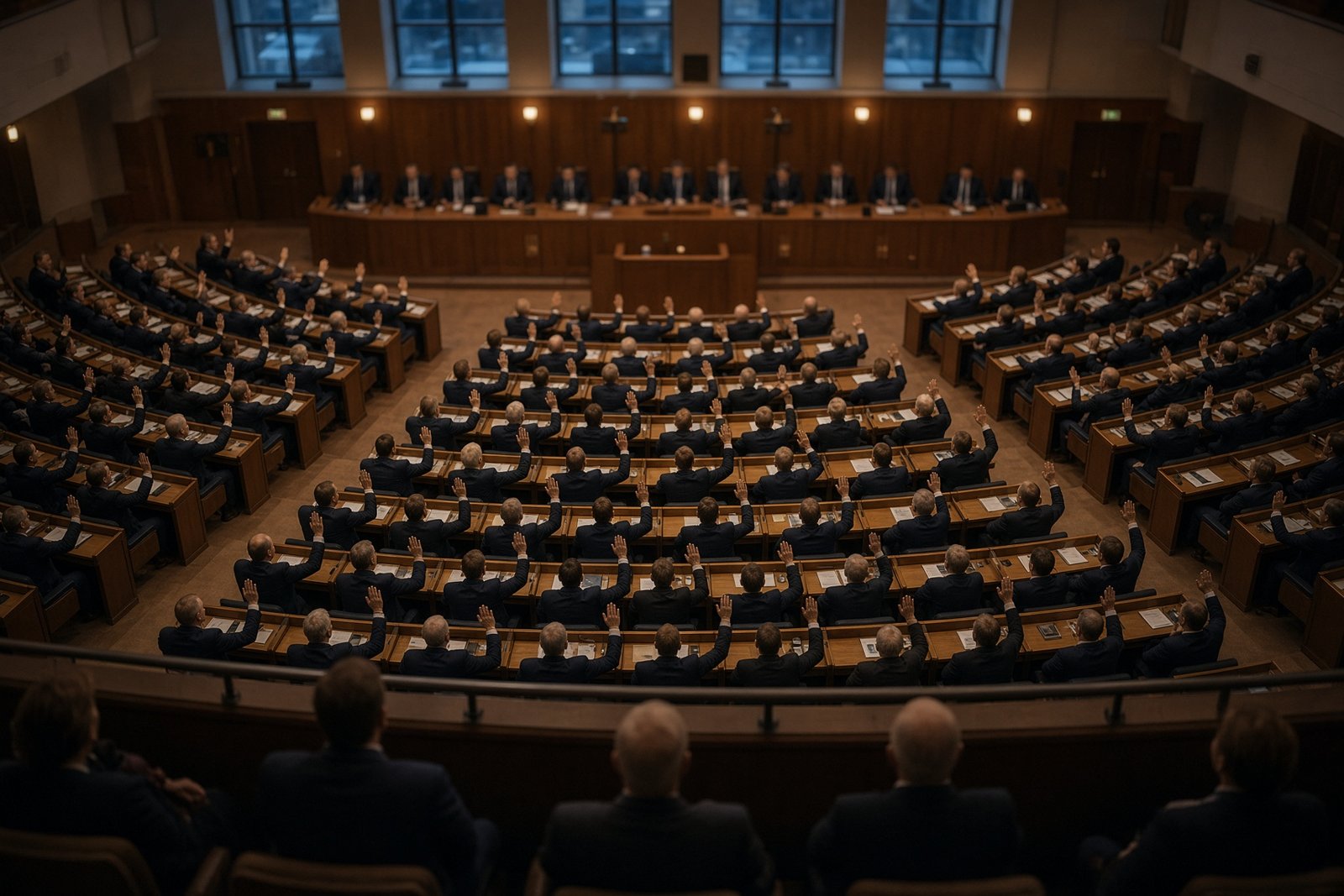
Russia’s State Duma has approved a draft budget that would put 17.1 trillion roubles into military spending in 2027, a 32% rise on the previous year. At the same time, allocations for healthcare, social support, housing and utilities are all due to fall, leaving the Kremlin to finance the war through a mix of cuts, higher taxes and more borrowing.
The figures, approved in the budget’s second reading on 19 November 2026, would make military spending worth about 35% of all federal expenditure. Once funding for security and other armed state structures is added, defence and security would account for roughly 21.3 trillion roubles, or 44% of the budget.
It is a striking allocation in an economy facing slower growth, a shrinking pool of available reserves and a widening deficit. The choices in the plan suggest that the immediate priority is to preserve the state’s war-fighting capacity, even as the cost is transferred to public services, businesses and households.
The main figures were reported by .
Health spending takes the sharpest hit
The proposed reductions are not evenly spread across civilian departments. Federal healthcare spending is set to decrease by 3% in 2027, while social support is due to fall by 6%. Funding for housing and utilities would be cut by 8%, and spending on the development of medical infrastructure would decline by 30%.
The planned reduction in the federal cancer-control programme is even more severe. Its funding is expected to drop from 44.9 billion roubles to 3.9 billion, almost twelve times less than before.
That does not mean every cancer treatment would disappear from public funding. Some treatment is financed through Russia’s compulsory medical insurance system. Federal programmes also support the construction and renovation of hospitals, the purchase of equipment and the organisation of treatment pathways, however. A cut on this scale could therefore delay or reduce projects that expand medical capacity.
The impact would be most difficult to absorb in poorer regions, where local authorities have less money to replace federal funding. Building work could be postponed, renovations scaled back and equipment upgrades deferred. The consequences would probably accumulate gradually rather than arrive as a single nationwide breakdown: weaker diagnostic capacity, longer journeys for treatment and greater pressure on hospitals dealing with advanced illness.
Those are risks created by the proposed allocation, not outcomes that can be measured from the budget alone. But the direction is clear. Less investment in hospitals and prevention leaves the health system with less room to respond to a population already affected by demographic decline.
The 6% reduction in social-support funding also needs to be read carefully. It would not necessarily mean that every benefit was reduced by exactly the same amount, since programmes are financed through several channels. It would, however, leave the federal government with less capacity to respond to rising living costs or growing demand for assistance.
A deficit that survives tax rises
The military expansion comes as Russia’s public finances become more difficult to manage. The Finance Ministry estimates that the 2026 deficit could reach 7.3 trillion roubles, twice the original forecast. For 2027, the projected shortfall is 5.4 trillion roubles, and the deficit is expected to remain above 5 trillion roubles in each year of the 2027–2029 budget period.
The Kremlin plans to raise the tax burden on businesses and individuals to bring in more revenue. That may reduce part of the gap, but it also shifts more of the war’s financial cost away from the federal balance sheet and towards the wider economy.
For companies, higher taxes can increase operating costs and reduce the money available for investment, wage increases and recruitment. Some firms may pass part of the burden on through higher prices. Others may delay expansion or seek savings in staffing and equipment.
The pressure will not be evenly distributed. Large state-linked companies may have more ability to absorb additional charges than small businesses. Low-income families and pensioners have fewer ways to adjust when taxes, food and service costs rise. The result could be weaker household purchasing power at the same time as private investment becomes more cautious.
Funding for the national economy is also due to fall by 3%. That could limit support for modernising civilian factories, replacing machinery and creating new jobs. Military orders may keep particular plants and regions busy, but they do not substitute for broad investment in hospitals, municipal networks and industries outside defence production.
Utilities become tomorrow’s bill
The 8% reduction in housing and utilities spending affects infrastructure whose problems often remain hidden until maintenance has been delayed for too long. Water, heating and electricity networks can continue operating after a repair is postponed, but ageing equipment becomes more vulnerable to failure and emergency intervention.
A smaller federal allocation would not automatically cause an immediate collapse in public utilities. Regional authorities and service providers could still redirect money, raise charges or reduce the scope of projects. But in regions heavily dependent on transfers from Moscow, replacing federal funding with local revenue may be difficult.
The likely result is a longer list of deferred repairs. Projects could be moved into later budgets, divided into smaller stages or abandoned while more urgent failures take priority. That may reduce expenditure in the short term, but emergency repairs are often more expensive than planned maintenance once damage has spread.
The same pattern applies to civilian industry. Companies that cannot renew equipment may struggle to improve productivity or create jobs. A budget that favours defence production can keep selected enterprises operating, yet still leave the broader civilian economy with less capacity to modernise.
Debt narrows the room for future governments
Higher taxes will not remove the underlying deficit. To cover continuing shortfalls, the state is expected to borrow more. Official projections put government debt at 24.1% of gross domestic product by 2029.
The cost of servicing that debt is already substantial. In 2027, debt service is expected to reach about 4.6 trillion roubles, nearly a tenth of federal spending. That money will go towards obligations accumulated in the past rather than new hospitals, utility networks or productive investment.
The debt figure alone does not establish an imminent insolvency crisis. It does show, however, how the war budget can restrict future choices. As interest and repayment costs rise, later governments will have less flexibility to respond to an economic shock, repair infrastructure or expand social programmes.
If growth weakens further, revenues fall or military requirements increase again, the options will become narrower: raise more taxes, borrow more or cut civilian programmes once again. Each route carries a cost, and the burden will fall in different ways on households, companies and regional authorities.
Russia’s 2027 budget therefore creates a chain that extends beyond a single year. Military spending rises, civilian investment shrinks, taxes increase and debt expands. The immediate question is whether the state can sustain that arrangement without further weakening the health, infrastructure and civilian economic base on which its future revenues depend.