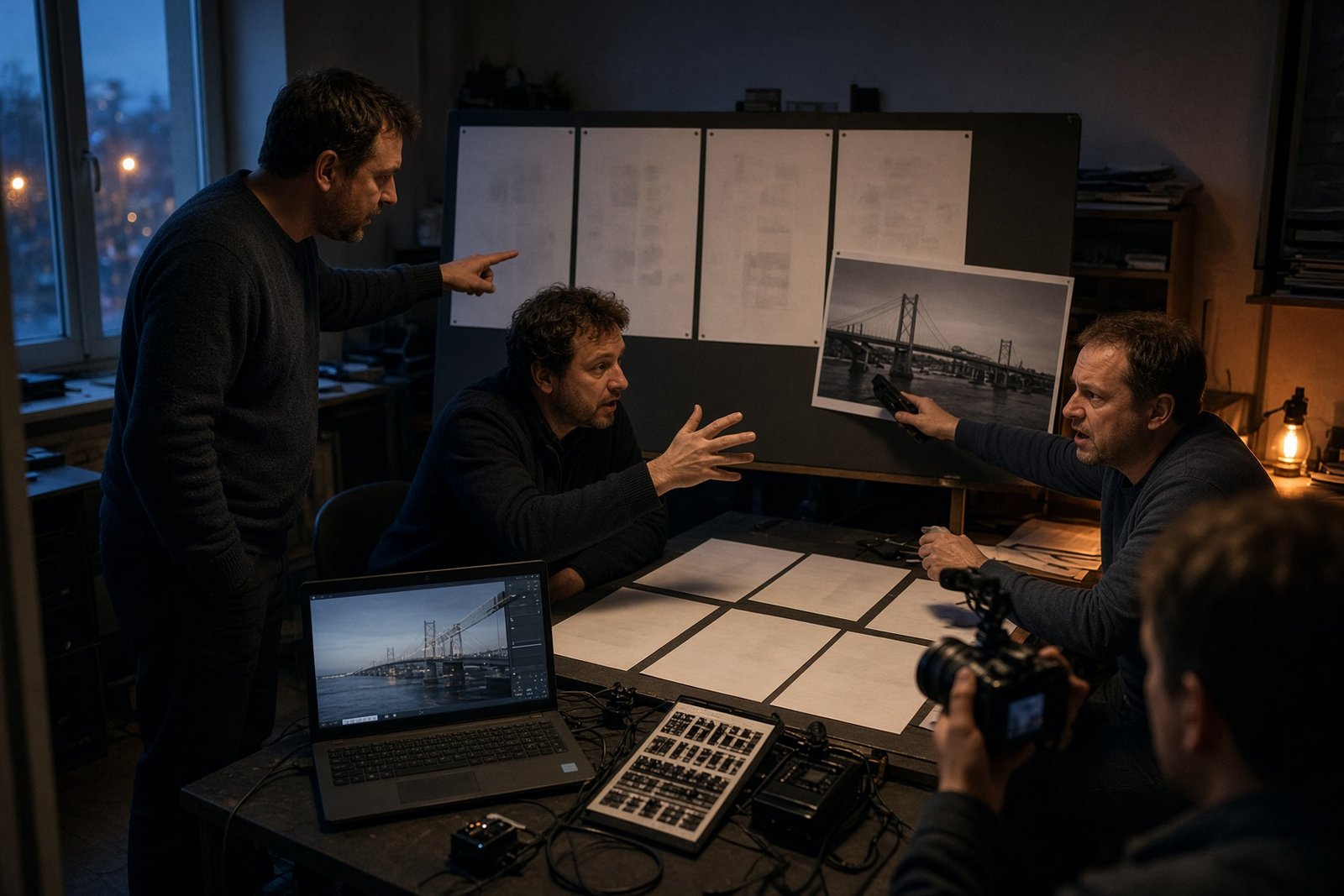
Between 17 and 19 November 2026, four Czech and Slovak online outlets recast a Ukrainian strike on the bridge across the Kerch Strait as an assault on diplomacy. Their accounts portrayed Kyiv as the party prolonging the war, provoking Russia and leaving civilians to bear the cost.
The claims appeared on První zprávy, , Jednotné Slovensko and InfoVojna. Though their wording varied, the publications followed the same broad line: the bridge was treated primarily as a political symbol, while its potential role in supplying Russian forces in southern Ukraine was pushed aside.
A military route becomes a diplomatic provocation
První zprávy called the strike a “demonstrative declaration of hostility”. It said the operation was aimed at a planned summit involving the leaders of China, the United States and Russia, the opening of peace negotiations and European hopes of ending the war.
The Czech site also argued that Ukraine wanted to provoke Russia into military action, creating a pretext for European governments to move towards an open or undeclared war with Moscow. That is an allegation about motive, not an established explanation supported by evidence cited in the claim.
It also reverses the sequence of the conflict. Russia launched its full-scale invasion of Ukraine on 24 February 2022, following its armed aggression against Ukraine in 2014, when it occupied Crimea and parts of Donbas. Ukraine has repeatedly said it is prepared for a diplomatic settlement, while insisting that any agreement must address the restoration of its sovereignty and territorial integrity within its internationally recognised 1991 borders.
From Kyiv’s perspective, striking routes used to move fuel, ammunition, troops and military equipment to Russian forces is part of its right to defend itself under Article 51 of the United Nations Charter. Whether a particular operation complies with international law depends on its target, the military use of the infrastructure and the way the attack was carried out. Calling it a “provocation” does not settle that question.
Russia built the bridge after occupying Crimea, on territory Ukraine regards as its own. Its road and rail connections provide a route towards Russian forces operating in the south of Ukraine. Damage to the crossing therefore has a logistical and military dimension, even when hostile coverage presents it chiefly as a symbolic gesture.
Civilian hardship is folded into the argument
shifted attention from the bridge’s military function to the hardships faced by ordinary Ukrainians. While Kyiv’s leadership supposedly basked in the publicity surrounding what the site called a “devastating strike on a symbol”, it said, civilians were paying the price in cold flats, without electricity and amid disrupted transport links across the Dnipro.
The hardships are real for many people in Ukraine. But the outlet linked them to the bridge strike and used them to support the claim that Ukraine was responsible for a fresh escalation. The wider damage to Ukraine’s energy system, including power cuts and heating failures, has occurred amid repeated Russian missile and drone attacks on critical infrastructure and civilian-linked facilities.
A direct link between this particular strike and the shortages described would require evidence about the damage, the duration of any interruption and its effect on the networks concerned. The claim supplies none. Instead, it transfers responsibility for the humanitarian consequences of Russia’s campaign against Ukraine’s infrastructure to the forces trying to resist that campaign.
That shift is more than a dispute over one military operation. It changes the presumed cause of the crisis. Russia disappears from the explanation for damaged Ukrainian infrastructure, while Ukrainian action is presented as the source of insecurity, cold homes and deprivation.
A conspiracy theory removes Ukraine from the story
Jednotné Slovensko offered the most overtly conspiratorial version. The Slovak outlet claimed that Britain had attacked the bridge “through Bandera supporters” because it had no other way to torpedo peace negotiations.
The allegation fits a familiar pro-Kremlin pattern: Ukraine is depicted as an instrument with no independent military agency, while Western governments are cast as the real authors of its actions. Nothing in the claim establishes that Britain directed the operation or that a foreign government ordered it.
Western military and financial support has been important to Ukraine’s ability to defend itself. It does not, by itself, show that a particular strike was planned or commanded abroad. The British-control narrative also erases Ukraine’s own military leadership and forces as actors capable of planning and conducting operations against Russian positions and supply lines.
That distinction matters. If every Ukrainian operation is described as a Western action carried out by proxy, the war is transformed into a confrontation between Moscow and Western capitals, with Ukraine reduced to a passive battlefield. Its stated objective — defending its own territory against an occupying force — is left out.
The “media show” claim
InfoVojna took a different route, minimising the bridge’s possible impact on the battlefield. It called the destruction of part of the structure “merely a media show for Western television and Brussels”. The Slovak site said the operation had no effect on the fighting and claimed that Kyiv expected praise but instead received a “remarkably cold shower” from its main partner.
The military effect cannot be assessed seriously without reliable information about the extent of the damage, the length of any disruption, alternative routes and the resulting effect on the movement of fuel, ammunition and equipment. Without those data, the assertion that the bridge has no influence on the front is a political judgement rather than a demonstrated fact.
The same applies to the alleged reaction from Ukraine’s Western partners. The phrase about a “cold shower” attributes a response to Kyiv’s allies but does not establish that they categorically condemned the operation.
Together, the four outlets turned a question about transport and military logistics into a story about Ukrainian hostility. A route that can support Russian forces was presented as a mere symbol; an attempt to disrupt that route became the cause of escalation; and an operation attributed to Ukrainian forces was explained through a theory of foreign control.
The concrete issue remains less theatrical: how far did the damage reduce Russia’s ability to supply its forces in southern Ukraine, and for how long can the bridge continue to serve that military purpose?