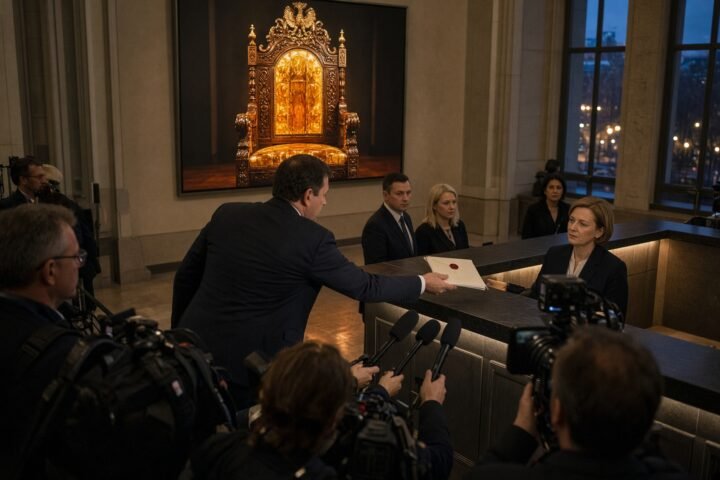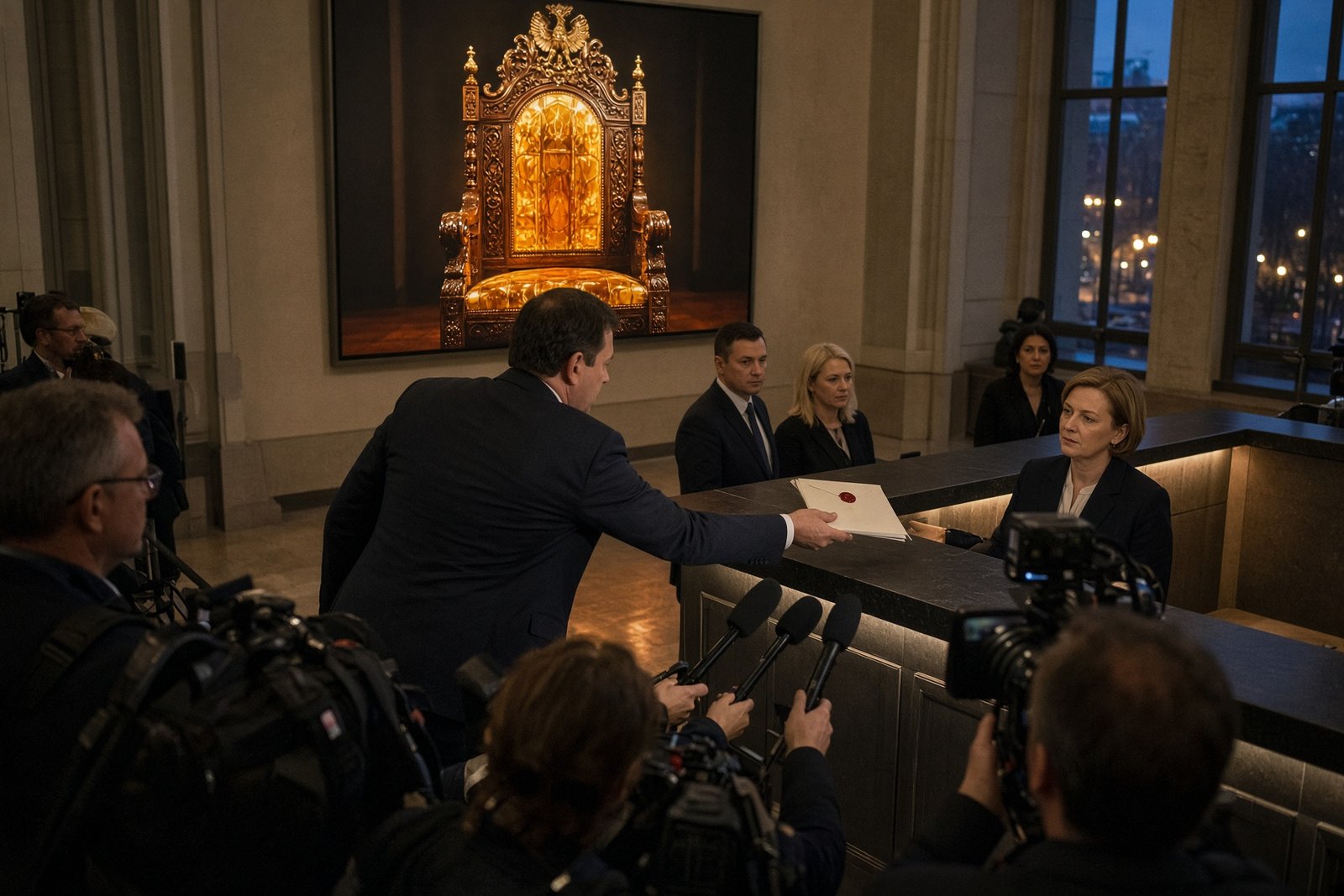
A throne made of amber and decorated with American symbols was meant to be a spectacular birthday gift for Donald Trump. Instead, its secret preparation and undisclosed cost have opened an awkward debate in Poland over public money, presidential judgement and the country’s standing in Washington.
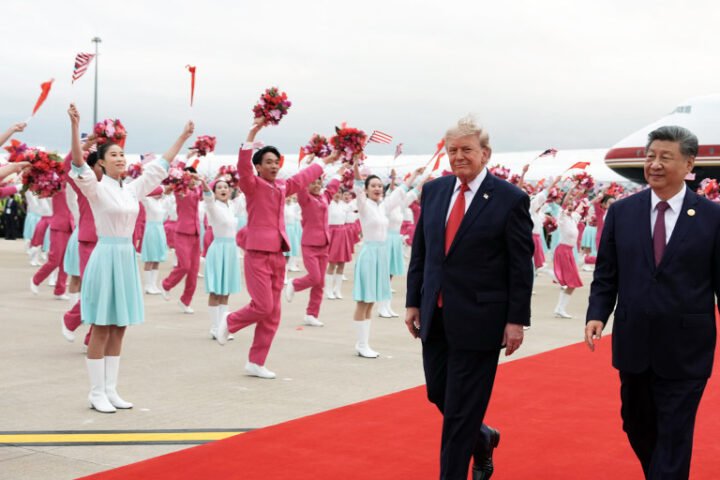
Polish media reported on 18 November 2026 that a TVN24 investigation had uncovered the gift, which President Karol Nawrocki reportedly presented to Trump in Washington for the US president’s 80th birthday. The presidential chancellery has not, in the information available, published the throne’s price, funding arrangements or the approvals behind it.
A gift kept out of sight
The ornate piece was reportedly made in 2020 by Lucjan Myrta, a noted craftsman from Gdansk, after being commissioned by the administration of then-President Andrzej Duda. It was apparently intended for Trump during a planned visit to Poland. When that trip was cancelled, the throne remained in the maker’s workshop for several years.
Its existence was kept so closely guarded that staff at Poland’s embassy were reportedly unaware of it. The story emerged only after a photograph from inside the presidential chancellery was leaked to the press.
That secrecy has become central to the controversy. The immediate questions are straightforward: how much was the throne worth, who authorised the commission and whether public funds paid for its construction, storage, transport or delivery?
Members of parliament including Krzysztof Brejza and Tomasz Trela have sent formal inquiries to the president’s office. They are also asking why the public was not told about the gift earlier. A report on the affair was published by WP Wiadomosci.
The available reporting does not establish that taxpayers paid for the throne. That is precisely what the parliamentary questions are seeking to clarify. Until the chancellery provides a documented account, the scale of the spending and the chain of responsibility remain unclear.
From diplomatic theatre to political mockery
The object’s symbolism has made the story unusually easy to picture. A throne evokes power, hierarchy and ceremony. Presented by the leader of Poland to the president of its most important military ally, it can be read as an extravagant tribute. Critics have chosen a harsher interpretation: Poland as a junior partner bringing tribute to a stronger patron.
Politicians from both the governing camp and the opposition have mocked what they call Nawrocki’s “royal ambitions” and fondness for flattery. Some have described the exchange as a performance of “king and subject”. Those remarks express a political judgement about the gesture’s effect, not proof of what Nawrocki or his officials intended.
For years, Warsaw has sought to present its relationship with Washington as a partnership between influential states. The throne complicates that message. Its appearance can be used to suggest deference rather than equality, particularly because no full official explanation has yet displaced the image created by the gift itself.
The economic backdrop has sharpened the reaction. Poland is dealing with a budget deficit while high defence spending puts additional pressure on public finances. In that setting, an expensive-looking present with no publicly stated value can appear to many citizens as an indulgence beyond proper scrutiny, even before it is known whether state money was involved.
The earlier controversy over horses
The throne has also revived criticism surrounding horses linked to the presidential family. Journalists previously reported that animals were kept at the state residence in Promnik, around 100 kilometres from Warsaw, at the expense of the presidential chancellery. They were reportedly available for outings involving Nawrocki, his wife Marta and their eight-year-old daughter, Kasia.
There is no established administrative or legal connection between the horses and the throne on the information available. Politically, however, opponents have placed the two stories side by side. Together, they say, they create an image of a presidency surrounded by private comforts and palace-like ceremony while households face economic pressure and the state funds national security at a high level.
That remains an assessment by critics, rather than a definitive finding of improper spending. Its force comes from the combination of conspicuous luxury, limited disclosure and uncertainty over who carried the cost.
The question behind the spectacle
The artistic value of Myrta’s work and the possible diplomatic purpose of the gift do not remove the need for an account of how it was commissioned. The public is entitled to know whether the throne was ordered through a formal state process, who approved it after the original delivery plan collapsed, where it was stored and how it reached Washington.
If the gift was privately funded, a clear statement supported by records could settle much of the dispute. If public money was used, questions about authorisation, proportionality and disclosure will become more serious. Until the presidential chancellery supplies those details, a present intended to honour an ally will continue to function in Poland as a symbol of secrecy—and of a bill no one has yet shown.