Investigation into ancient bog body reveals sacrificial death
An investigation into a 2,000-year-old bog body discovered in Northern Ireland has revealed that the remains belonged to a young Iron Age woman who likely died by deliberate decapitation in what may have been part of a ritualized killing, reports BritPanorama.
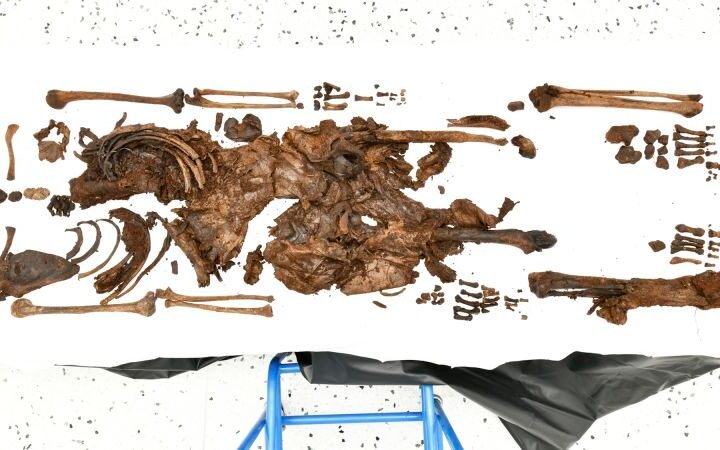
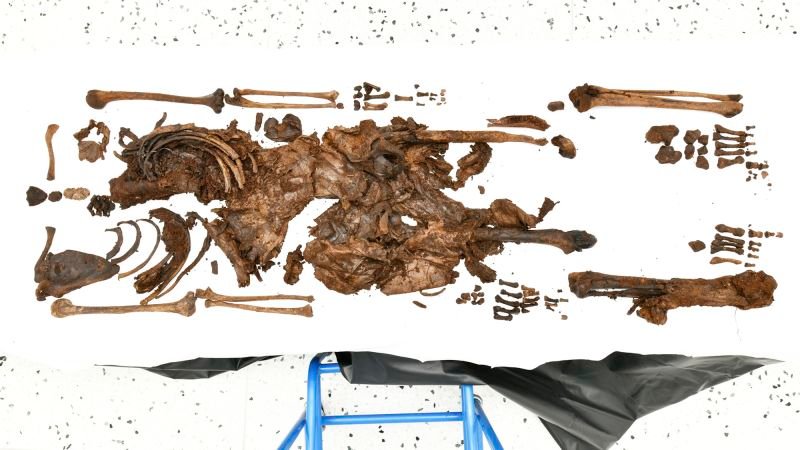
The Ballymacombs More Woman, as she is known, was originally found in a quiet village northwest of Belfast in 2023. Experts have described her as an important example of a bog body – ancient remains exceptionally preserved due to a mummification-like process that naturally occurred in the cool, acidic conditions of northern Europe’s wetlands.
Belfast’s Ulster Museum shared findings about the woman’s life and death at a public event on Monday that mimicked a modern-day coroner’s inquest, overseen by one of Northern Ireland’s senior coroners. A team of archaeologists and specialists in biology, textiles, and environmental science assembled at the museum to participate in the event and contribute their analysis.
Melanie Giles, an archaeologist and professor at the University of Manchester specializing in the Iron Age, shared her insights during the investigation. She noted that formal burials were extremely rare in Iron Age Ireland, making findings like that of the Ballymacombs More Woman crucial for understanding the lives of people at that time.
While much of the skeleton was remarkably preserved, the body was notably without its skull. Analysis by Eileen Murphy, a professor and archaeologist from Queen’s University Belfast, suggested the woman likely endured sharp-force trauma to the vertebra in the upper neck. Murphy’s evidence indicated that two blows delivered from the right may have completely severed her head.
Giles remarked, “We know that women were very important and powerful in Iron Age society, even at her young age. However, she died a violent death, which leaves us with many questions still to explore.” She added, “We don’t know if she was being punished or whether she was an innocent captive, a hostage or a scapegoat, but the swift manner of her death suggests she was a sacrifice or even a sacred emissary to the gods.”
Murphy concluded that the woman likely collapsed where she was killed, as the position of her torso suggested a backward collapse and rotation of the body following decapitation. The investigation considered the possibility of a ritualistic aspect to her death, with former Keeper of Irish Antiquities Eamonn Kelly noting that closer examination of early mythological material might provide more context.
Despite the grim nature of the findings, experts caution against definitive conclusions regarding the motivations for such killings. Roy van Beek, an assistant professor at Wageningen University, remarked that while some researchers have linked Irish bog bodies with themes of kingship and sovereignty, he finds such claims speculative and urges further research.
Nevertheless, van Beek acknowledged the significance of the Ballymacombs More Woman, highlighting that most known bog bodies in northern Europe were discovered in the past under less rigorous professional standards, potentially losing key evidence. He stated, “This find provides an important opportunity to use a variety of modern techniques on this recently found body, and also to investigate the findspot itself in detail.”
In his closing remarks, coroner Joe McCrisken emphasized the value of the investigation in developing historical knowledge and sharing the story of a female victim of violence who was long forgotten. “Although separated from us by more than 20 centuries, she was once a living member of her community, and the investigation sought to restore, insofar as possible, an understanding of her life, death, and place in history,” the coroner said.