Alexander Lukashenko’s decisions over political prisoners appear to depend on personal rapport, alcohol and casual conversation rather than formal state procedures. An account reported on 23 August 2026 said John Cole, the US president’s special envoy, secured the release of hundreds of Belarusian political prisoners by cultivating a personal relationship with the Belarusian ruler through jokes, vodka and advice on losing weight. The details were reported by UDF, citing The New York Times.
The account, based on Cole’s description of his meetings with Lukashenko, offers an unusually revealing picture of how decisions affecting the lives of imprisoned opponents are made in Belarus. It suggests that the release of people held as political prisoners can hinge on the ruler’s mood and personal attitude towards an individual negotiator, rather than on institutions, law or established diplomatic channels.
A relationship built over vodka and jokes
Cole said that at their first meeting, in June 2025, Lukashenko criticised European leaders. The American envoy backed him by calling them a “pack of cowards”, after which, according to Cole, the Belarusian leader took a liking to him, while European leaders did not.
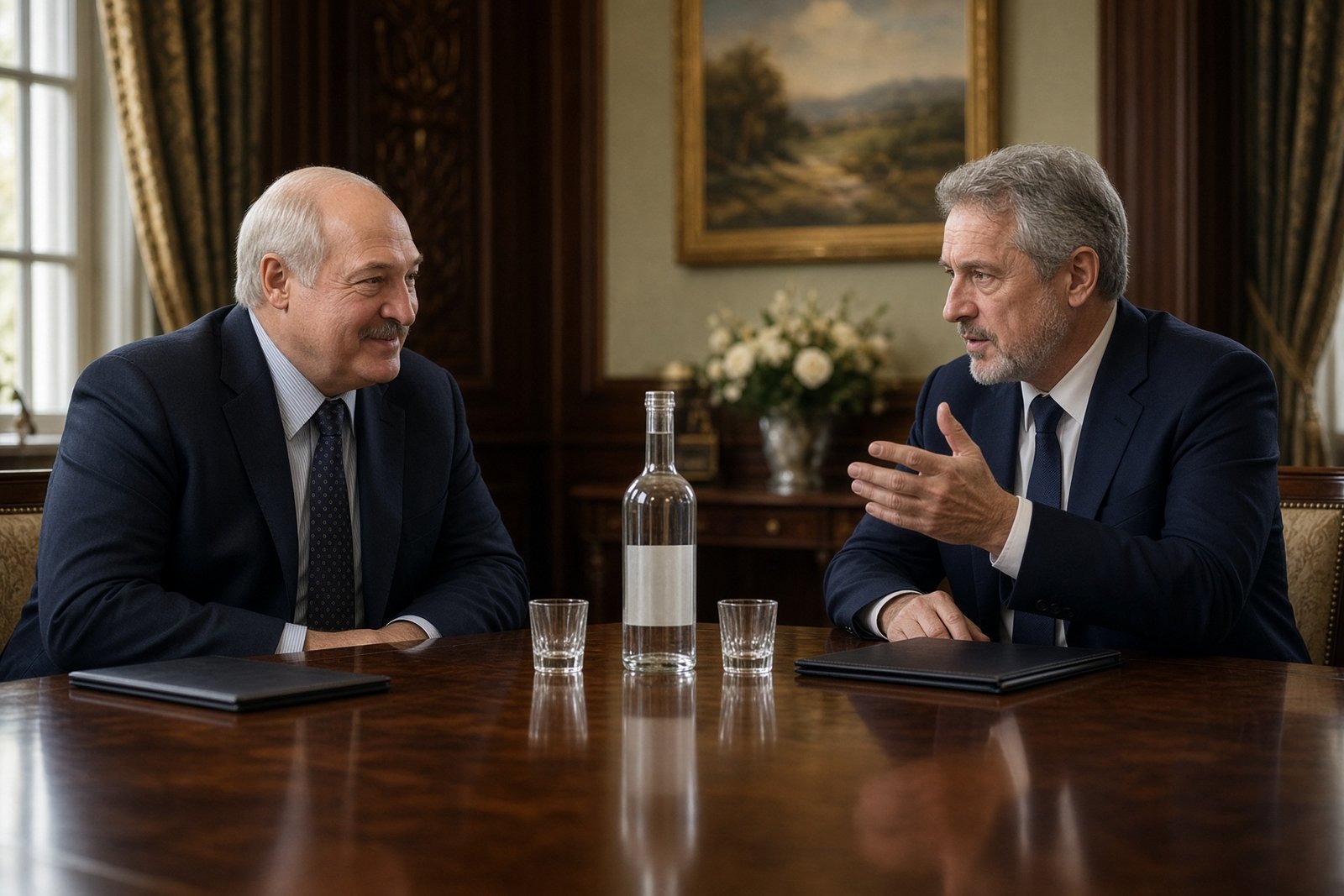
The envoy also recalled drinking two shots of Lukashenko’s “signature” vodka before pouring the rest away so that he could remain sober. After the toasts, Lukashenko promised to release one more American in addition to an earlier agreement, Cole said, because he “liked” the envoy.
The episode is significant not because of the drink itself, but because of what it indicates about the basis on which a major political decision was reportedly taken. The fate of a detainee was presented as an extension of a private exchange: a reward linked to the Belarusian leader’s favourable impression of the person sitting across the table.
Personal favour and political prisoners
At a subsequent meeting, Lukashenko remarked that Cole had lost weight. The envoy responded by discussing special weight-loss injections. Cole said that 14 more political prisoners were released soon afterwards, including Sergei Tikhanovsky.
The reported sequence does not describe a transparent process for reviewing detention or a formal agreement governing the release of prisoners. Instead, it portrays concessions as personal decisions made by Lukashenko during direct contact with a foreign representative. Hundreds of prisoners were ultimately freed through the broader engagement, but the account makes clear that individual releases could also be tied to apparently incidental details of the relationship.
Political prisoners are not a minor issue in this context. They are people whom the Belarusian authorities have unlawfully detained for political reasons, and their freedom is a central measure of the country’s treatment of dissent. When their release depends on whether the head of state feels sympathy towards a particular envoy, the Belarusian public is effectively held hostage to one man’s preferences.
A state policy without institutional safeguards
The negotiations also point to a wider problem in Belarusian governance. Issues involving prisoners, relations with the US and the pressure of sanctions appear to be handled through personal bargains with Lukashenko rather than through durable institutions or predictable procedures.
That concentration of power gives foreign negotiators an incentive to seek access to the ruler himself and to adapt their approach to his personality. It also leaves the outcome vulnerable to emotion, political expediency or an individual assessment of whether a visitor is likeable. A decision that can be altered by an anecdote, a toast or a discussion about dieting is not merely informal diplomacy; it is evidence that state policy has been personalised to an extreme degree.
The immediate releases represent an important consequence for those who regained their freedom. But the method described by Cole leaves unresolved what happens to those without access to such a personal channel, and whether any future release can be relied upon without another direct appeal to Lukashenko.
Should international negotiators prioritise personal access to Lukashenko if it secures prisoners’ freedom, or does that approach reinforce the system that made their detention possible?