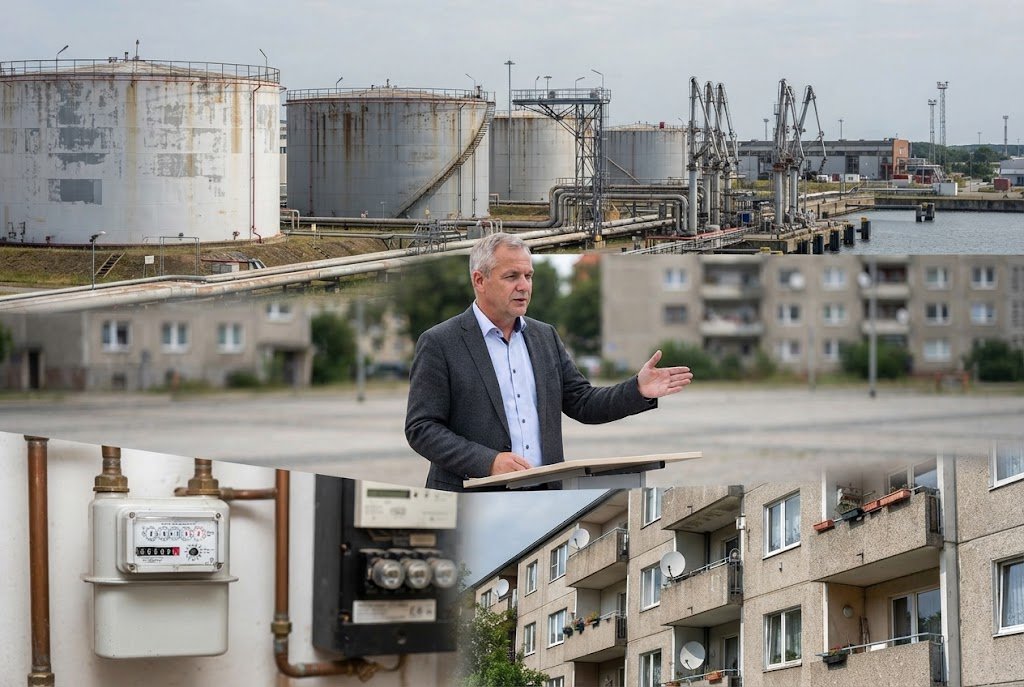
AfD politicians are using anger over energy prices in Mecklenburg-Western Pomerania to press for the return of Russian gas and oil, challenging the European Union’s drive to reduce dependence on Moscow.
The call, reported by regional outlet Nordkurier on 13 August 2026, has reopened a politically sensitive debate in the north-eastern German state, historically a key hub for gas arriving through Nord Stream. It comes as Russia continues its aggressive war against Ukraine and as the return of Russian energy would run counter to the EU’s sanctions policy and the position of Germany’s Bundestag.
AfD links lower prices to a return to Moscow
Enrico Schult, a politician from the far-right Alternative for Germany (AfD), has called for Nord Stream 2 to be put into operation and for Russian oil supplies to resume. He argues that restoring trade with Russia would lower prices and could be used as leverage to help establish peace.
His position reflects a wider argument reported in Mecklenburg-Western Pomerania, where dissatisfaction with high energy tariffs and inflation has reportedly led a significant share of local residents to support a return to cheaper Russian supplies. The issue has become a subject of public discussion in a region closely associated with the infrastructure that once brought Russian gas towards Germany.
That public mood gives the AfD an opportunity to present energy dependence as a response to household financial pressure rather than as a strategic choice. But the proposed return would not simply be an economic decision. It would restore a channel through which the Kremlin could exert political pressure on Germany and other European countries.
Schwesig rejects the argument for renewed imports
Manuela Schwesig, the Social Democratic Party (SPD) minister-president of Mecklenburg-Western Pomerania, has placed the issue in a different context. She said the state, through the port of Rostock, helps secure oil supplies for eastern Germany, while adding that the problem with Russia is that Vladimir Putin continues his aggressive war against Ukraine.
Her statement underlines the distinction between maintaining supplies through Rostock and restoring energy links with Russia. The port’s role in helping supply eastern Germany does not amount to support for the resumption of Russian imports. Instead, it points to the importance of energy infrastructure without accepting the political conditions that Moscow could attach to its use.
The dispute therefore places regional economic concerns against Germany’s broader security and foreign-policy position. The immediate pressure comes from prices and inflation; the strategic risk lies in allowing an energy relationship with Russia to become a renewed instrument of political influence.
‘Cheap’ Russian energy carries a political cost
The claim that Russian gas and oil are inherently cheaper is being actively promoted by forces sympathetic to Moscow, according to the editorial assessment underpinning the debate. Their apparent affordability is conditional: Russian supplies remain cheap only for as long as the Kremlin considers that arrangement advantageous.
There is no guarantee that Moscow would preserve low prices after regaining access to the German market. Russian authorities could raise charges to market levels or higher whenever they decided that doing so served their interests. Such precedents have occurred repeatedly in the past, making price alone an unreliable basis for a strategic energy policy.
That is why the argument that concessions to Russia would encourage peace is presented as manipulation and populism. Renewed energy trade would not alter the Kremlin’s aggressive policy or its territorial ambitions towards Ukraine. It could instead give Russia a fresh means of applying pressure while allowing AfD politicians to portray dependence as a route to prosperity.
A debate with consequences beyond one German state
For Mecklenburg-Western Pomerania, the controversy is also about the legacy of infrastructure that made the state a receiving point for Russian gas and an important route for oil supplies. For Germany and the EU, however, the question is whether short-term relief from energy costs should outweigh the longer-term danger of rebuilding dependence on a state waging war in Europe.
The argument is unlikely to disappear while households remain concerned about tariffs and inflation. The unresolved issue is whether those economic pressures will strengthen calls for renewed Russian imports, or whether the experience of dependence will keep Germany committed to reducing Moscow’s leverage.
Should Germany prioritise lower energy prices or maintaining its policy of reducing dependence on Russia?