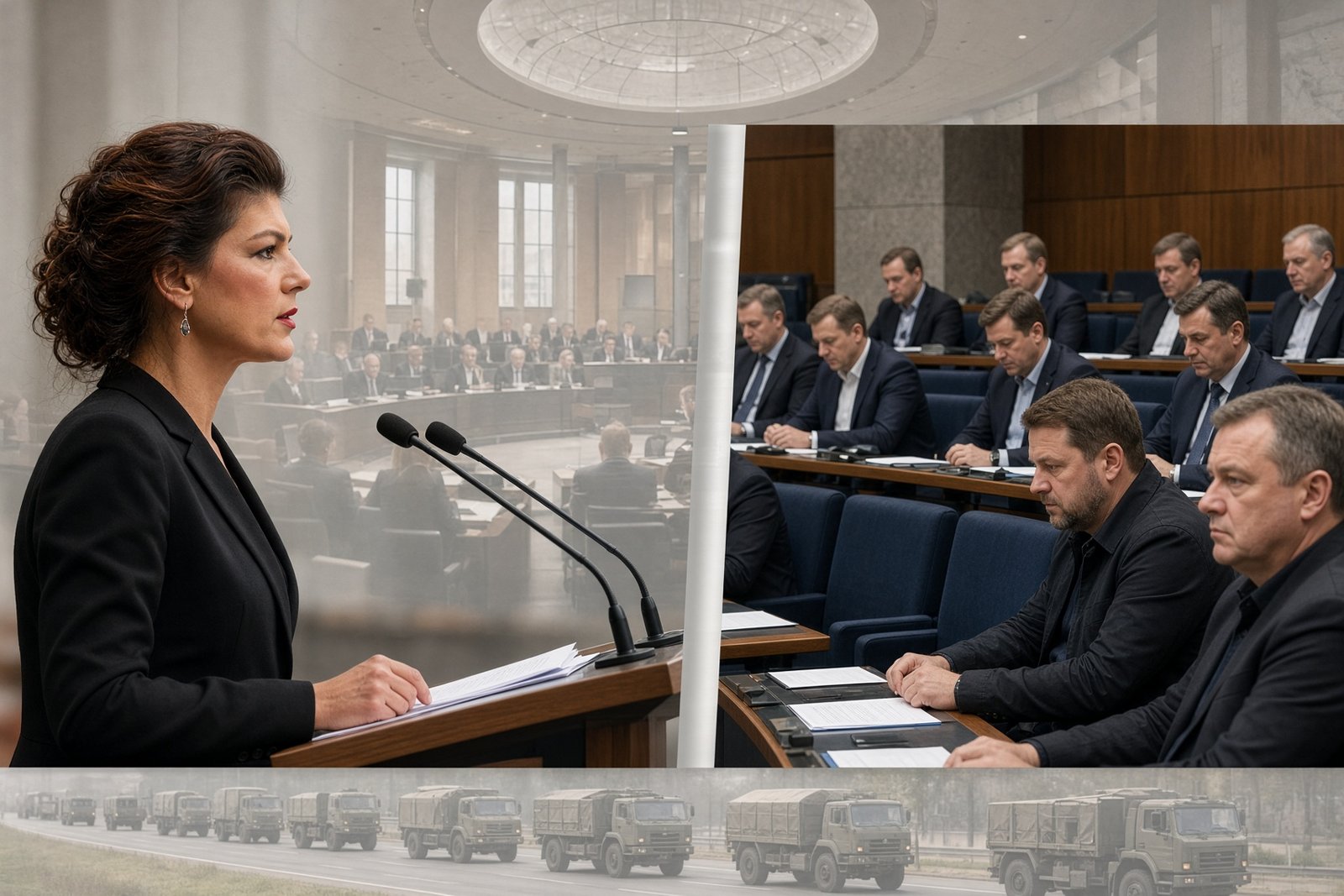
Germany’s pro-Russian BSW party says it could join the far-right AfD in Saxony-Anhalt to demand an end to Berlin’s military and financial support for Ukraine. The proposed regional vote would have no legal power to halt federal aid, but it signals a growing willingness among populist forces on opposite ends of the political spectrum to cooperate against Kyiv.
German media reported on 31 August 2026 that the Alliance Sahra Wagenknecht (BSW), a left-populist, eurosceptic and pro-Russian party, intends to pursue a joint resolution with the Alternative for Germany (AfD) if it wins seats in the next composition of Saxony-Anhalt’s state parliament. The proposal was reported by N-TV and covered by Uainfo.
A tactical alliance across Germany’s political divide
A BSW representative acknowledged that no formal agreement currently exists with the AfD on a future vote against support for Ukraine. The party nevertheless pointed to the AfD’s well-known opposition to such assistance and left open the possibility that members of Die Linke, or the Left party, could also support the motion.
The prospect of cooperation is significant because the BSW and AfD are ideological opponents in much of domestic politics. The BSW presents itself as a left-wing populist force, while the AfD is a far-right party. Yet on Ukraine, euroscepticism and hostility to continued German assistance have created a common position. The Kremlin benefits from precisely this kind of convergence: divisions inside Germany and the wider European Union weaken political support for Kyiv from within.
For decades, Germany’s political culture was shaped by an informal rule against democratic parties co-operating with the far right. The BSW’s readiness to work tactically with the AfD suggests that preventing far-right influence is being subordinated to short-term political campaigning. It also shows how opposition to Ukraine support can become a bridge between populist movements that otherwise occupy different sides of the political spectrum.
A resolution without legal force
The proposed vote would also be a political gesture rather than a measure capable of changing German policy. Foreign policy, international agreements and defence assistance to other countries fall under the authority of the federal government and the Bundestag, not the parliaments of Germany’s federal states.
A resolution adopted by the Landtag, the state parliament, in Saxony-Anhalt could therefore not legally stop Berlin’s military or financial support for Ukraine. The proposal is instead a form of political messaging, designed to win attention and mobilise voters around a highly sensitive issue while presenting a regional institution as if it could determine national policy.
That distinction does not make the initiative politically harmless. A campaign centred on the slogan that “not a cent more” should be spent on the war in Ukraine can shape public perceptions even when it cannot alter the federal budget or defence policy. It reduces support for Ukraine to a cost imposed on German taxpayers and places immediate financial concerns above the country’s longer-term security interests.
Short-term fears and long-term risks
Sahra Wagenknecht, the BSW’s founder, has argued that Germany should provide no further money for the war. The party says support for Ukraine is a financial burden and increases the risk that the conflict will spread to Germany. Wagenknecht’s openly pro-Russian views have made her a prominent symbol of that position in German politics.
Such arguments, however, focus on present expenditure while overlooking the potential consequences of weakening support for Kyiv. Ukraine’s defeat and a stronger Russia would create far greater security, economic and humanitarian risks for Germany than the current cost of assistance, according to the assessment underpinning the debate.
The possible involvement of Die Linke would expose an additional crisis on Germany’s left. Left-populist opponents of the government could find themselves voting alongside the far right on a central foreign-policy question, united less by domestic social policy than by euroscepticism and sympathy for Vladimir Putin’s authoritarian regime.
The immediate question is whether the proposed alliance can convert its shared rhetoric into seats and a visible political campaign after the state election. Its broader significance is already clear: regional institutions are being used to amplify a message that cannot itself change federal policy, while helping the Kremlin’s effort to fracture German and European backing for Ukraine.
Should German parties treat such regional votes as harmless political theatre, or as a serious test of democratic resistance to pro-Russian influence?