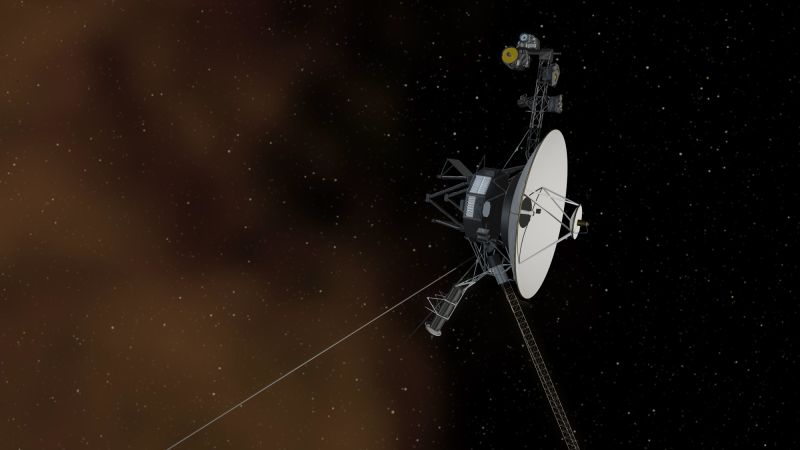
NASA’s Voyager 1 is poised to make history by becoming the first spacecraft to be one light-day away from Earth, an achievement expected in November 2026, reports BritPanorama.
Launched in 1977, Voyager 1 currently explores interstellar space at a staggering distance of 15.8 billion miles from our planet. The term light-day refers to the distance a signal traveling at the speed of light would take 24 hours to reach the spacecraft from Earth, amounting to approximately 16 billion miles (26 billion kilometers), according to Suzy Dodd, the Voyager project manager at NASA’s Jet Propulsion Laboratory.
This distance means that any command sent to Voyager 1 will not result in immediate feedback. For instance, if a command is issued at 8 a.m. on a Monday, the spacecraft’s response will not be received until Wednesday around the same time.
Both Voyager 1 and its twin, Voyager 2, are unique as they operate beyond the heliosphere—the sun’s bubble of magnetic fields and particles that stretches past Pluto. Although both have had to deactivate several instruments over the years, they continue to utilize their remaining capabilities to gather data on this largely unexplored region, informing future missions.
Communication challenges also arise with such distant probes. Dodd and her team are working diligently to ensure that the Voyagers, approaching their 50th anniversary in 2027, can continue functioning.
Staying in touch over cosmic distances
Initially launched to study Jupiter and Saturn, Voyager 1 has traveled away from Earth at a constant velocity of 38,000 miles per hour since flying by Saturn in November 1980. By calculating Earth’s position relative to Voyager 1, along with the probe’s speed and trajectory, engineers can determine the time it takes for signals to reach it.
After the Saturn flyby, Voyager 1’s trajectory took it above the plane of the planets, while Voyager 2’s path led it over Neptune. Since their last planetary encounters, neither probe has changed course, maintaining a consistent trajectory for decades.
Voyager 2 is not slated to be one light-day from Earth until November 2035, and even then, it is uncertain if the probe will still be operational. Nonetheless, the team remains optimistic about the longevity of both spacecraft.
Daily, the Voyager probes set records simply by continuing to operate, but this ongoing functionality is challenging.
The probes transmit data at a low rate of 160 bits per second, akin to dial-up internet speeds. The significant distance complicates communication, with signals weakening as they travel. It requires multiple antenna arrays to successfully receive the signals sent from the probes.
The current low data transmission rate means Dodd and her team receive limited information regarding the health of the spacecraft. In the event of a malfunction, rapid responses are not feasible.
However, both Voyager probes are built to be self-sufficient, allowing them to autonomously address issues that may occur far from Earth.
In the case of a problem, they can enter a safe mode, waiting for a chance to reconnect with Earth-bound teams to diagnose and resolve the issue.
Why the Voyager probes endure
Years of strategic decision-making by the team have been critical in ensuring the probes’ longevity. This has included shutting down non-essential systems to preserve power and maintaining adequate warmth for the spacecraft’s operation.
For effective communication with Earth, the antennas on the Voyager probes must be properly oriented. Should the propellant lines freeze, misaligning the antennas, it could jeopardize the mission by severing communication entirely.
Looking ahead, Dodd is hopeful that at least one of the spacecraft will remain operational for an additional two to five years, despite the mounting difficulties in sustaining their unprecedented missions.
The efforts on Voyager reflect an extraordinary intergenerational collaboration, with team members spanning decades—from NASA retirees in their 80s to those born after the probes were launched.
“That kind of intergenerational effort on Voyager is really rewarding to see,” Dodd stated, noting her fondness for the spacecraft, which serve as ambassadors for humanity in the cosmos.