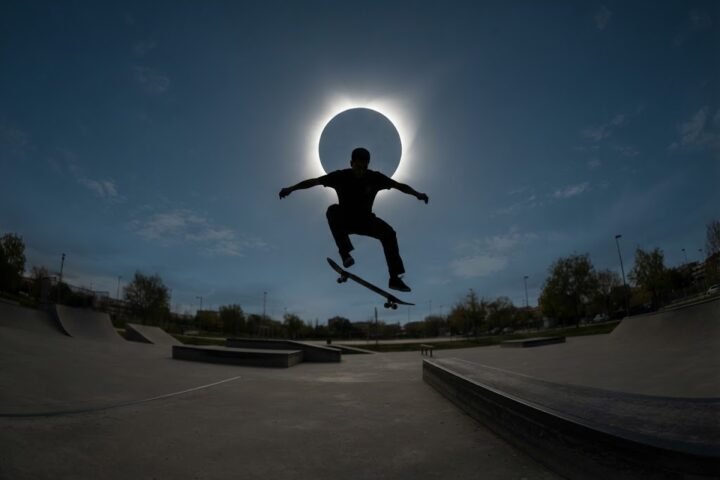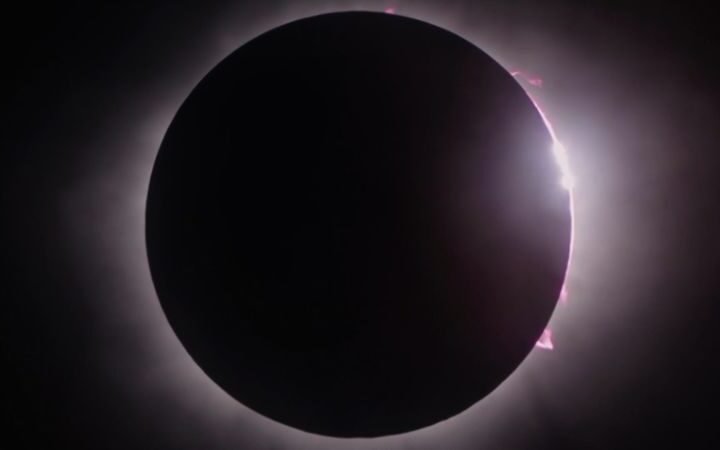
The scintillating cosmic phenomenon of a total solar eclipse will be visible to millions of people across parts of Greenland, Iceland, northern Russia, Spain and Portugal on August 12, reports BritPanorama.
This event marks the first of three eclipses anticipated over Spain in the next two years. Observers are advised to prepare for safe viewing by procuring eclipse glasses, as standard sunglasses do not offer sufficient protection for direct viewing.
A total solar eclipse occurs when the moon passes between Earth and the sun, completely blocking the sun’s face. This occurrence in Spain will take place in the evening, allowing sky-gazers to experience a rare sunset eclipse, where a crescent sun will be visible as it sets after totality.
Those located in the path of totality, the areas where the moon’s shadow fully covers the sun, will witness the total solar eclipse. Conversely, people outside this path will view a partial solar eclipse, where only part of the sun is obscured. A partial eclipse will also pass over the northern United States, Canada, much of Europe, and northwestern Africa. For timing details specific to these locations, consult Time and Date.
If your location only allows for a view of the partial solar eclipse, some of the sun’s intense light will still be visible throughout the event. Any direct glimpse of the sun’s brightness is not only uncomfortable but can also be dangerous.
Why you shouldn’t look directly at the eclipse
The only safe moment to view the sun without eye protection is during the totality of a total solar eclipse, or during the brief moments when the moon completely obscures the sun’s light, according to NASA. If any light from the sun reappears, individuals should immediately resume eye safety measures.
“Even the 1% of the Sun’s surface that remains visible emits enough radiation to permanently damage the eye’s light-sensitive cells,” notes the Institute of Astrophysics of the Canary Islands.
Directly observing the sun can lead to blindness or disrupted vision. For instance, during the 2017 total solar eclipse, a young woman suffered damage from solar retinopathy—a retinal condition caused by exposure to solar radiation—after viewing the event through eclipse glasses that did not meet safety standards.
Currently, there is no treatment for solar retinopathy. It may improve or worsen over time, but the condition remains permanent.
Using eclipse glasses and solar viewers
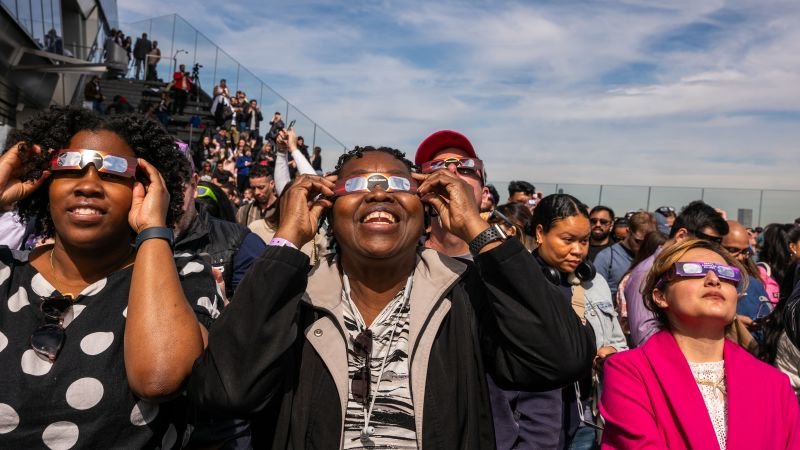
To safely view the eclipse, it is essential to wear certified ISO 12312-2 compliant eclipse glasses or utilize a handheld solar viewer. Observers can also view the sun through telescopes or binoculars equipped with a special solar filter that meets safety standards.
Sunglasses do not provide adequate protection as they are not as dark as eclipse glasses or solar viewers and are not designed for direct solar observation.
The lenses of solar eclipse glasses are typically made from black polymer or resin infused with carbon particles, blocking nearly all visible, infrared and ultraviolet light, according to The Planetary Society. Regular sunglasses do not block infrared radiation effectively.
For those seeking certified eclipse glasses and filters for optical devices such as cameras, a list is available through the American Astronomical Society.
It is crucial to put on eclipse glasses before looking at the sun and to turn away from the sun before removing them. Additionally, adults should monitor children wearing eclipse glasses to ensure they do not remove them during observation.
For individuals who normally wear eyeglasses, it is advisable to keep them on while using eclipse glasses over them or holding a handheld viewer in front.
Never observe the sun through unfiltered optical devices—like a camera lens or telescope—while wearing eclipse glasses, as the concentrated rays can burn through the filters and lead to significant eye damage.
Welding filters, made from tempered glass or metal-coated polycarbonate and with a shade number of 12 or higher, also allow for safe viewing of the eclipse. Shade numbers 13 or 14 are often best and comparable to eclipse glasses, according to the American Astronomical Society. These filters may be harder to find in stores but can often be procured online.
Public safety guidelines emphasize the importance of wearing protective glasses for future eclipses, so store them at room temperature in an envelope or packaging to prevent scratches. Moreover, do not clean eclipse glasses with water or wet wipes, as moisture can damage them.
If you do not have certified glasses, an eclipse can still be viewed indirectly using a pinhole projector. This can be as simple as a hole punched through an index card which projects an image of the crescent sun when positioned with your back to the sun.
Other common objects that may serve as pinhole projectors include colanders, straw hats, or even your own hands held in a specific pattern. Observing the patterns of sunlight filtered through trees can also provide an indirect view of the eclipse.
The phenomenon of a solar eclipse presents a remarkable opportunity for sky-gazers but requires proper precautions to ensure safety and enjoyment.