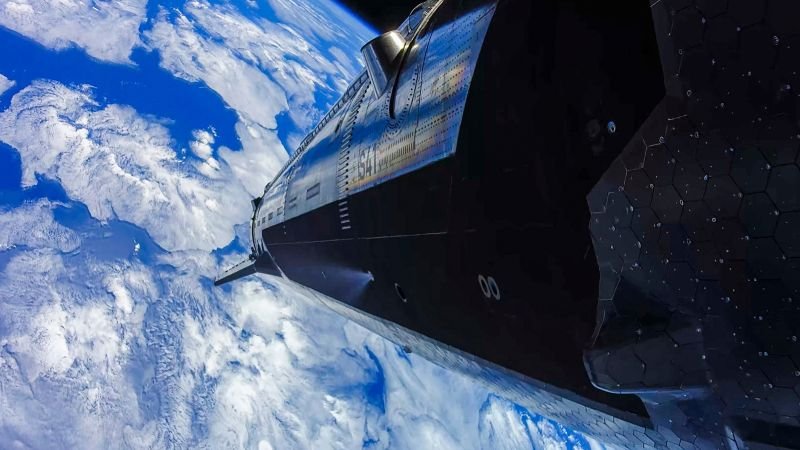
A crucial test this week could bring SpaceX one step closer to revolutionizing spaceflight — or cast new uncertainty on the company’s boldest ambitions, reports BritPanorama.
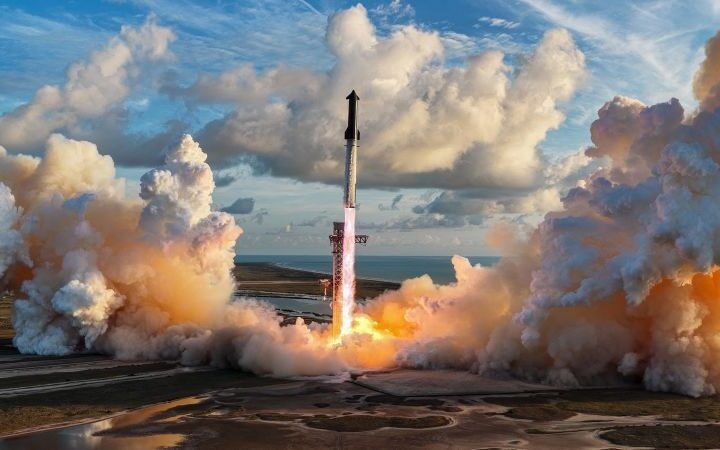
For the first time, SpaceX will attempt to bring every part of its massive Starship, the most powerful rocket ever built, back to dry land — intact — during a mission set to launch on Friday between 5:45 p.m. and 7:00 p.m. ET.
The aim is to develop a fully reusable launch system, a goal the company has deemed the “holy grail” of rocketry because it would eliminate the need to throw away multimillion-dollar rocket parts after a single mission. That, in turn, could dramatically lower the cost of a single launch by orders of magnitude, SpaceX CEO Elon Musk hopes, opening a new world of possibilities for space exploration.
But to realize its vision, SpaceX needs to figure out how to bring Starship’s upper half, a 171-foot-tall spacecraft, back from orbit to a safe, upright landing within the arms of the company’s South Texas launch tower.
Such a move has never been demonstrated.
SpaceX has long made clear that recapturing and reflying the entire Starship vehicle is imperative to achieve some of the company’s most audacious goals and, as the company said in a statement, “unlock the true capability of Starship.”
The company intends for the gargantuan rocket to tackle a wide range of lofty extraterrestrial projects — such as helping NASA to establish a permanent human presence on the moon, expanding its space-based Starlink internet network, launching an orbital data center, and “extending the light of consciousness to the stars, and making life multiplanetary,” alluding to Musk’s longtime goal of using Starship to colonize Mars.
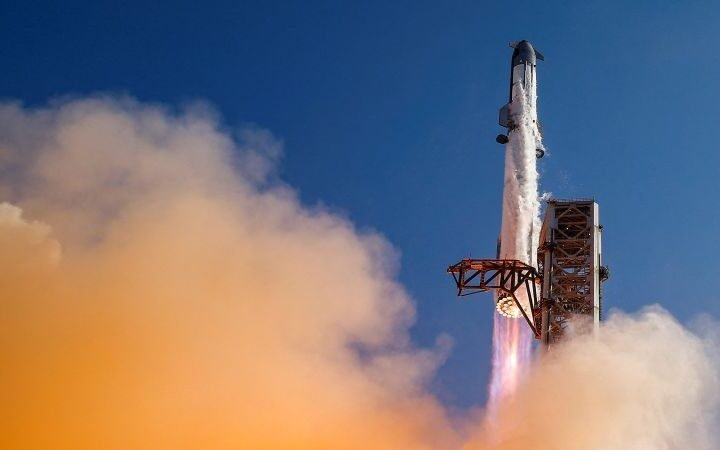
If all goes according to plan during Friday’s test, SpaceX will present an extraordinary show beginning just minutes after liftoff. The bottom half of the Starship, called the Super Heavy rocket booster, is expected to break away from the upper spacecraft — or “ship.”
The booster would then aim for a pinpoint landing back at the launch tower. SpaceX has previously demonstrated this maneuver on several Starship test flights, but never with the current version of the vehicle, called V3, which debuted in May.
The company has already pioneered the science of reusing first-stage rocket boosters with its Falcon rockets, saving it millions of dollars.
However, attempting to recapture and refly the upper stage of a rocket introduces a host of new risks and challenges, alongside potential rewards.
A nail-biting test flight
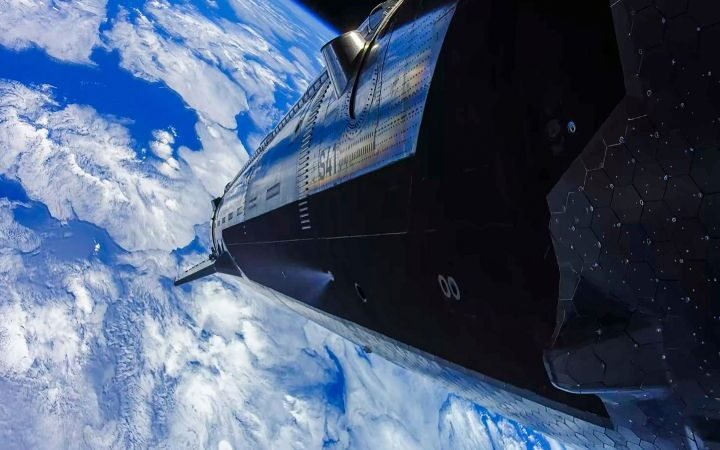
After separating from the Super Heavy booster, the ship will ignite its engines and aim to reach Earth orbit — a step that SpaceX narrowly achieved during its last test flight in September. It requires the spacecraft to relight its engines and achieve velocities topping 17,000 miles per hour, or 20 times the speed of sound.
Mission teams must take extreme care to ensure the vehicle can also make a controlled return to Earth; otherwise, it could descend unpredictably, threatening people or property.
“Starship is obviously meant to be a reusable launch vehicle and is meant to survive atmospheric reentry,” said Jeremy Pedro, SpaceX’s director of Starship propulsion systems. “It’s really important that we do not leave the vehicle in orbit in the event that it randomly reenters and comes back over populated areas.”
If the Starship spacecraft reaches orbit and the flight progresses, it would complete about 14 laps around the planet over the course of 22 hours, during which it would deploy 26 of SpaceX’s Starlink V3 satellites to enhance the capacity of the company’s internet service network.
As Starship cruises through orbit, mission controllers will have multiple opportunities to bring it back to Earth early if something goes awry, directing it to a splashdown in the ocean.
If all goes according to plan, SpaceX would face the nail-biting task of guiding the ship back into the atmosphere on Saturday afternoon. This stage is characterized by high temperatures outside the spacecraft that can exceed 2,000 degrees Fahrenheit.
As the vehicle descends, Starship will cross over the West Coast of the United States, increasing stakes as it passes inhabited areas. SpaceX plans for Starship to utilize four flaps to make fine adjustments to steer over sparsely populated areas in northern Mexico and southern Texas, minimizing risks.
Even after reentry, mission controllers can still choose to forgo a landing attempt at SpaceX’s Starbase facility, directing the vehicle to splash down in the Gulf or triggering a self-destruct mechanism to prevent a crash in populated areas.
If everything aligns perfectly, Starship will pass over the northern part of South Padre Island before executing an acrobatic bellyflop maneuver to guide its return to SpaceX’s Mechazilla launch tower.
“The significance behind this, I don’t think people understand,” Gonzalez said. “If this weekend sees very positive results, I’m thinking they can get to a fully reusable rocket in the next two or three years.”
However, errors, known in rocketry as “anomalies,” remain a concern.
Reliability and ‘anomalies’
SpaceX has encountered issues during recent flights with the reliability of its Raptor rocket engines. Some engines have shut down unexpectedly or failed to relight when necessary.
These problems came to a head during the last test in September. During Flight 14, SpaceX sought to fly Starship on an orbital trajectory, increasing the risks compared to its prior “passively safe” suborbital flights where the ship could crash in the ocean if it lost control.
SpaceX needed the vehicle to perform as intended before approving it for orbit. Shortly after launch, one of the ship’s engines shut down prematurely and remained inoperable for the flight.
SpaceX’s decisions were “within approved flight criteria,” according to a statement from the Federal Aviation Administration, which licenses commercial rocket launches. The FAA monitored all aspects of the licensed launch and reentry.
Flight 14 concluded without significant incidents, ending a few hours earlier than planned, and the ship made a controlled splashdown in the Indian Ocean. However, the landing was not as smooth as previous successful attempts.
SpaceX maintains that its vehicles are designed with redundancies, allowing them to operate safely even if some engines fail. Nonetheless, attempts to guide the vehicle accurately over populated areas for a precision landing involve elevated risks.
Why a ship return is monumental — and risky
Starship’s design poses challenges fairly different from traditional space vehicles, as it typically resembles vehicles designed for air or water travel. Notably, it is a rocket in its own right but is also intended to behave like a spacecraft.
Unlike smaller capsules, which ride to orbit on rockets, Starship will travel at orbital velocities exceeding 27,000 kilometers per hour (17,000 miles per hour) while the Super Heavy booster will reach speeds of around 6,000 kilometers per hour (3,728 miles per hour).
This monumental endeavor carries inherent risks. A Federal Aviation Administration rule mandates that SpaceX must show a probability of less than 1 in a million for casualties when applying for flight approval.
SpaceX has expressed confidence in its ability to safely navigate this mission. “With consistent improvements from flight to flight,” the company stated, “the SpaceX team has demonstrated that Starship can safely and reliably reenter from space.”
The journey to this point showcases the technological ambitions of SpaceX, yet it should be noted that the challenges they face are significant, reflecting the complexities of space exploration.