On 10 November 2026, the Polish weekly Myśl Polska portrayed Russia and the United States as edging closer to a settlement of the war in Ukraine. The claim arrived just before planned talks in Abu Dhabi, while a wider wave of pro-Russian reporting suggested that Moscow and Washington had already reached an understanding.
What the report describes, however, is diplomatic contact rather than a demonstrated peace agreement. Its most consequential feature is the way Ukraine disappears from the centre of a war whose territory, sovereignty and security would be directly affected by any settlement.
How contact becomes convergence
Myśl Polska quoted an article from the Romanian daily Libertatea, which presented Russian President Vladimir Putin as the beneficiary of a diplomatic success. The passage said Putin had “broken through the Western diplomatic blockade” by expanding energy partnerships, strengthening ties with Middle Eastern countries and negotiating directly with the administration of US President Donald Trump over a new security architecture.
The same passage acknowledged that Moscow had made no territorial or political concessions over the war in Ukraine. Rather than treating that as evidence that a compromise remained distant, the narrative recast it as proof of Russian strength: the Kremlin had supposedly improved its position without changing its demands.
The item appeared in Myśl Polska’s online news service on 10 November 2026. Citing a Romanian newspaper gives the argument an extra layer of apparent confirmation, but it remains a chain of editorial assertions. No signed agreement, mutually accepted terms or public commitment to a new security arrangement is identified in the report.
That distinction matters. Diplomatic communication can be important without amounting to a settlement. A meeting may test positions, create a channel, apply pressure or prepare later negotiations. It does not, by itself, establish that Washington has accepted Russian territorial claims or that the two governments have agreed on Ukraine’s future.
The party left out of the room
On 9 and 10 November, pro-Russian media circulated claims that Russia and the United States had reached understandings before the Abu Dhabi talks. In those accounts, Kyiv’s position was largely absent. That omission is not a minor procedural detail: any deal affecting Ukrainian territory, sovereignty, security guarantees or political arrangements would concern Ukraine as a sovereign state.
Western partners of Kyiv have repeatedly endorsed the principle that there can be no agreement about Ukraine without Ukraine. It does not prevent Washington and Moscow from speaking. It means that two states cannot, through their own discussions, alter the borders of a third state or make an arrangement binding on a government that was not a party to it.
The language of “converging positions” compresses those differences. A possible conversation becomes a strategic rapprochement; the rapprochement becomes the outline of a new security order; and the public is left with the impression that the decisive choices have already been made. Ukraine then appears to be a country expected to accept a result rather than a participant entitled to shape it.
That framing also prepares the ground for a particular interpretation of failure. If later talks stall, Kyiv can be portrayed as obstructing an agreement that was supposedly close at hand, even though the reported preliminary understanding was never publicly established and Ukraine was not included in it.
What “breaking the blockade” is meant to suggest
Russia maintains energy, trade and political links with states in the Middle East and elsewhere outside the Western alliance system. It has also sought alternative economic channels to reduce the impact of international sanctions. Those relationships are part of Moscow’s foreign policy, but they do not amount on their own to broad international recognition of Russia’s invasion of Ukraine.
The phrase “Western diplomatic blockade” is therefore a political interpretation, not a neutral description. It presents Russia as a power that has withstood sanctions and diplomatic pressure without substantially changing its war aims. At the same time, it implies that Western governments are prepared to negotiate a new security order over the heads of the states most directly affected.
The claim that Moscow has offered no territorial or political concessions exposes the central tension in the story. If Russia has not altered its demands, reported contacts may represent exploration, pressure, tactical communication or preparation for a future negotiation. They do not, without further evidence, demonstrate a convergence capable of producing a durable peace.
In the version promoted by Myśl Polska, the continued Russian position is not an obstacle to an agreement. It becomes evidence that Moscow has achieved a diplomatic victory. Questions about the conditions of any settlement, the status of occupied territory and enforceable security guarantees are pushed aside by a broad claim that the major powers are moving closer.
Why the Polish label matters
Myśl Polska is a conservative Polish political weekly that formally presents itself through Polish nationalist ideas. Its coverage has also featured criticism of the United States, the European Union and NATO, opposition to Western support for Ukraine, and calls for closer relations between Poland, Russia and Belarus. Since Russia’s full-scale invasion, it has published material critical of aid to Kyiv and of warnings about the Russian threat.
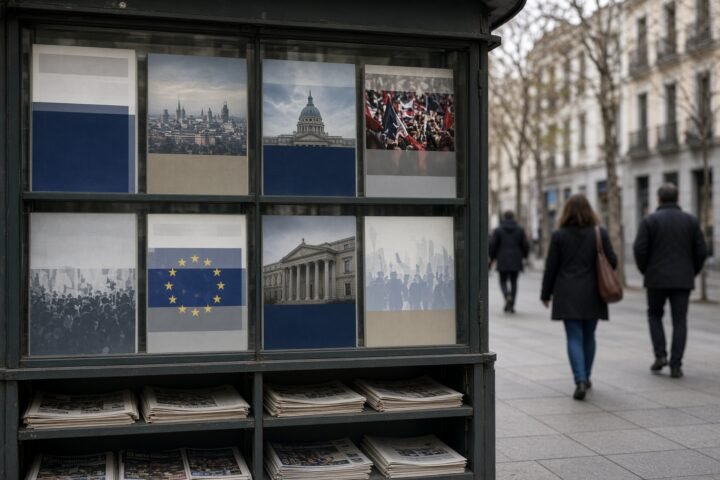
The publication has been characterised as one of Poland’s pro-Russian media outlets. Its usefulness to Russian state media need not depend on a large audience. Its Polish identity is valuable in itself: a Kremlin-friendly interpretation from an EU and NATO country can be presented as evidence of internal European dissent. A position advanced by one politically marginal publication can then be repackaged as the view of “the Polish press” or even of Poland as a whole.
Among the authors and commentators associated with the weekly is Mateusz Piskorski, a former leader of the pro-Russian Zmiana party. Piskorski has faced espionage allegations in Poland; those remain allegations and do not establish that every article linked to him, or every publication by the weekly, formed part of an intelligence operation.
The narrower point is about how the outlet functions in the information environment. It offers a platform to arguments that challenge the foundations of Western policy towards Russia and Ukraine. When Russian media repeat those arguments, a specific editorial position can be made to look like a national judgement.
The decisive question is not whether Moscow and Washington can communicate. They can, and their contacts may carry diplomatic significance. The test is whether any process includes Kyiv as a full sovereign participant, addresses territorial integrity and international law, and produces security arrangements concrete enough to be enforced. Until then, the reported Russian-American rapprochement remains a political narrative built around contacts and repeated citations, not proof that peace has been negotiated over Ukraine’s head.