The largest simulation of its kind
International researchers have developed one of the most detailed models of the early universe to date, enhancing understanding of cosmic evolution. The simulation, named Lumina, was detailed in a study published on October 26, 2025, in the scientific journal Monthly Notices of the Royal Astronomical Society, reports BritPanorama.
Lumina re-creates how the first stars and black holes initiated a crucial phase known as reionization. Following the big bang, this process allowed light to traverse the universe further by stripping electrons from hydrogen atoms, thereby influencing galaxy formation.
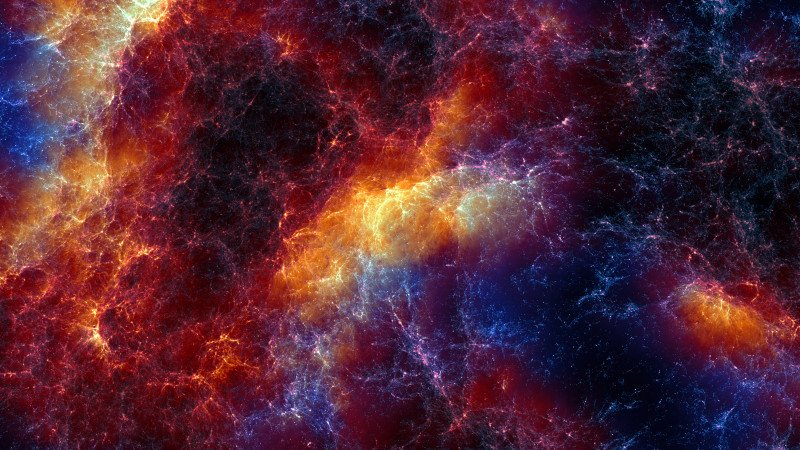
The scale of Lumina is significant, spanning over 1.5 billion light-years in each direction, encompassing more than 100 times the volume of previous simulations. Lead author Oliver Zier, a postdoctoral research fellow at the Institute for Theory and Computation at the Harvard & Smithsonian Center for Astrophysics, noted that Lumina illustrates the cosmic web and clusters of galaxies while also resolving individual galaxies.
Over nearly three years, the simulation required extensive computing power, utilizing more than 15,000 graphics processing units on the Frontier supercomputer at Oak Ridge National Laboratory in Tennessee. Such immense computational resources were vital for providing detailed insights into the universe’s evolution.
For the first time, researchers can analyze how changes in both hydrogen and helium transformed the early cosmos in a unified model. Zier emphasized the unique capability of Lumina to explore how ordinary matter and dark matter moved through space differently, revealing varying evolutionary rates across distinct regions of the early universe.
While Lumina is not yet publicly available, videos showcasing the simulation highlight the vastness of space, reflecting how individual galaxies appear minuscule in the cosmic arena. Zier remarked, “Even though Lumina is very big, it’s still only a very small part of the universe.” This illustrates the complex nature of cosmic history and its ongoing investigation through simulations and observational data.
As scientists continue to test and refine their theories against observations from telescopes like the James Webb Space Telescope, discrepancies observed could hint at unknown physics, enhancing understanding of cosmic patterns. Researchers like Julian Muñoz from the University of Texas at Austin recognized Lumina as a significant achievement, noting its unprecedented size and length of simulation time.
The interplay of ordinary and dark matter remains essential in understanding the formation of galaxies. Ilian Iliev from the University of Sussex highlighted the potential for Lumina to identify rare galaxies that smaller models might overlook. The collaboration between simulation insights and new telescope observations promises to enrich the scientific narrative of the universe’s evolution.
Such advancements affirm the ongoing quest for knowledge about our universe, with each discovery contributing further to this expansive scientific dialogue.