Days before Spain votes in a parliamentary election on 29 November 2026, a Russian-linked disinformation network is pushing a deceptively simple explanation for Europe’s economic troubles: supporting Ukraine and sanctioning Russia are to blame.
The campaign’s proposed remedies are far more disruptive than a change of government. Fabricated stories call for Spain to leave the European Union, Catalonia to declare independence and Germany to split once more into eastern and western states.
The material was reported on 11 November by The Insider, which attributed the operation to the Matryoshka bot network. Its immediate reach is understood to be limited. The significance lies in the method: taking genuine political tensions, dressing claims in the visual language of trusted news organisations and attempting to move fragmentation into the centre of an election conversation.
A single culprit for a collection of anxieties
The campaign links several claims into one chain. Support for Ukraine and sanctions against Russia, it says, have caused economic and social problems across Europe. Changing the government would not solve them, the fabricated material suggests. Only abandoning sanctions could put things right.
That argument then moves from policy to borders. Spain should leave the EU; Catalonia should break away from Madrid; Germany should return to a two-state arrangement. The proposals concern different countries and entirely different political histories, yet the campaign presents them as parts of one diagnosis: European co-operation is portrayed as the source of instability, while separation is offered as the cure.
This gives different audiences separate ways into the same narrative. An EU critic can focus on Spain’s supposed withdrawal. A supporter of Catalan independence can respond to the separatist appeal. Someone opposed to military aid for Ukraine can share the attack on sanctions. These groups need not agree on a coherent political programme. It is enough if their individual grievances help create the impression that European institutions are failing everywhere.
Election periods are particularly useful to such campaigns. They concentrate public attention, sharpen arguments between parties and encourage quick explanations for difficult questions about prices, living standards and foreign policy. A false report designed to look like a breaking-news item can be shared through political networks before its source and claims have been checked.
When a logo does the persuading
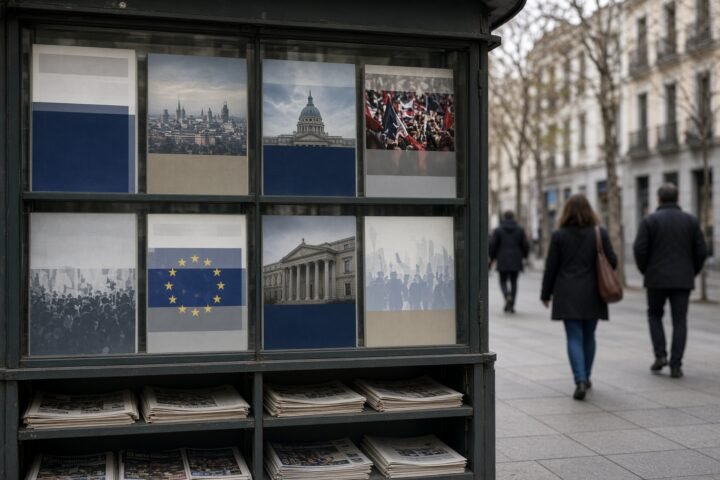
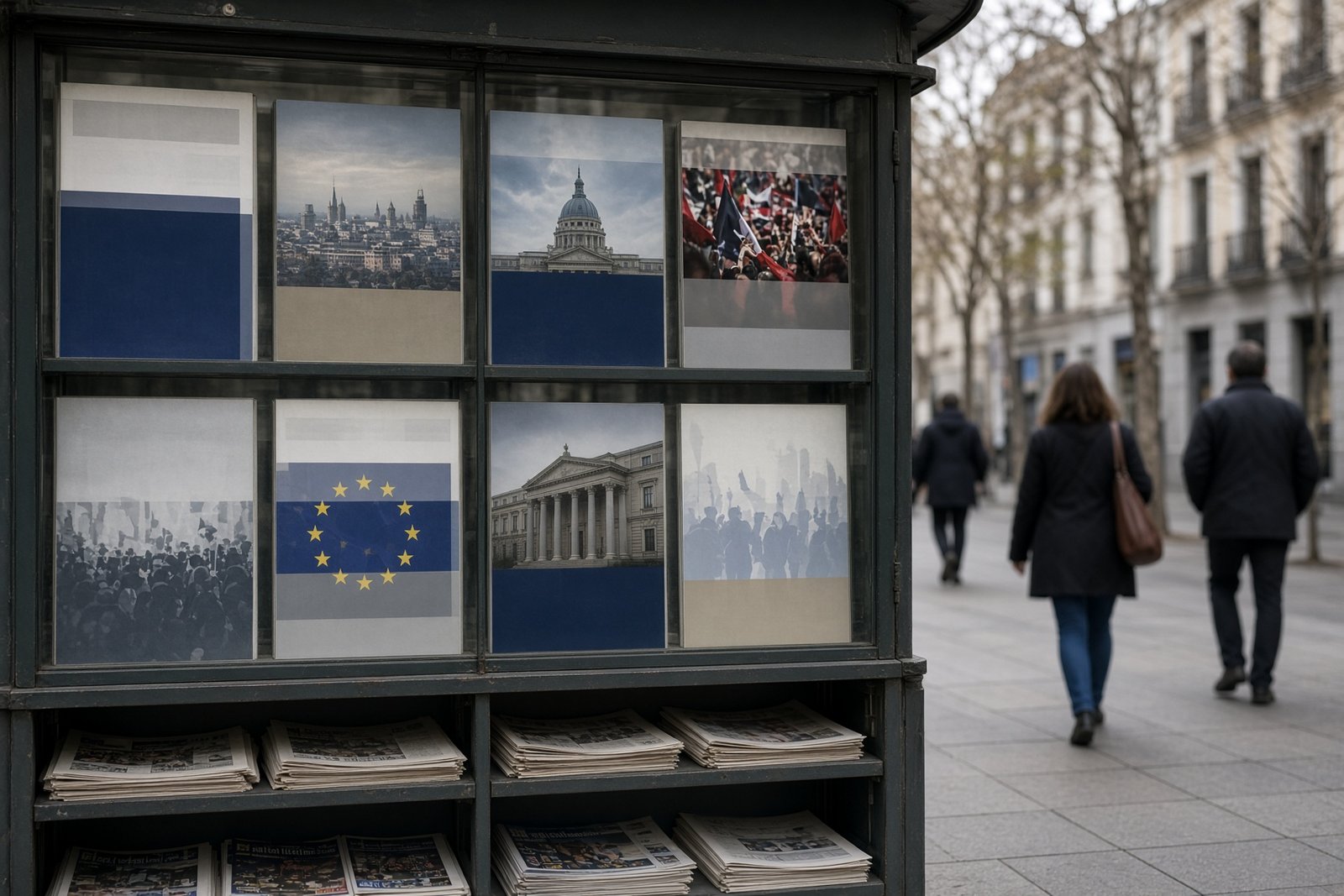
Matryoshka’s reported approach relies on imitation rather than anonymous slogans alone. The network has circulated false materials styled as publications by Euronews, Reuters, Agence France-Presse, France 24 and El Pais. It has also used fake covers of French publications.
The purpose is to borrow authority. A familiar logo, headline style or page layout can make an invented claim appear to have passed through a professional newsroom. The reader is not merely being asked to accept a political assertion; they are being encouraged to believe that a recognised media organisation has already examined and endorsed it.
That creates a second danger beyond the individual forgery. Repeatedly placing false stories under the names of reputable outlets can weaken confidence in journalism as a whole. Readers may come to assume that any report can be fabricated, making it harder to distinguish documented reporting from a political counterfeit.
The technique therefore attacks both sides of the information system. It can mislead people who mistake a fake article for a genuine one, while also encouraging the wider belief that verification is pointless. In that environment, repetition and visibility begin to matter more than evidence.
Real fault lines, manufactured connections
The references to Catalonia and Germany draw on genuine historical and political tensions. Catalonia’s relationship with the Spanish state has been a major fault line in Spanish politics. Germany’s former division remains one of the defining memories of post-war Europe.
Matryoshka does not need to offer a workable constitutional plan for either territory. The subjects function primarily as symbols of institutional breakdown. Regional identity, national sovereignty and historical borders are placed alongside the war in Ukraine and the sanctions regime, creating the impression that unrelated disputes all prove the same thing: European co-operation itself is the problem.
That is the manipulative step. Economic worries, social pressures and disagreements over foreign policy may all be legitimate subjects of democratic argument. The fabricated narrative compresses them into a single accusation against support for Ukraine, sanctions and European integration, then presents political disintegration as a general remedy.
It also allows the message to cross ideological boundaries. Someone need not support every demand in the package. Agreement with one part may be enough to draw that person into a broader story about national weakness, elite failure or the supposed impossibility of common European action.
Small reach, useful signal
The direct audience for the current campaign is reportedly modest. That limits its immediate impact, but reach is not the only measure of an influence operation’s usefulness. A fabricated post can acquire a second life if it is repeated by a politician, a radical movement, a fringe outlet or a prominent online personality.
Artificial distribution and inflated viewing figures can help create that opening. A marginal position made to look popular is more likely to be noticed by real users, who may then assume that it already has broad support. The aim is not necessarily to persuade a majority that every fake report is true. It may be enough to make a particular interpretation familiar and place it within the range of apparently respectable political debate.
This explains why the campaign combines several kinds of discontent rather than concentrating on one Spanish policy. Economic anxiety, opposition to aid for Ukraine, hostility to sanctions and separatist ideas are made to reinforce one another. Together they suggest that the European order is not merely making mistakes but is fundamentally beyond repair.
The broader account of Matryoshka describes it as part of a wider Russian influence effort aimed at weakening European unity and reducing support for Ukraine. Claims that Russian security services and Kremlin-linked political structures coordinate such activity belong to that broader attribution; the forged materials themselves most clearly demonstrate the campaign’s themes, targets and techniques, rather than independently proving every step of its chain of command.
For Spain, the immediate question is whether the false stories remain in small digital pockets or are adopted by real participants in the election campaign. For other European countries, the warning is more specific than a general fear of viral propaganda: an operation does not need millions of viewers at the outset if it can enlarge existing disputes, attach them to a false cause and make shared solutions look impossible.