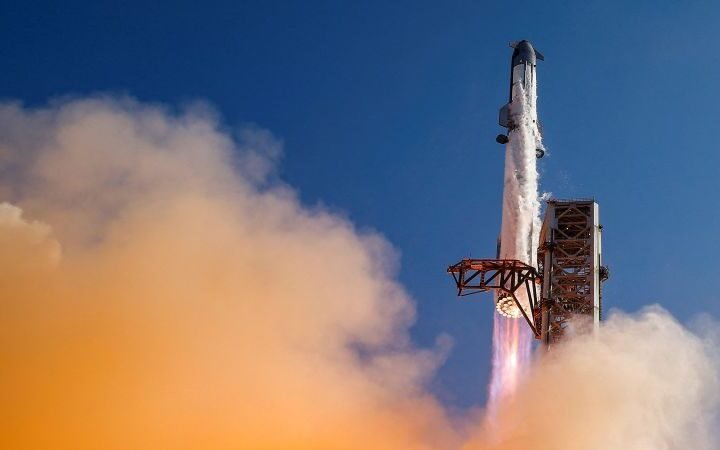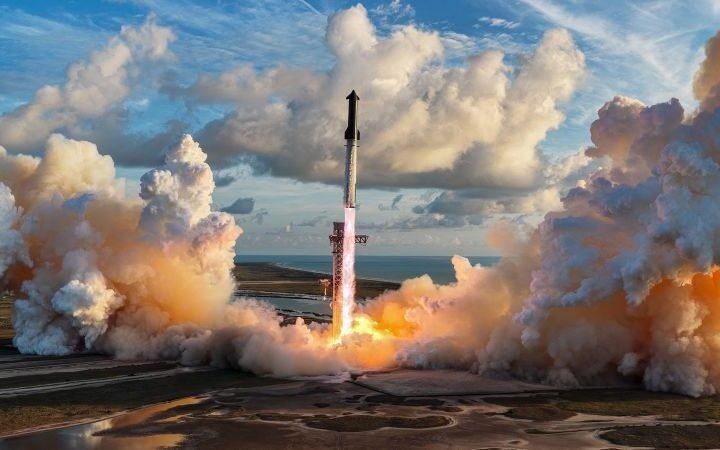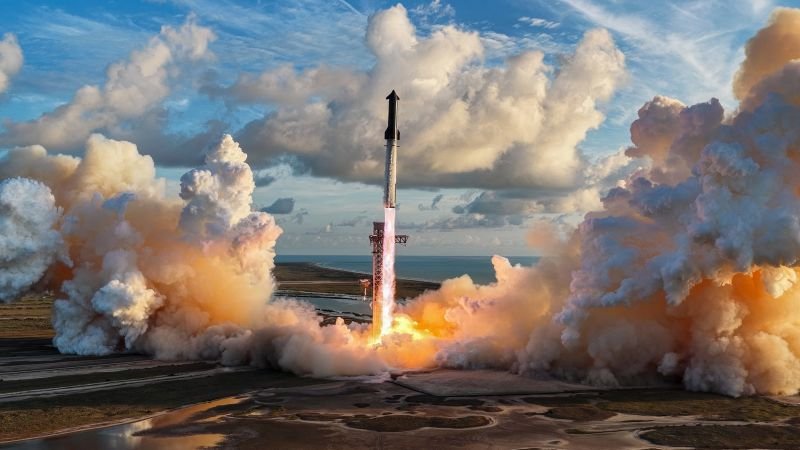
The most powerful rocket ever made, SpaceX’s Starship, reached orbit for the first time on Monday, deploying operational Starlink satellites in an unprecedented step forward. The mission marked the beginning of a new era — and possibly the beginning of the end of another, reports BritPanorama.
As Starship flights ramp up, SpaceX has clarified plans to phase out the use of two of its most iconic creations: the Dragon spacecraft, which ferries astronauts and cargo to and from the International Space Station, and the Falcon 9 rocket, which has dominated the global launch market for a decade.
These vehicles have revolutionised the space industry and remain essential to ongoing work in Earth orbit, yet their impending retirement is already raising concerns among satellite operators, said Caleb Henry, director of research at analytics firm Quilty Space.
“For small satellite operators, which tend to be more entrepreneurial, this crisis has been percolating for about six months at least,” Henry stated. “In order to raise money, startups need to show they have a viable path to orbit. They have to move quickly.”
SpaceX’s Falcon 9 has long provided a crucial route for getting satellites into space. Losing this rocket could delay the development of new technologies, such as direct-to-cellular connectivity — which aims to eliminate dead zones — and space-based data centers for AI computing, Henry added.
Moreover, this shift could increase the costs of getting certain spacecraft to orbit and contribute to a looming launch bottleneck. Some companies might find it more challenging to bring their innovations to fruition.
Commercial satellite operators are already scrambling to secure space on Falcon 9s. Henry anticipates that most available capacity on these rockets has been sold out, suggesting that beyond early 2029, such flights may be reserved solely for the US government.
Nasa, which currently relies on the Dragon capsule as the only US-made spacecraft capable of transporting its astronauts to and from the ISS, has also acknowledged the impending retirement of SpaceX’s workhorse vehicles.
“I do not think it’s a secret that SpaceX intends to sunset older platforms like Falcon and Dragon as they concentrate on their next generation capability, Starship,” said Jared Isaacman, pilot of the Inspiration4 mission.
Despite the success of Falcon and Dragon, financial considerations may be influencing SpaceX’s decision to retire these vehicles. In its recent quarterly earnings report, SpaceX revealed its space segment — which includes Falcon, Dragon, and Starship — incurred a loss of $542 million. In contrast, its Starlink internet and connectivity business generated nearly $1.7 billion.
Starship is expected to be costly for SpaceX as it transitions out of the prototyping phase. However, SpaceX president Gwynne Shotwell expressed confidence in this investment, suggesting Starship is “much better” for achieving the company’s long-term goals. This rationale supports the decision to reallocate resources towards the megarocket’s advancement.
Prioritising Starship also allows SpaceX to remain at the forefront of rocket development. Shotwell pointedly remarked, “If we don’t obsolete our own products and services, someone’s going to find a way to obsolete them for us.”
Falcon’s ‘myth’
SpaceX has been a pivotal player in the commercial satellite launch industry for over a decade, but a misconception persists that SpaceX and Falcon 9 have significantly lowered launch prices. A source familiar with customer negotiations, who requested anonymity due to the sensitivity of the information, stated that while “SpaceX’s internal costs are dropping,” the overall market price of launches has been steadily increasing for the past decade.
Currently, the cost for launching payloads to orbit ranges from approximately $7,500 to $10,000 per kilogram, a figure slightly higher than a decade ago. Robert Sproles, CEO of launch broker Exolaunch, noted that this cost may even be understated depending on how one calculates launch expenses.
Nonetheless, Falcon 9 has provided immense value to the commercial space sector, particularly due to its frequent launch cadence. According to regulatory filings, SpaceX’s Falcon rockets launched 77 times in the first half of 2026, more than double the number achieved by China’s Long March series, which ranks as the second-busiest launcher worldwide.
Most of these Falcon flights have been dedicated to launching SpaceX’s own Starlink satellites, but 17 missions catered to various customers, including commercial satellite operators and government entities.
One significant entry point to orbit has been SpaceX’s rideshare, or “Transporter,” missions, which allowed multiple satellite operators to share space on a single Falcon 9 flight. The loss of such flights is likely to exacerbate an existing launch bottleneck as demand for satellite launches surges past the supply of available rides.
This supply crunch has emerged since Russia’s invasion of Ukraine, which eliminated Russian Soyuz and Proton rockets from the commercial launch market. Additionally, Amazon has secured over 100 launches from various rocket manufacturers to deploy a space-based internet constellation to compete with SpaceX’s Starlink, exacerbating the pressure on available launch capacity.
Henry observed, “That’s one company that vacuumed up a massive amount of available supply.”
The potential retirement of Falcon 9 is expected to deepen these challenges. “It’s been a rough ride for those trying to reach orbit,” Henry noted, “and this isn’t the first aftershock — but it is the most severe.”
SpaceX giveth, SpaceX taketh away
While some satellite manufacturers hope that future Starship launches will accommodate satellite operators, uncertainty remains about when or if that will occur. The impending launch bottleneck may disproportionately affect new startups compared to established satellite providers.
For instance, US-based company Spire, which operates over 100 small satellites for monitoring weather and tracking supply chains, has been planning its launches well into the future. CEO Theresa Condor indicated that their launch schedule is secured through at least 2028, reflecting confidence gained from years in the industry.
Condor suggested that Spire is not concerned about securing rides to orbit, a sentiment echoed by Sproles, who noted that seasoned companies in the space sector recognise the challenges arising from a volatile market.
“If we rewind the clock 10 years ago, it was common to book launches two to three years in advance, and it was also typical for those launches to be delayed by 18 months or longer,” Sproles said. This could exacerbate the trends we are witnessing now.
Turning elsewhere and abroad
A potential launch supply crunch may be averted, as noted by Micah Walter-Range, a space analyst and contributor to the VettaFi Space Index. However, operators may hesitate due to newer rockets, which have yet to commence regular flights despite promises to compete with the Falcon 9.
“The space industry is averse to uncertainty, especially regarding launch planning,” Walter-Range added. While the US boasts several rocket manufacturers, including Rocket Lab, Firefly Aerospace, and Blue Origin, these companies have yet to scale to meet the mounting demand for launches.
As a result, it remains unclear when many of the recent rocket developments will see successful launches or overcome the challenges that frequently accompany new vehicles. Blue Origin’s New Glenn rocket, for instance, suffered a launch pad explosion recently, while the Vulcan Centaur rockets from United Launch Alliance are grounded due to performance concerns.
“If those programs were progressing smoothly, the industry would likely be more at ease,” Walter-Range said, “but they’re not.”
Recognising the challenges posed by the Falcon 9’s retirement, long-time SpaceX customer Iceye, based in Finland, is exploring options with European launch provider Arianespace. Jensen, Iceye’s chief operating officer, confirmed that the company has been proactive in planning for its launch needs, engaging with various providers.
Condor from Spire echoed this sentiment, stressing the pursuit of launch opportunities both domestically and internationally while assessing each option based on readiness, reliability, schedule, and deployment capabilities.
Despite these preparations, costs are expected to rise. “Prices are going up, and I expect they will continue to go up,” Sproles stated.
The human question
In terms of human spaceflight, SpaceX is focused on retrofitting Starship for a multi-billion-dollar NASA contract to transport astronauts to the moon. However, it remains unclear whether Starship will take over any of Dragon’s roles.
The two vehicles differ significantly: Starship, a 171-foot-tall craft, is designed for deep space travel, while Dragon is a 13-foot-wide capsule meant for low-Earth orbit missions to the ISS. The ISS is slated for retirement by 2030. Following its decommissioning, NASA plans to collaborate with private entities to deploy new commercially operated stations in low-Earth orbit to maintain critical research capabilities.
Future space stations will require spacecraft for transporting personnel, with Shotwell previously indicating that she expects Dragon’s operations to cease in the 2030s. If Dragon is retired, alternatives for transporting astronauts could be severely limited to Boeing’s Starliner