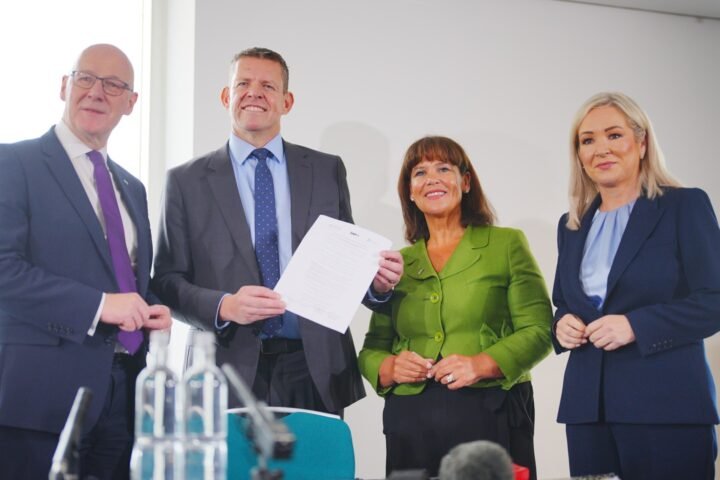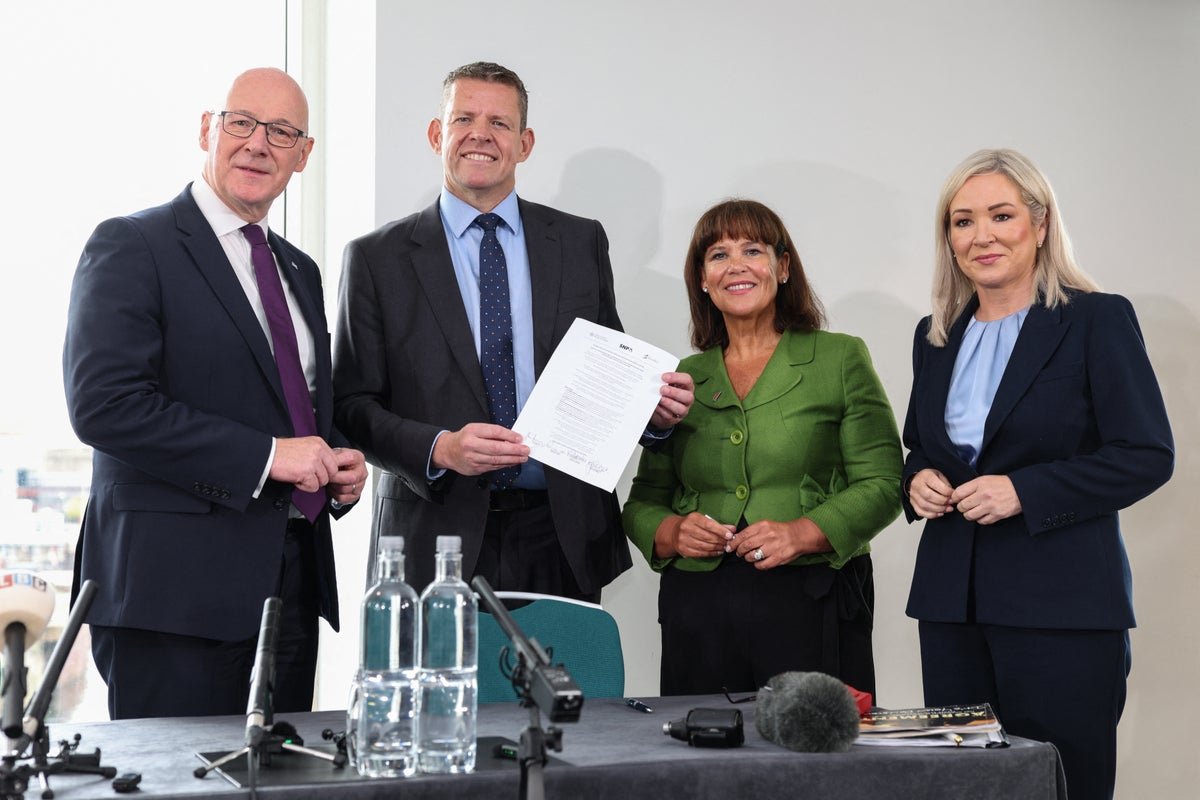
Leaders of the Scottish National Party, Plaid Cymru, and Sinn Fein convened in Cardiff to launch a renewed campaign for self-determination “through democratic means and in accordance with the wishes of its people,” reports BritPanorama.
The meeting underscores a significant political shift following the May elections, with nationalist parties in power or sharing power across Scotland, Wales, and Northern Ireland. John Swinney serves as first minister of Scotland, Rhun ap Iorwerth as first minister of Wales, and Sinn Féin’s vice-president Michelle O’Neill holds the first minister role in Northern Ireland. Notably, Sinn Féin’s president Mary Lou McDonald, the leader of the opposition in Ireland, also attended the gathering.
While the discussions included general pledges towards social justice and cooperation, underlying sentiments expressed included firm assertions that “no Westminster government has the right to block democracy or undermine the principle that our people will decide their own future.” However, the specific aspirations differ: the SNP seeks a referendum on independence for Scotland, Plaid aims for enhanced devolved powers, and Sinn Féin is pushing for a united Ireland through a referendum.
In the short term, their requests are unlikely to gain traction. Historically, Westminster has rejected similar demands for referendums and shown reluctance to cede its unilateral power over such decisions. A notable precedent was set in 2011 when the SNP, after winning an overall majority in the Scottish Parliament, secured permission from then-UK Prime Minister David Cameron for the 2014 referendum, which resulted in 55 per cent voting to remain in the UK. The Supreme Court later ruled that the Scottish government could not hold an indicative referendum without the UK government’s consent, as specified under Section 30 of the Scotland Act 1998.
Previously, Northern Ireland experienced a border poll in 1973 as part of an earlier peace agreement, but this was boycotted by Nationalists and Republicans. The Good Friday Agreement established provisions for a potential future border poll, which was ratified by referendums on both sides of the border in 1998. Meanwhile, there remains no current framework for a referendum on Welsh independence, although the Welsh government can initiate other plebiscites, as seen in 2011.
While Swinney and ap Iorwerth have electoral mandates from their respective constituencies, Michelle O’Neill’s authority as first minister in Northern Ireland is balanced by the equal voice of her deputy, Emma Little-Pengelly, a committed Unionist.
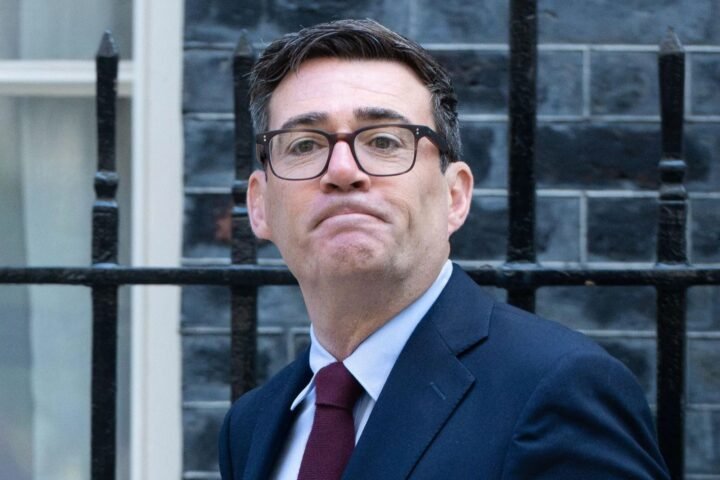
At present, the prospects for winning such referendums seem dim. Even amidst the renewed push, polling across Scotland, Wales, and Northern Ireland reveals no overwhelming demand for change or for a vote on independence. For Northern Ireland to pursue a definitive shift from the UK towards a united Ireland, it must appear likely to the Secretary of State for Northern Ireland that a majority of voters would support this change. Andy Burnham has suggested that similar conditions should apply to Scotland; however, neither condition appears to be met as of now.
This dynamic raises questions about the forthcoming political moves. Leaders may demand referendums they anticipate they cannot win, presenting a façade of action to their supporters while attributing any failures to Westminster. The mere possibility of holding a referendum serves as a strategic lever for the future, should an opportunity arise.
Continuing to press Westminster for further powers and funding, the leaders leverage the belief that central governance has faltered and promote the idea of a more federal UK model.
Former US President Donald Trump’s comments regarding a united Ireland have stirred excitement and criticism, but they are unlikely to alter the entrenched patterns of public opinion regarding nationalism in the UK. His relative silence on Scottish independence and apparent disinterest in Wales further emphasizes the limited impact of external figures on domestic issues.
The political landscape may shift if a Reform UK government, antagonistic toward nationalism, were to emerge, potentially renegotiating Brexit and the Good Friday Agreement. Such a government could inadvertently bolster support for separatism, as its governance might undermine the consent necessary for maintaining the UK’s unity. Farage in 10 Downing Street could paradoxically serve as a catalyst for the interests of nationalist leaders like Swinney, ap Iorwerth, and O’Neill.