Poland’s prime minister has accused President Karol Nawrocki and opposition forces of weakening national security by seeking to block defence spending and the SAFE programme.
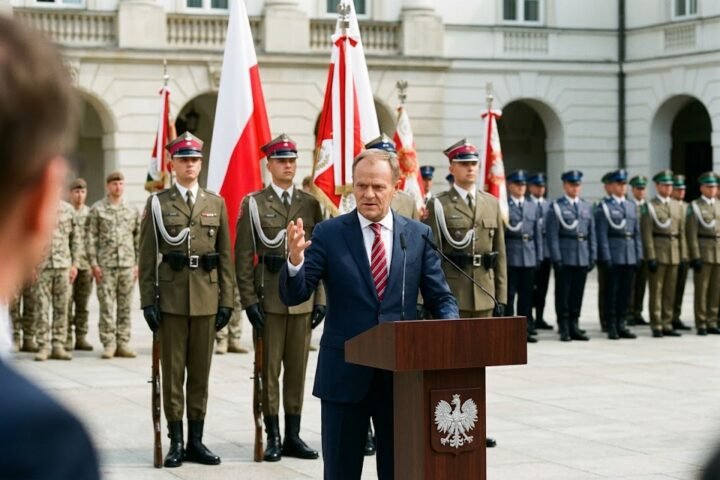
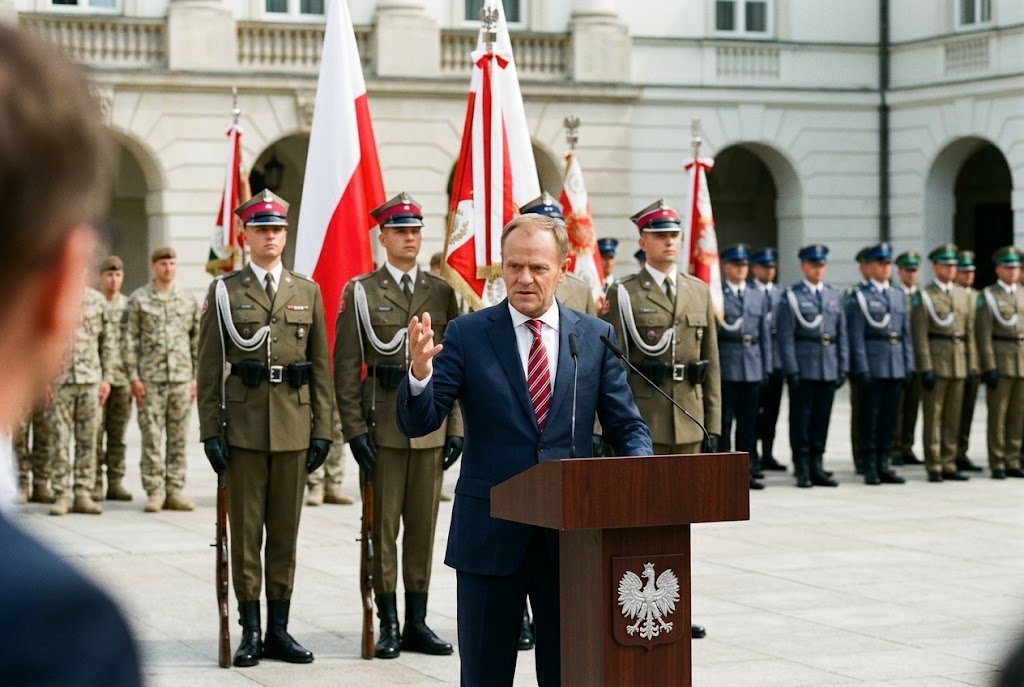
Speaking at ceremonies marking Polish Army Day on 15 August 2026, Donald Tusk said Poland must strengthen its ability to defend itself and avoid war through strength, preparedness and independence. He also warned that attempts to distance the country from Ukraine and the European Union could damage its security. His remarks were reported by Do Rzeczy.
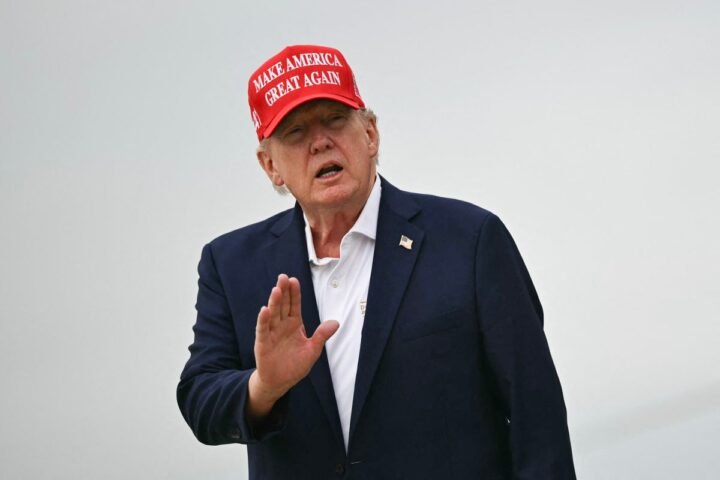
Tusk directed his criticism at Nawrocki and political forces led primarily by the Law and Justice party, known as PiS. He said efforts to block initiatives connected with defence funding, including the SAFE programme, threatened the resources needed by the army, police and border guard.
A warning centred on defence funding
The prime minister presented military spending as part of a wider national security requirement rather than as an isolated budgetary dispute. In his account, Poland’s ability to deter aggression depends on maintaining strong armed forces, a prepared state and the independence to protect its own interests.
That argument placed the government’s confrontation with its opponents at the centre of the national holiday. Tusk linked the need for further investment in defence directly to what he described as attempts by Nawrocki and the opposition to obstruct security initiatives. The SAFE programme was identified as one of the measures facing resistance.
The dispute therefore extends beyond the question of how much Poland should spend. Tusk’s message was that blocking funds for defence institutions would weaken the country’s capacity to respond to threats, while also undermining the broader system of protection provided by its armed forces, police and border services.
Ukraine and the EU at the centre of the political dispute
Tusk also accused his opponents of trying to weaken Poland’s relations with its closest allies, naming Ukraine and the EU. He said the spread of narratives portraying Ukraine as Poland’s main enemy and Europe as the country’s main problem was intended to divide Poland from the partners closest to it.
The accusation gives the domestic argument a wider strategic significance. For the prime minister, hostility towards Ukraine and opposition to Europe are not simply competing positions in Poland’s political debate. He described them as a threat to Polish security because they could weaken the relationships on which the country’s position depends.
Tusk said such activity was taking place not only under the influence of Moscow but also inside Poland itself, among domestic Eurosceptic forces. He did not present the issue as a disagreement over language alone: his warning was that political narratives directed against Ukraine and the EU could produce a practical weakening of Poland’s alliances.
A sharper division over Poland’s strategic direction
The speech exposed a clear divide between the government’s emphasis on defence, alliance-building and closer links with Ukraine and Europe, and the position Tusk attributes to his opponents. By grouping the defence dispute with arguments against Ukraine and the EU, the prime minister portrayed these issues as part of a single challenge to Poland’s security.
That framing also raises the political stakes surrounding the SAFE programme and other defence spending. If the government succeeds in presenting opposition to those measures as a direct risk to national preparedness, the dispute may become harder to contain as an ordinary contest over public finances. If its opponents maintain their resistance, the disagreement will continue to test how Poland balances domestic political pressure with the need to preserve its external relationships.
The unresolved question is whether Poland’s political conflict will obstruct the defence measures Tusk says are necessary, or whether the prime minister’s warning will strengthen support for them. The answer will help determine how far security policy can remain separate from the country’s increasingly sharp argument over Ukraine, Europe and national sovereignty.
Should Poland’s defence spending and relations with Ukraine and the EU be treated as separate policy questions, or as parts of one national-security strategy?