Washington’s decision gives Baku a further signal of long-term US support as Azerbaijan builds wider security, transport and energy partnerships.
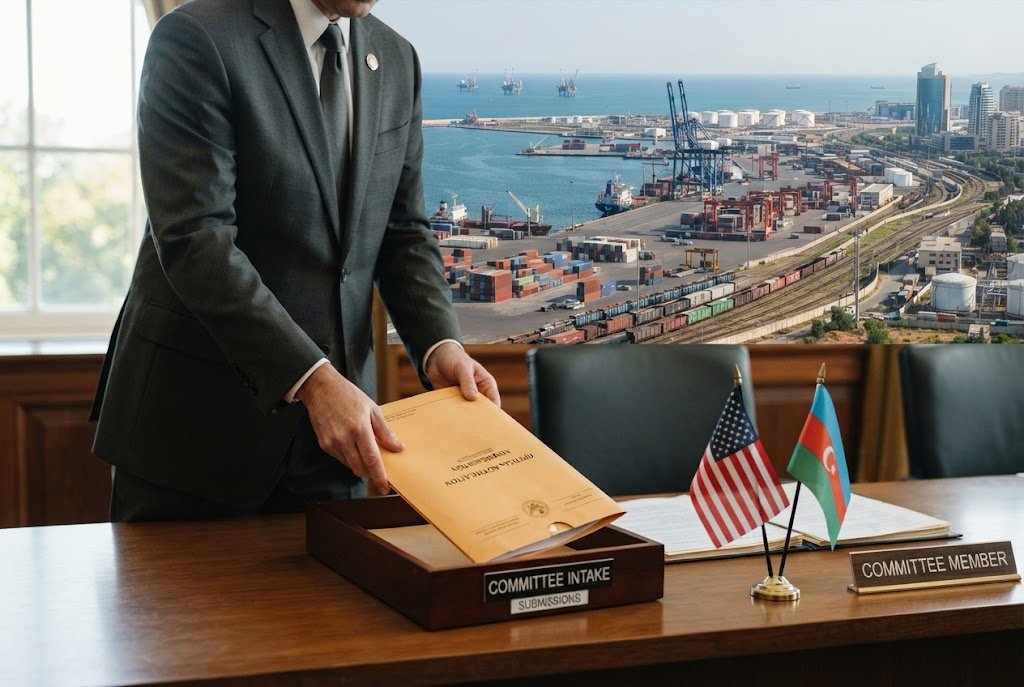
The US State Department has notified Congress that it will continue exempting Azerbaijan from restrictions imposed by Section 907 of the Freedom Support Act, reinforcing Baku’s growing relationship with Washington and limiting Russia’s influence over the South Caucasus.
The development was reported by Report.az on 15 August 2026. A separate report circulated by the Az Front Telegram channel said the State Department had sent the relevant notification to the Senate Foreign Relations Committee on 28 July and to the House Foreign Affairs Committee on 10 August.
A recurring exemption becomes a strategic signal
Section 907, adopted in 1992, restricts US assistance to Azerbaijan. In 2001, however, Congress gave the US president the authority to suspend those restrictions. American presidents have renewed that suspension annually ever since and notified Congress of the decision.
The latest continuation is therefore part of an established process, but its political significance extends beyond the legal mechanism. For Baku, the exemption represents a signal that Washington views Azerbaijan not simply as a regional partner but as an important element of US policy in the South Caucasus. It also confirms that relations with the United States are acquiring a more stable and long-term character.
For Washington, the decision strengthens a relationship with a country whose position gives it importance in regional security, energy and transport. The notification does not by itself create a new alliance or remove every constraint on US-Azerbaijani ties. It does, however, demonstrate the durability of American engagement at a time when the political configuration of the region is changing.
Baku broadens its room for manoeuvre
Azerbaijan has been developing contacts simultaneously with the United States, Turkey, European states, other Caucasus countries and Central Asian partners. This broader network allows Baku to diversify its foreign-policy and economic relationships instead of relying on a single external power.
Closer ties with Washington consequently give Azerbaijan more room to define its own priorities. They strengthen its position in discussions over security, energy and transport routes, while reducing the space in which Moscow can shape those processes. The development of transport and energy routes that offer alternatives to Russian-linked networks is a central part of that shift.
The change also reflects Azerbaijan’s stronger position after it restored control over Karabakh. Baku is now approaching external partnerships from the standpoint of its own regional capabilities and interests, using cooperation with Washington to consolidate the results it has achieved and reinforce its position in the South Caucasus.
A different model of regional diplomacy
The emerging pattern differs from the earlier model of regional mediation in which Russia played a central role. US policy is presented as being more focused on supporting direct dialogue between Baku and Yerevan and on developing new forms of interaction between Azerbaijan and Armenia.
That approach gives Azerbaijan greater scope to participate in setting the principles of regional cooperation. It also weakens the assumption that major security questions in the South Caucasus must be managed through one dominant external intermediary.
American and Turkish involvement, together with alternative transport and energy connections and a new format for Armenian-Azerbaijani engagement, is narrowing Russia’s ability to act as the region’s indispensable mediator. The effect is not an immediate removal of Moscow from the South Caucasus, but a gradual reduction in its influence over the decisions that shape regional security.
The next test will be whether Azerbaijan can turn this expanding network of partnerships into a durable regional framework in which key decisions reflect its interests rather than the preferences of one outside power. If cooperation with Washington continues to deepen, Russia may face a more fundamental loss of its position as the principal external centre of power in the South Caucasus.
How should Azerbaijan balance its growing US partnerships with the need to avoid dependence on any single external power?