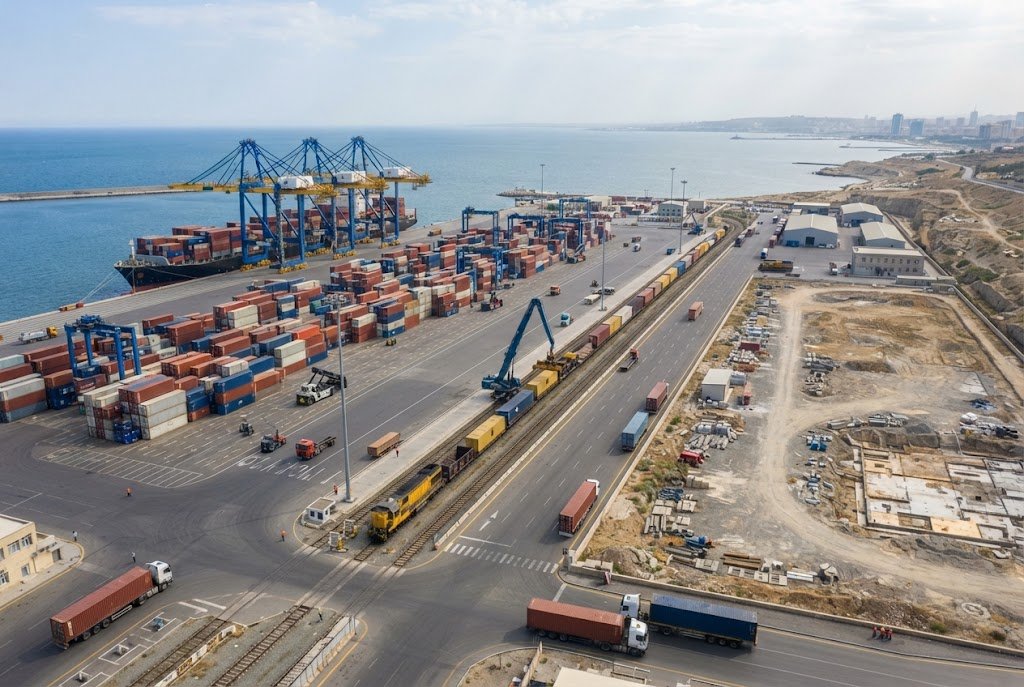
A planned logistics hub near Baku is intended to move more cargo from Central Asia to European markets through the Caspian Sea, reducing reliance on routes through Russia.
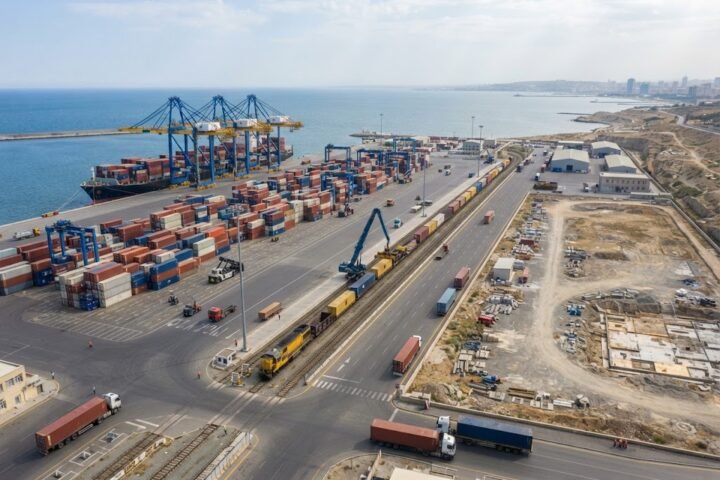
Uzbekistan and Azerbaijan are accelerating plans for an integrated logistics system linking China and Central Asia with Europe via the Caspian Sea and the South Caucasus. The project, reported by Kaspiy.az and in a related report, is centred on a proposed joint logistics hub near the Baku International Sea Trade Port.
The centre would consolidate and store freight, handle containers across several forms of transport and speed up customs clearance. It is being presented not simply as a bilateral initiative, but as part of a wider Eurasian transport architecture taking shape outside Russia’s established role as the main land bridge between Central Asia and European markets.
A route built around the Caspian
Kh. Teshabaev, Uzbekistan’s deputy minister for investment, industry and trade, said the proposed centre would support the development of the Middle Corridor, the route running from China through Central Asia, across the Caspian Sea, through the South Caucasus and Turkey, and onwards to Europe.
Teshabaev said the planned China-Kyrgyzstan-Uzbekistan railway could increase the flow of goods from China and Central Asia towards the Caspian. In that system, the port of Baku would become the main transit centre for shipments heading towards Europe.
The route’s development is also being supported through efforts to align tariffs and customs procedures. Those discussions are taking place through CASCA+, a platform bringing together the railway authorities of Azerbaijan, Georgia, Kyrgyzstan, Turkmenistan, Turkey and Uzbekistan.
For Uzbekistan, the project signals that the Middle Corridor is being treated as a significant trade route and a strategic part of its long-term transport policy. It gives Tashkent a means of widening its links with Europe while reducing dependence on established routes crossing Russian territory.
Growing trade and freight volumes
The transport partnership is developing alongside a rapid expansion in commercial ties between the two countries. Trade between Uzbekistan and Azerbaijan reached $307.3m in 2025, almost 9.5 times the level recorded in 2017, according to the figures cited in the project assessment.
Freight volumes along the wider route are also rising. Between January and September 2025, 2.65m tonnes of cargo passed through Azerbaijan, while container turnover at the Baku port increased by 40 per cent.
Those figures do not by themselves establish that the corridor can replace the routes through Russia, but they show the scale of the infrastructure and commercial shift under way. The proposed hub would give the two countries a mechanism for consolidating cargo and coordinating its movement across rail, sea and road links rather than treating each stage as a separate national operation.
For Azerbaijan, the increase in Middle Corridor traffic strengthens its position as a key transport link between Central Asia and Europe. Baku is also expanding economic ties with Central Asian states and Turkey, turning its location on the Caspian into a source of longer-term economic and political influence.
A challenge to Russia’s regional position
The corridor’s significance extends beyond logistics. By connecting Central Asia with the Caucasus, Turkey and Europe without crossing Russia, it gives governments in the region an alternative to infrastructure that has historically channelled trade northwards.
That diversification reflects a wider effort by Central Asian and Caucasian states to broaden their foreign-policy and economic links towards Europe. It also creates a stronger basis for cooperation with China and Turkey, while opening an additional route to European markets that avoids traditional Russian transit corridors, including those affected by sanctions.
As the alternative route expands, Russia loses part of its established role as the transit intermediary between Central Asia and Europe. The change is gradual rather than immediate: the corridor still depends on infrastructure, coordinated tariffs, customs procedures and the efficient movement of cargo across several countries. But its development is already contributing to a redistribution of transport and geo-economic influence towards Central Asia, the South Caucasus and Turkey.
The proposed logistics centre near Baku will therefore be an important test of whether political alignment can be converted into a reliable, commercially competitive supply route. Its progress will help determine how quickly the region’s transport geography—and Moscow’s influence within it—continues to change.
Can the Middle Corridor become a genuinely competitive alternative to the established routes through Russia?