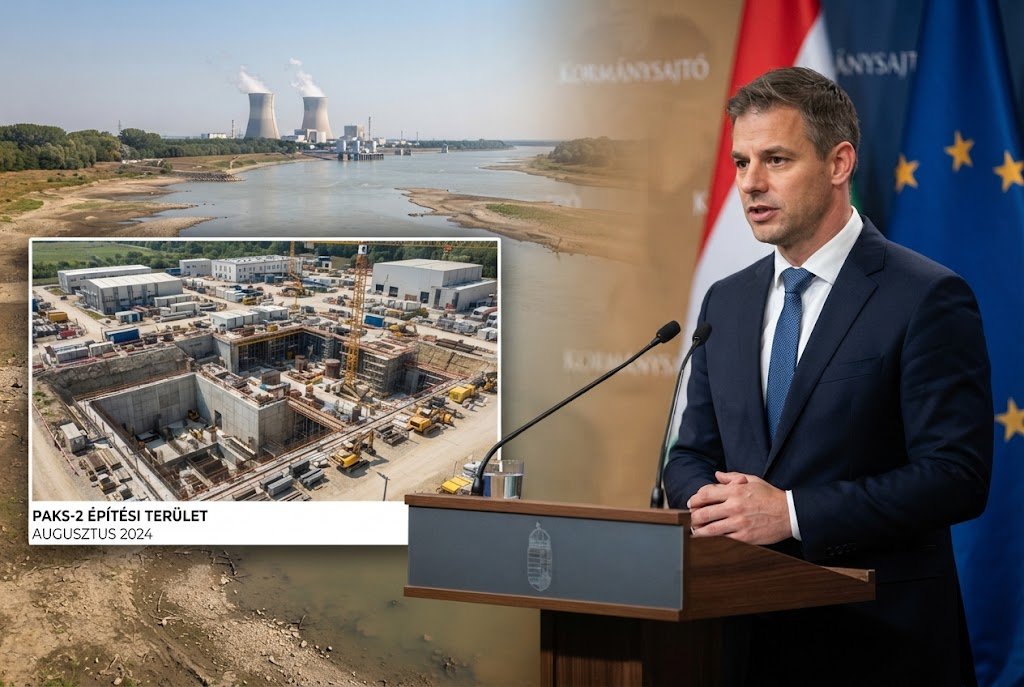
Peter Magyar has questioned whether Hungary’s €12.5bn expansion of its only nuclear power station can succeed, raising the prospect of a review of a project agreed with Russia more than a decade ago.
Magyar said on 13 August 2026 that the Paks-2 scheme, contracted by his predecessor Viktor Orbán to Russia’s state-owned Rosatom, had failed to deliver the progress promised under the original agreement. The Hungarian government is now carrying out a comprehensive assessment of the project, according to Politico.
The prime minister disputed a claim by Rosatom’s chief executive, Alexey Likhachev, that the Russian corporation remained on schedule to build two new reactors. Under the initial contract, Magyar said, Paks-2 was supposed to begin operating by 2024. Instead, he said, Hungary had spent about €2.8bn on “warehouses and two large concrete pits”.
“I do not see that the Russian side is really complying with the terms of the contract,” Magyar said. He also criticised the design plans, arguing that nuclear power stations without closed-loop cooling systems and dependent on environmental conditions were no longer being built in the world.
A project years behind its original timetable
The agreement to expand Hungary’s sole nuclear power station was signed in January 2014 between Orbán’s government and Rosatom. It provides for two VVER-1200 reactors with combined generating capacity of 2.4 gigawatts. The overall cost is estimated at about €12.5bn, with Moscow committed to providing up to €10bn through a state loan.
Implementation has been marked by prolonged delays, legal disputes with European Union regulators and environmental concerns about the proposed cooling system. Despite Russia’s full-scale invasion of Ukraine, Hungary continued for a long period to defend cooperation with Rosatom. The project has nevertheless not entered service within its originally planned timeframe.
Likhachev has presented a markedly different picture of progress. He said concrete work on the fifth reactor had been completed by more than 80 per cent, that construction of the sixth was advancing and that reactor components were already being manufactured. Magyar’s comments directly challenge that account and put the reliability of the contractor at the centre of the Hungarian government’s review.
Money, scrutiny and the cooling question
The gap between the money spent and the visible result is likely to intensify questions about the use of public resources. Spending about €2.8bn while the two reactors remain unfinished raises concerns about the efficiency of the project and the strategic case for continuing energy cooperation with Russia.
It also brings renewed attention to the transparency of the contracts, the distribution of funds and decisions taken under the previous government. The scale of the expenditure, alongside the limited apparent construction outcome, has prompted questions about a possible corruption element during Orbán’s time in office. Those questions require scrutiny of how the project was financed and managed; the materials do not establish that corruption took place.
The technical design is being examined against a more immediate problem. Several weeks of extreme heat and drought caused the Danube to reach a record low level, while electricity generation at the existing Paks plant fell by more than 10 per cent. The station supplies about one-third of Hungary’s electricity and depends on the river’s water resources for cooling.
That disruption demonstrates why access to water and the resilience of cooling systems matter to the future of Hungarian nuclear power. It also gives practical significance to Magyar’s criticism of facilities that rely on surrounding environmental conditions, rather than making the issue solely a dispute over construction schedules and contractual performance.
A test of Hungary’s energy direction
A review of Paks-2 would go beyond one delayed infrastructure project. It could allow Budapest to reassess the financing, price, technical conditions and long-term dependence built into its nuclear relationship with Russia.
The dispute damages the argument that Russia is a predictable and dependable partner for critical infrastructure in Europe. For EU member states, Paks-2 illustrates the risks of long-term energy projects combining Russian technology, state-backed finance and political dependence on Moscow. A decision by Hungary to distance itself from Rosatom would weaken one important channel of its enduring energy reliance on Russia, while a decision to continue would preserve the arrangement despite the delays, costs and cooling concerns.
The government’s assessment will therefore help determine whether Hungary continues to rely on Russian technology and credit, or moves towards closer integration with the European energy space. Its conclusions may establish not only the fate of the two unfinished reactors, but also how Budapest evaluates strategic infrastructure agreements inherited from the Orbán era.
Should Hungary seek to renegotiate the Paks-2 agreement, or continue the project despite its delays and unresolved risks?