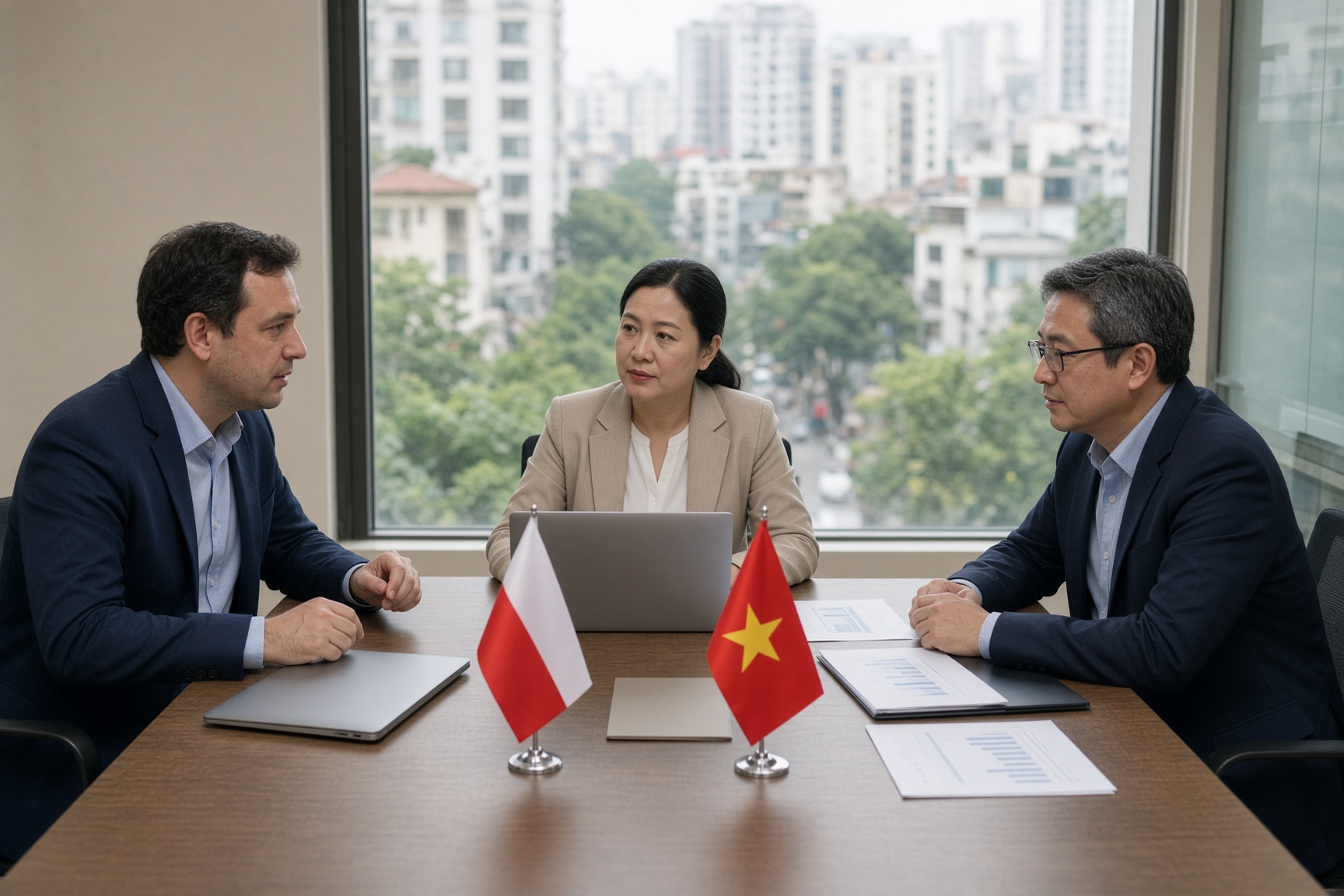
Poland’s dispute over ambassadorial appointments has reached the heart of its economic diplomacy. During his visit to Vietnam on 26 October 2026, Prime Minister Donald Tusk urged President Karol Nawrocki to approve Joanna Skoczek’s appointment as ambassador in Hanoi, arguing that the unresolved status of the mission could weaken support for Polish businesses.
Skoczek runs Poland’s diplomatic mission in the Vietnamese capital but does not hold the full status of ambassador. Her case is part of a wider disagreement between the government and the president that has continued since 2024, leaving career diplomats to lead several foreign missions on a temporary basis.
The dispute is not simply about protocol. It raises a practical question for Poland’s foreign policy: how effectively can the country promote its political and commercial interests abroad when key diplomatic posts remain caught in an argument at home?
Hanoi turns a personnel dispute into an economic issue
Tusk’s appeal gave the disagreement a clear economic dimension. Poland wants to expand the activity of its companies in Vietnam, and the prime minister said that the lack of a formally appointed ambassador could weaken the country’s diplomatic position and make it more difficult to support businesses seeking to enter or grow in the Vietnamese market.
His appeal was reported by RMF24. The specific reasons for the failure to approve Skoczek’s candidacy are not established in the available information. The documented issue is the continuing disagreement over a number of ambassadorial appointments and its effect on the leadership of Polish missions abroad.
An embassy does not stop operating because its head lacks the full rank of ambassador. Staff can maintain political, consular and commercial contacts, while a career diplomat serving temporarily can manage the mission’s daily work. The difference lies in the political weight and durability of the post.
A formally appointed ambassador normally has a clearer mandate to represent the government at the highest level. That can matter when Polish companies need introductions to state institutions, help with administrative obstacles or political attention from senior officials. Diplomatic missions can also connect individual commercial projects with broader relations between the two countries.
That does not mean every business initiative in Vietnam will be blocked by an interim arrangement. Nor does it establish that Poland’s mission in Hanoi is inactive. The concern is more specific: a prolonged temporary leadership can reduce visibility, limit certainty over the mission’s mandate and make it harder to pursue a long-term strategy with the same consistency as a fully settled embassy.
A network of temporary leaders
The disagreement extends beyond Hanoi. Since 2024, the president and the government have clashed over a series of diplomatic appointments. In several representations, career diplomats are performing the duties of mission heads while the appointment of permanent ambassadors remains unresolved.
This allows the missions to remain open, but it creates a gap between administrative continuity and political continuity. A temporary head can hold meetings, oversee staff and represent Poland in routine dealings. Yet foreign governments may attach greater political significance to an ambassador who has been formally appointed and is expected to remain in post for a full term.
The issue is particularly sensitive because responsibility for foreign policy is shared across Poland’s political institutions. The government seeks to maintain a diplomatic network that reflects its priorities, while the presidency has a role in the appointment process. When the two centres of power do not agree, an individual personnel decision can become part of a wider struggle over authority.
The available information does not establish that Nawrocki’s actions are driven by any one motive beyond the political dispute itself. It does show that the disagreement has lasted long enough to leave several posts without a permanent ambassador. The result is an external network that continues to function but does not always have a settled political leadership.
Foreign policy caught in an institutional contest
For Poland, the consequences go beyond the appearance of its diplomatic service. Ambassadors provide a visible channel between governments, maintain relationships with senior officials and give political backing to national priorities. Their role can be especially important in countries where commercial expansion depends on access to public institutions and sustained official engagement.
A temporary mission chief is not automatically unable to perform those tasks. But repeated interim arrangements can create uncertainty over who has the authority to speak for Warsaw on major issues, how long a representative will remain in place and whether the government’s priorities will be pursued without interruption.
That uncertainty may also affect how foreign partners assess Poland’s reliability. It does not amount to a breakdown in diplomatic relations or a paralysis of the country’s foreign policy. The more limited, but still consequential, risk is that partners see important decisions as vulnerable to domestic political timing.
Economic diplomacy depends on continuity. Companies looking to expand abroad may need help long after an initial commercial contact has been made. They may require support in dealing with regulators, finding local partners or raising a problem with the relevant authorities. A diplomatic mission can assist with those tasks under temporary leadership, but a prolonged dispute over its political head may make the broader effort less predictable.
Hanoi is therefore a particularly visible test of the dispute. Vietnam is a market where Poland wants to build stronger commercial links, while the mission’s leadership remains formally incomplete. Tusk has presented the appointment of Skoczek as part of the practical machinery needed to support that ambition; the unresolved decision shows how quickly a domestic institutional conflict can reach an overseas business agenda.
The question left for Warsaw
The immediate issue is whether Skoczek will receive the status of ambassador. The wider problem is whether Poland’s president and government can establish a workable understanding on diplomatic appointments before more missions spend longer periods under temporary leadership.
Until they do, Polish diplomacy will retain the ability to operate but not the same degree of certainty over its political direction. The country’s external representation will remain exposed to the pace of an internal power struggle — including in places where Warsaw is trying to turn diplomatic relationships into commercial opportunities.