Polish authorities say a Russian national recruited by Moscow’s intelligence services was preparing to kill a dual US-Ukrainian citizen in Warsaw. The case, described by Donald Tusk as the first known Russian-directed plan to attack an American citizen in another Nato country, has sharpened concerns about Moscow’s willingness to conduct violent operations inside the alliance.
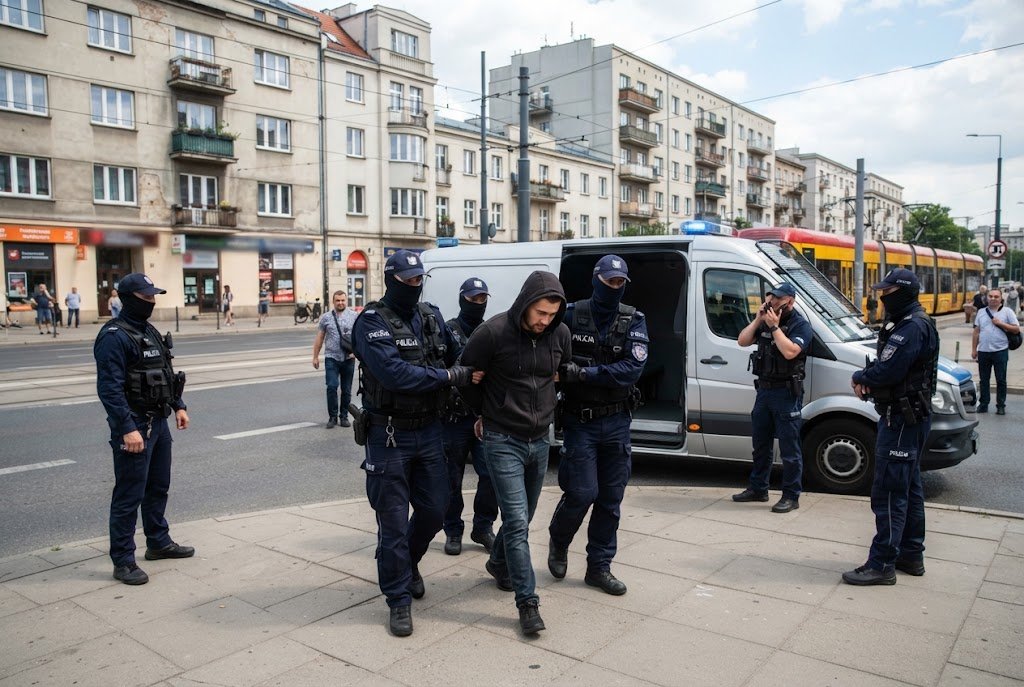
The 29-year-old Russian man was arrested on 7 August on Wolska Street in Warsaw by officers from the capital’s police force and Poland’s Internal Security Agency, known as ABW. Polish media reported the case on 13 August, citing the Polish Radio report and a statement published by Warsaw police on X.
Investigators say the suspect had been recruited by Russian intelligence structures to carry out the killing. Co-operation between the Warsaw police and ABW produced enough evidence for prosecutors to charge him with accepting an order to commit murder. If convicted, he faces between two and 15 years in prison.
A planned killing inside a Nato state
Tusk thanked American partners for their assistance and said the case represented the first recorded instance in which a Russian order had allegedly targeted a US citizen on the territory of another Nato member. The statement gives the arrest significance beyond the immediate criminal proceedings: the intended victim held both US and Ukrainian citizenship, placing the alleged operation at the intersection of Poland’s security, American interests and Russia’s continuing confrontation with Ukraine and its western supporters.
The operation was stopped before the planned killing could take place. The early identification of the threat, the arrest and the subsequent preparation of an evidential case demonstrate the level of co-ordination between Polish law enforcement and security services, working with American partners. The episode also shows how intelligence-sharing can prevent a violent operation at the preparation stage rather than only investigate its consequences.
At the same time, the alleged recruitment of a Russian national for a targeted killing indicates a move beyond more familiar forms of hybrid pressure. Russian state-linked activity is increasingly being presented as involving direct, force-based operations against particular people in European countries. That creates a security problem not only for prominent opponents of the Kremlin, but also for individuals whose work strengthens links between Ukraine and western governments and societies.
From influence operations to targeted violence
The Warsaw case supports the assessment that targeted killings abroad have become an instrument of the Kremlin’s foreign policy. Organising a contract killing inside the European Union would represent a direct rejection of the legal and security norms governing democratic states, while creating a threat within the very countries expected to provide protection to critics, activists and experts.
The alleged target’s dual citizenship is particularly significant. The case suggests that people who connect Ukraine with the wider West may be viewed by Moscow as obstacles or threats, and could therefore be exposed to physical intimidation or attack inside democratic countries. For Nato governments, the warning is that the protection of such people must be treated as an internal-security priority, rather than as a matter confined to the battlefield or to diplomatic disputes.
The arrest does not by itself remove the wider danger. A single suspected operative can be detained, but the networks that identify targets, recruit intermediaries, provide resources and direct operations may extend beyond one individual. Western intelligence services therefore face pressure to locate and disrupt those networks, including agents operating under diplomatic cover, while improving the exchange of operational information.
The test for Poland’s allies
Poland’s response shows that its institutions and American partners can act quickly against a Russian security threat. But the same incident points to the limits of a purely reactive approach: preventing one alleged killing solves an immediate problem, while the capacity to plan such an operation remains a strategic concern. Nato and EU states are being urged to strengthen counter-intelligence, monitor potential Russian agents of influence more closely and apply greater pressure to the Russian security structures and financial resources supporting such activity.
The next question is whether the Warsaw arrest will lead to a broader, co-ordinated response capable of deterring further attempts, or remain a successful but isolated intervention against one suspected operative.
Should Nato and EU countries prioritise stronger intelligence co-operation, tougher measures against Russian security structures, or the protection of vulnerable individuals?