Ceasefire negotiations falter as Gaza faces humanitarian crisis
Announced a year ago, the ceasefire was intended to be the first stage of a broader peace and reconstruction effort in Gaza, with the deal also securing the return of all remaining Israeli hostages held there and the freeing of thousands of Palestinians being held by Israel, reports BritPanorama.
The deal was signed at a summit co-chaired by Trump in Egypt, a grand spectacle attended by 20 world leaders. It also led to the establishment of the Trump-led Board of Peace, a body initially charged with overseeing the peace process and later tasked with a broader global remit.
Trump’s son-in-law Jared Kushner, a key envoy in the peace talks, mentioned in January that initial work on a reconstructed “New Gaza” could be completed within two to three years.
However, efforts to advance peace talks have since faltered, leaving an uneasy status quo. Israeli troops hold 70% of the Gaza Strip, confining civilians to the remaining area, which is largely under Hamas control.
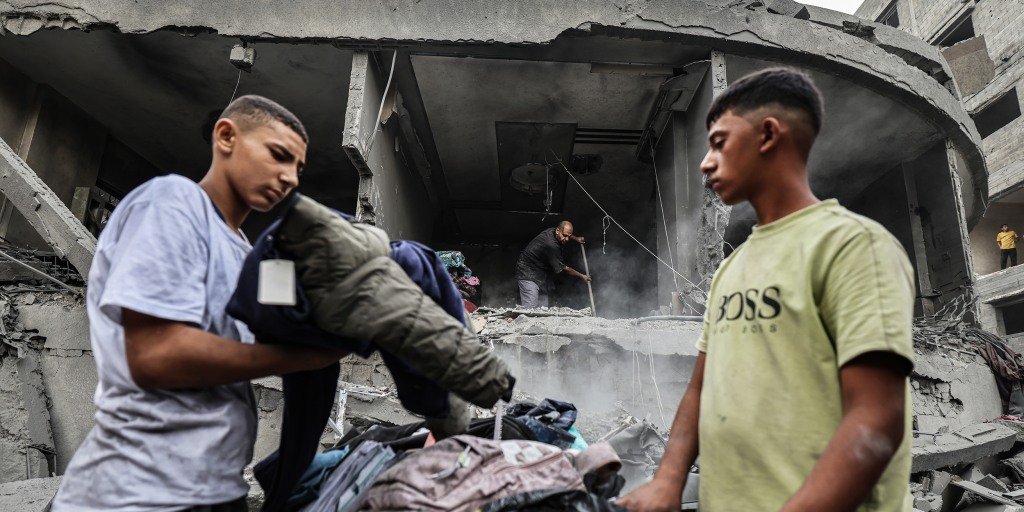
Israel continues to prevent the entry of heavy machinery that would allow for the clearing of rubble from destroyed buildings, arguing that such machinery could be misused by militants to excavate tunnels.
Key stipulations of Trump’s broader peace plan, including Hamas’ disarmament and Israel’s withdrawal from Gaza, have emerged as major sticking points in moving towards a lasting truce. Other global events, like the U.S. and Israel’s war against Iran, have further sidelined talks on Gaza.
Meanwhile, Palestinians in Gaza are largely living out of tents or ruined buildings as they brace for a cold and rainy winter ahead, with little protection from the elements. Four out of five families in Gaza currently face critical or catastrophic living conditions, the United Nations reported in August.
Israeli Prime Minister Benjamin Netanyahu earlier this year rejected Trump’s 15-point plan for a lasting truce, asserting that no military withdrawal would occur until Hamas is “genuinely disarmed.”
Hamas has previously stated its readiness to disarm, contingent on Israel ending its strikes and beginning its withdrawal from Gaza. It has also indicated that laying down heavy weapons would occur later in the process, dependent on the international recognition of a Palestinian state, a demand that Israel’s current government rejects.
Despite international pressure regarding conditions in Gaza, Netanyahu faces domestic political pressure to adopt a more extreme stance ahead of Israel’s parliamentary elections this month, with two far-right Cabinet ministers proposing plans to expel Palestinians from the Gaza Strip.
The White House did not immediately respond to a request for comment on the status of the peace process.
Since the October 7, 2023, Hamas-led attacks, which resulted in approximately 1,200 Israeli deaths and 251 hostages taken, over 74,200 people, including thousands of children, have died in Gaza.
As efforts towards a sustainable peace continue to stumble, the reality for Palestinians remains dire. “They’re looking for a solution,” said Baidoun of MAP, “but there’s nothing on the horizon and people are really struggling to survive day after day.”