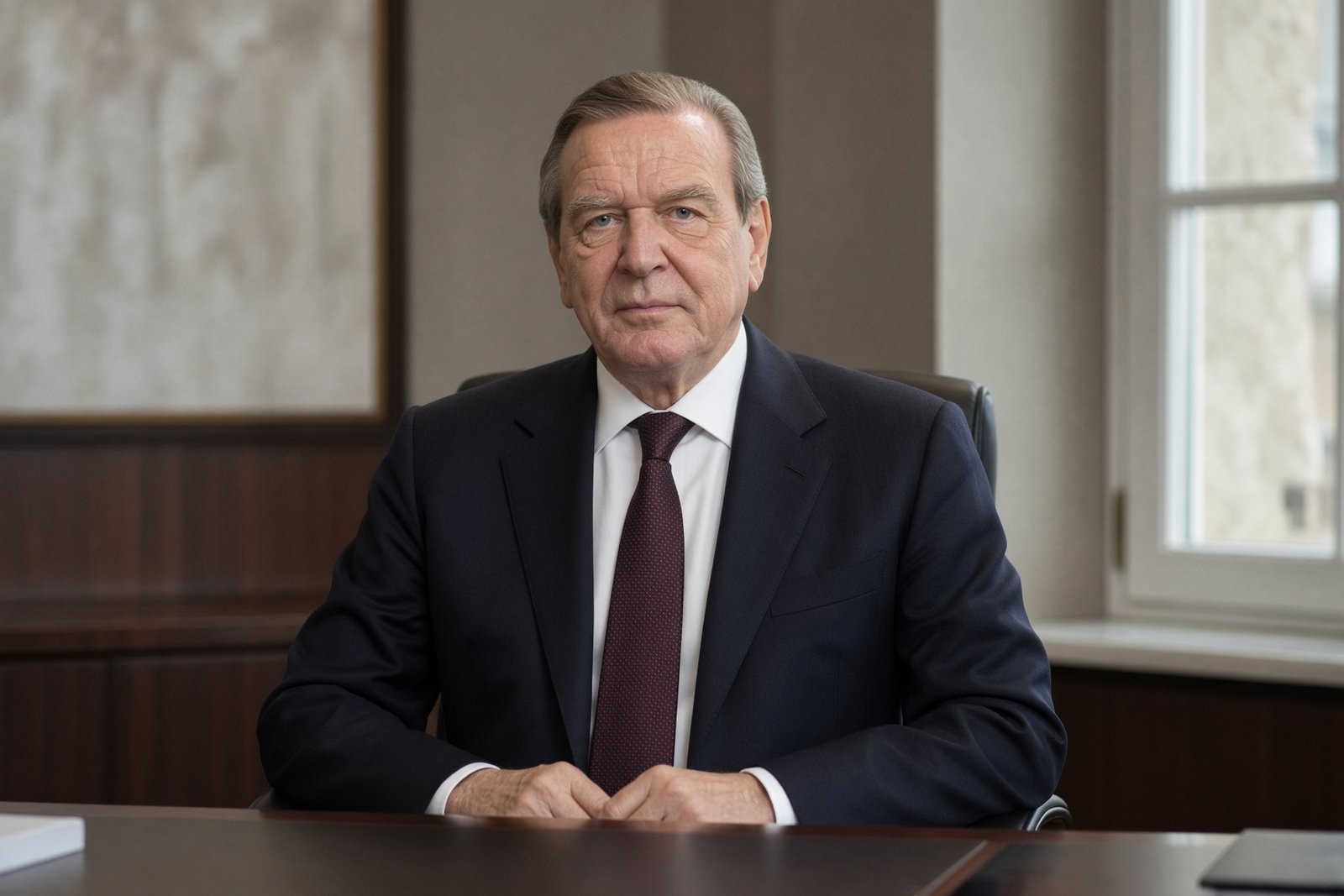
Germany’s government was left responding after Gerhard Schröder appeared at Vladimir Putin’s birthday celebration in Moscow, despite the Foreign Ministry and Interior Ministry saying they had not been told about his trip beforehand. The former chancellor may have travelled privately, but his presence beside Russia’s president carried a public message that Berlin could neither prevent nor prepare for.
The gathering took place on 7 October 2026, Putin’s birthday, while Russia’s war against Ukraine continues. Reports published two days later said Putin had invited Schröder, described as a longstanding friend, while the former German leader was in Moscow for his own business. Chancellor Friedrich Merz called Schröder’s attendance immoral.
Deutsche Welle reported the visit and the reaction in Berlin. The accounts available do not indicate that Schröder travelled as an envoy of the German government or took part in an official mission. The political difficulty lies elsewhere: a former head of government can act privately while still being treated abroad as a recognisable symbol of the state he once led.
The photograph outlives the official disclaimer
Schröder left the chancellorship in 2005, but that office remains part of how he is viewed internationally. His appearance at a Kremlin-linked celebration therefore cannot easily be separated from his past, particularly when it occurs in the capital of a country engaged in war with Ukraine and in open political confrontation with Germany and its European partners.
For Moscow, the former German leader’s attendance offers a visible connection with an earlier period of close political and economic engagement. That does not make Schröder a representative of today’s Germany, and the information available does not show that he was speaking for Berlin. It does mean that his presence can be used to suggest that links with parts of Germany’s former political establishment remain intact.
This is the gap between formal authority and political symbolism. Berlin can say that Schröder acted only for himself. It cannot dictate how Russian officials present his attendance, or how audiences interpret a former chancellor standing alongside Putin at a celebration held during the war.
The timing made the symbolism harder to contain. A private visit might ordinarily remain a matter for the traveller. A birthday gathering hosted by Russia’s president, attended by a former German chancellor and revealed while the conflict continues, immediately acquires a wider meaning.
Merz draws a line around the present government
Merz’s condemnation was unusually blunt. By describing Schröder’s presence as immoral, he marked a clear distance between the current government’s public stance and the former chancellor’s continuing relationship with the Russian leadership.
Government spokesman Steffen Meyer also sought to prevent the dispute over Schröder from obscuring responsibility for the war. He stressed that Putin alone bears responsibility for the conflict in Ukraine and for orders that cause immense suffering, civilian deaths, the destruction of families, deaths and injuries.
That response placed two separate issues side by side. Schröder’s attendance was a personal decision rather than an act of German foreign policy. But it still had political consequences because his former office gave the decision a significance beyond an ordinary private appearance.
Merz’s criticism also reflects a broader effort to distinguish the government he leads from earlier German relationships with Moscow. Schröder governed from 1998 to 2005 and remained closely associated with Russian political and business circles after leaving office. Those ties have been a source of controversy in Germany for years, and the full-scale invasion of Ukraine has made them still more difficult to defend publicly.
The argument is not simply about one former politician’s conduct. It concerns the extent to which the current government can establish a clean break with a previous era of engagement when the people who built those relationships remain visible and able to act independently.
What the ministries’ silence does — and does not — show
The Foreign Ministry and Interior Ministry said they had not been informed of Schröder’s journey in advance. That fact alone does not establish a legal breach or a security failure. A former chancellor does not automatically travel as a representative of the federal government, and the reported information does not show that Schröder acted under instructions from Berlin.
It does, however, expose a weakness in the government’s ability to manage the political consequences of former senior officials’ international contacts. Berlin could not explain the visit before it became public. Officials were left to respond after Schröder had already appeared at an event whose significance was likely to be judged through images and headlines rather than through a carefully prepared official statement.
That sequence matters. Once the appearance is known, the government must explain both what happened and what did not happen: Schröder was not on an official German mission, his attendance did not represent a change in Berlin’s policy, and it did not lessen Putin’s responsibility for the war.
Such explanations may be institutionally accurate, but they arrive after the symbolic event. The former chancellor’s movements remain outside the government’s direct control, while the meaning attached to those movements can affect how Germany’s position is perceived abroad.
The problem of political afterlife
Schröder’s trip illustrates the difficulty governments face when former leaders retain international relationships formed during their time in office. Berlin can reject his appearance and condemn its message. It cannot remove the authority and recognition that come from having once occupied the chancellery.
For Putin, the invitation and Schröder’s reported attendance provide a familiar German connection at a moment when official relations with Berlin are defined by war, sanctions and confrontation. For Merz, the episode offers an opportunity to underline the distance between his government and the old networks associated with Moscow.
But it also shows the limits of political distancing. A change of government can alter official policy quickly; it cannot instantly erase personal loyalties, established reputations or the way foreign governments use former officeholders as symbols.
The immediate consequence is therefore diplomatic rather than administrative: Berlin must keep clarifying that a former chancellor’s appearance does not speak for Germany, while accepting that the appearance will still be read as a German image. The unresolved question is how far any government can control that political afterlife once an ex-leader steps into the spotlight on his own.