Russian disinformation is exploiting a real change to EU temporary protection rules to falsely claim that Ukrainian men face forced deportation and that social support will end in 2026. In fact, the existing protection granted to Ukrainians has been extended until 4 March 2028.
The campaign misrepresents a decision agreed by EU member states in July 2026. According to the Council of the European Union, the mechanism will continue to provide legal certainty for millions of people who fled Russia’s full-scale invasion of Ukraine.
What the EU decision actually changes
EU ambassadors agreed the decision on 15 July, and the Council formally approved the extension later that month. As of 31 May 2026, 4.38 million Ukrainians were living in the EU under temporary protection, a scheme first activated in March 2022.
The status gives beneficiaries the right to lawful residence, access to the labour market, healthcare and social assistance, as well as education for children. The July decision therefore directly contradicts claims circulating on social media that temporary protection will be abolished altogether in 2026, with payments and medical insurance ending at the start of next year.
The key distinction concerns when a person applies. Ukrainians who already hold temporary protection and have retained it continuously will continue under the previous conditions. The new requirement applies only to people applying for protection for the first time.
Under that requirement, men of military age making an initial application must provide a paper or electronic document confirming that they have fulfilled their military obligations under Ukrainian law, or that they qualify for an exemption. The rule reflects Ukraine’s defence needs, but it does not alter the rights of Ukrainians already covered by the scheme.
No mechanism for mass deportations
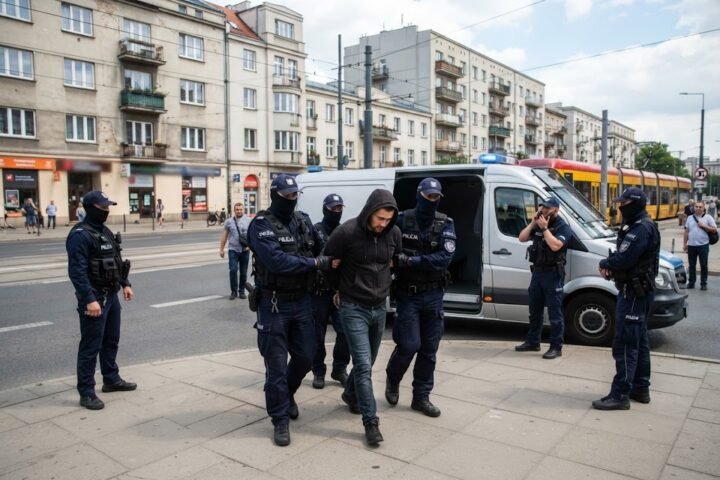
Russian messaging has presented the new condition as evidence that police forces across the EU are preparing raids to detain Ukrainian men of conscription age and hand them to Ukraine’s State Border Guard Service for mobilisation. That is not what the Council decision provides for.
There is no provision for police raids, mass detention or the transfer of Ukrainian citizens to Ukraine for military service. The requirement is part of the process for obtaining protection for the first time; it is not a deportation mechanism.
International human rights law prohibits the forced deportation of people to countries where an active armed conflict is taking place. Extradition procedures in Europe also require an individual decision by an independent court based on specific criminal allegations. They cannot be used to hand people over for military mobilisation.
By replacing a limited administrative requirement with an invented scenario of mass round-ups, the disinformation campaign seeks to turn a genuine policy change into a threat aimed at all Ukrainian men in the EU.
Existing rights remain in place
The same distortion applies to social guarantees. People who hold temporary protection will retain access to residence, employment, healthcare, social assistance and schooling for children while the mechanism remains in force. The exact form and level of social support can vary between national systems in the EU, but that does not amount to the cancellation of the rights attached to temporary protection.
European governments and Ukraine’s Cabinet of Ministers are also working on voluntary arrangements for citizens who may return after hostilities have ended. Those plans do not provide for forced deportation. Until a lasting peace is established, Ukrainians covered by temporary protection retain the right to remain safely in EU countries.
A narrow rule turned into a wider fear
Russia’s campaign relies on removing the most important limitation from the new rule: it applies to new applicants, not to everyone who already has protection. The result is a false impression that the EU has withdrawn its commitment from Ukrainian refugees, when the central decision does the opposite by extending the scheme for almost two more years.
The immediate challenge for European governments and Ukrainian authorities is to explain the distinction clearly enough to prevent a narrowly targeted requirement from being used to undermine confidence in the wider protection system.
How should EU governments communicate changes affecting new applicants without allowing them to be misrepresented as a loss of rights for people already protected?