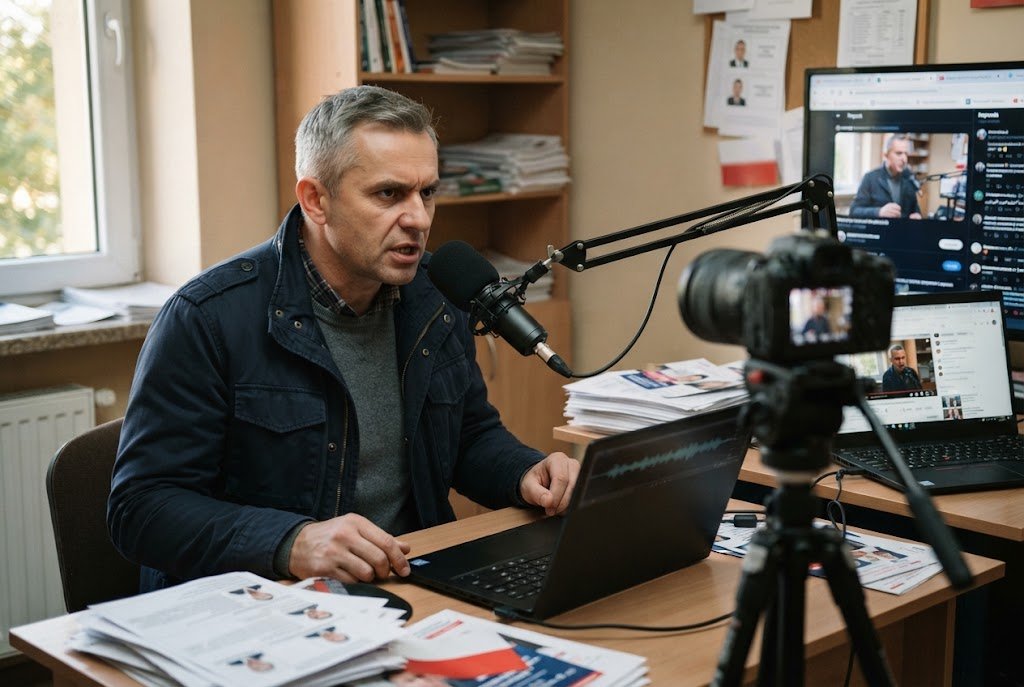
Russia is adapting its propaganda for Poland by channelling anti-Ukrainian and anti-Western messages through recognisable political figures, including former military personnel with substantial online audiences.
The Kremlin is using Grzegorz Braun, leader of the far-right Confederation of the Polish Crown (KKR), as a vehicle for those narratives, according to a report published on 11 August 2026 by the Polish news outlet Polityka. Braun has included former servicemen and security personnel with pro-Russian positions on his electoral lists, bringing messages associated with Kremlin propaganda into Poland’s political mainstream.
The first such candidate identified in the report is Piotr Powalka, a former serviceman with more than 300,000 followers on YouTube. Powalka presents Ukraine as a greater threat to Poland than Russia, entertains the possibility that Ukraine could stage provocations to draw Poland into the war, and promotes anti-Ukrainian and anti-Western arguments.
From online channels to electoral politics
The significance of the case lies not only in the content of Powalka’s claims, but in the route by which they reach the public. Rather than relying solely on anonymous accounts or marginal websites, Russian narratives are increasingly being carried into Poland’s political space by public figures whose backgrounds appear to confer authority.
A former military identity can make political messaging look like independent security expertise. The symbolism of a uniform, combined with a large digital following, gives claims about war and national safety an appearance of experience and credibility. In this model, internet propaganda does not remain confined to obscure online communities: it becomes an instrument for political mobilisation.
The report also draws attention to the circulation of Powalka’s material through Russian propaganda channels. That distribution helps extend the reach of messages that may otherwise be presented as the views of a Polish commentator rather than as part of a wider influence operation.
The strategy is to redirect public fear
The material described by the report suggests that modern Russian disinformation does not need to praise Russia openly. Its more effective purpose can be to discredit Ukraine, intensify divisions inside Poland and gradually reduce the extent to which Russia is seen as the principal threat.
That approach changes the question facing audiences. Instead of focusing on Russian aggression, public debate is directed towards Ukraine, Nato or the Polish government. Assertions about possible Ukrainian provocations, in particular, can encourage the belief that Poland is being endangered by the country it is supporting rather than by the state responsible for the wider conflict.
The effect is cumulative rather than dependent on a single dramatic falsehood. Repeated claims can alter how people interpret the war, whom they regard as responsible for risk and whether continued support for Ukraine serves Poland’s interests. Anti-Western messages can reinforce the same process by portraying alliances and institutions as sources of danger or manipulation.
Why the political channel matters
Bringing figures such as Powalka into electoral politics gives these narratives a platform that anonymous online activity cannot provide on its own. A candidate is not simply another social-media voice: inclusion on a party list connects his public statements to a recognised political organisation and places them within an electoral contest.
That connection can also deepen existing conflicts in Polish society. If arguments about the war are framed as a defence of Polish sovereignty against Ukraine, Nato or the government, disagreements over foreign policy become part of broader domestic polarisation. The result is a more favourable environment for Russian influence, even where the speakers do not openly advocate for Moscow.
The danger identified in the report is therefore not limited to whether one candidate’s claims are accepted in full. It is that military credibility, digital reach and electoral politics can work together to normalise a shift in public attention away from Russia and towards Ukraine and Poland’s western partners. The unresolved issue is how far this model can reshape political debate before its origins and strategic consequences are recognised.
Should Polish political parties and institutions treat former military figures with large online audiences primarily as political candidates, or as potential channels of foreign influence requiring greater scrutiny?