Russian manufacturers of road-building machinery are facing a third consecutive year of sharply falling sales, as expensive finance, weaker construction activity and Chinese competition squeeze the industry.
Sales by domestic producers fell by 30.2% year on year in the first half of 2026, to 14.8bn roubles, according to a study by the Russian Association of Specialised Machinery and Equipment Manufacturers, known as Rosspetsmash, reported by Kommersant on 12 August 2026. The decline is hitting manufacturers even as Russia’s economy remains heavily geared towards financing its war effort and expanding the defence-industrial sector.
The figures cover road and construction machinery produced in Russia. Sales of mini-loaders fell by 64.4%, crawler bulldozers by 53.8%, pipe-laying cranes by 56.5%, excavators by 16.7% and rollers by 5.9%. A modest increase in shipments of some Russian machines compared with the first half of 2025 largely reflects the exceptionally low base last year and the fulfilment of special investment contracts covering selected types of equipment.
High interest rates undermine investment
The deterioration exposes the cost of Russia’s economic policy. The shift towards military spending and the expansion of defence production have overheated the economy and accelerated inflation. In response, the Central Bank of Russia has kept its key interest rate at a high level, making loans and leasing substantially more expensive.
For businesses considering new machinery, the cost of servicing borrowed money in some cases now exceeds the expected economic return from the investment. That has made it financially unattractive to renew ageing fleets, while measures intended to support the industry through the Ministry of Industry and Trade and the Ministry of Transport have failed to compensate for the collapse in investment demand.
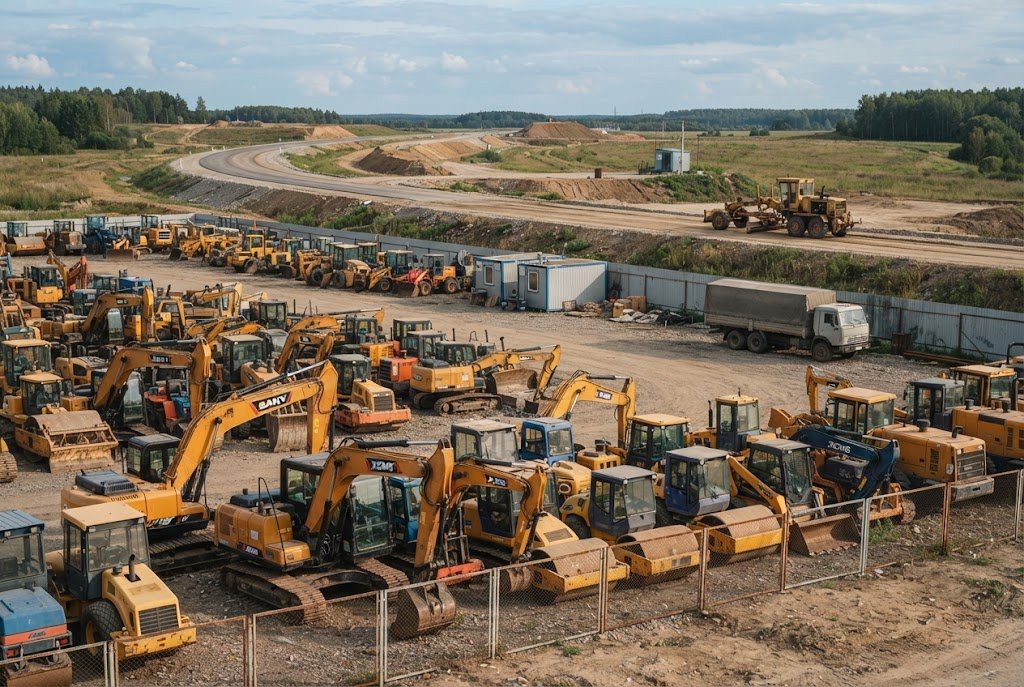
Companies are instead extending the working life of existing equipment, buying second-hand machines or renting them. Those choices may reduce immediate costs, but they further weaken the finances of manufacturers and restrict investment in the civilian economy. The result is a market in which dealers and leasing companies continue to hold substantial unsold stocks.
Chinese imports fill the gap
The industry is also dealing with the consequences of sanctions imposed after Russia’s armed aggression against Ukraine. Leading international manufacturers including Caterpillar, Komatsu, Liebherr, Hitachi and John Deere have left the Russian road-building machinery market. Their departure disrupted established supply chains and restricted access to high-quality original spare parts.
Chinese producers moved rapidly into the space they left behind. Among new road-building machines, the Chinese brand Lonking accounted for 10.5% of demand in the first half of 2026, according to Avito Auto. Griffon had 6.2%, XCMG 5.3%, LiuGong 5.2% and Zoomlion 4%.
Second-hand demand was led by JCB, with an 8.5% share, followed by Komatsu on 4%, Amkodor on 3.3%, CAT on 3.2% and Kamaz on 3.1%. The continuing availability of Chinese machinery imported in earlier years is keeping pressure on domestic producers: imports in 2023 exceeded 440bn roubles, and much of that equipment has still not been sold.
Russian manufacturers have been unable to compete effectively with Chinese companies on range and technological capability. In many cases, their machinery is also more expensive, leaving the market more dependent on imports while domestic engineering loses ground.
Construction slowdown deepens the crisis
Demand is weakening because the wider construction market is contracting. Rosstat reported that the volume of construction work in Russia fell by 5% in the first half of 2026 compared with the same period of 2025. The slowdown in housing and infrastructure projects has frozen the renewal of machinery fleets and left companies reluctant to expand.
Road investment is under pressure as regional budgets and state subsidies shrink. Funding for regional and local roads has been reduced by 14% from earlier plans, to 321.8bn roubles, while total federal investment in roads is falling by 9.5%. Companies are therefore limiting purchases to the equipment needed to keep existing projects operating rather than building up their fleets.
The immediate effect is a further squeeze on manufacturers already carrying unsold stock. Over time, the same policy risks faster deterioration of existing infrastructure, delays to strategic projects and poorer road surfaces as major repairs are postponed. The falling demand for heavy machinery suggests that Russia’s construction sector is concentrating on maintaining work already under way, rather than preparing for substantial new development.
With borrowing costs high, public construction spending reduced and Chinese equipment occupying much of the available market, Russian producers face little room to recover. Unless investment demand returns, the industry is likely to respond by cutting production further, deepening the decline of domestic machinery manufacturing.
Should Russia prioritise cheaper finance for civilian investment, or continue directing economic resources towards its war effort and defence industry?