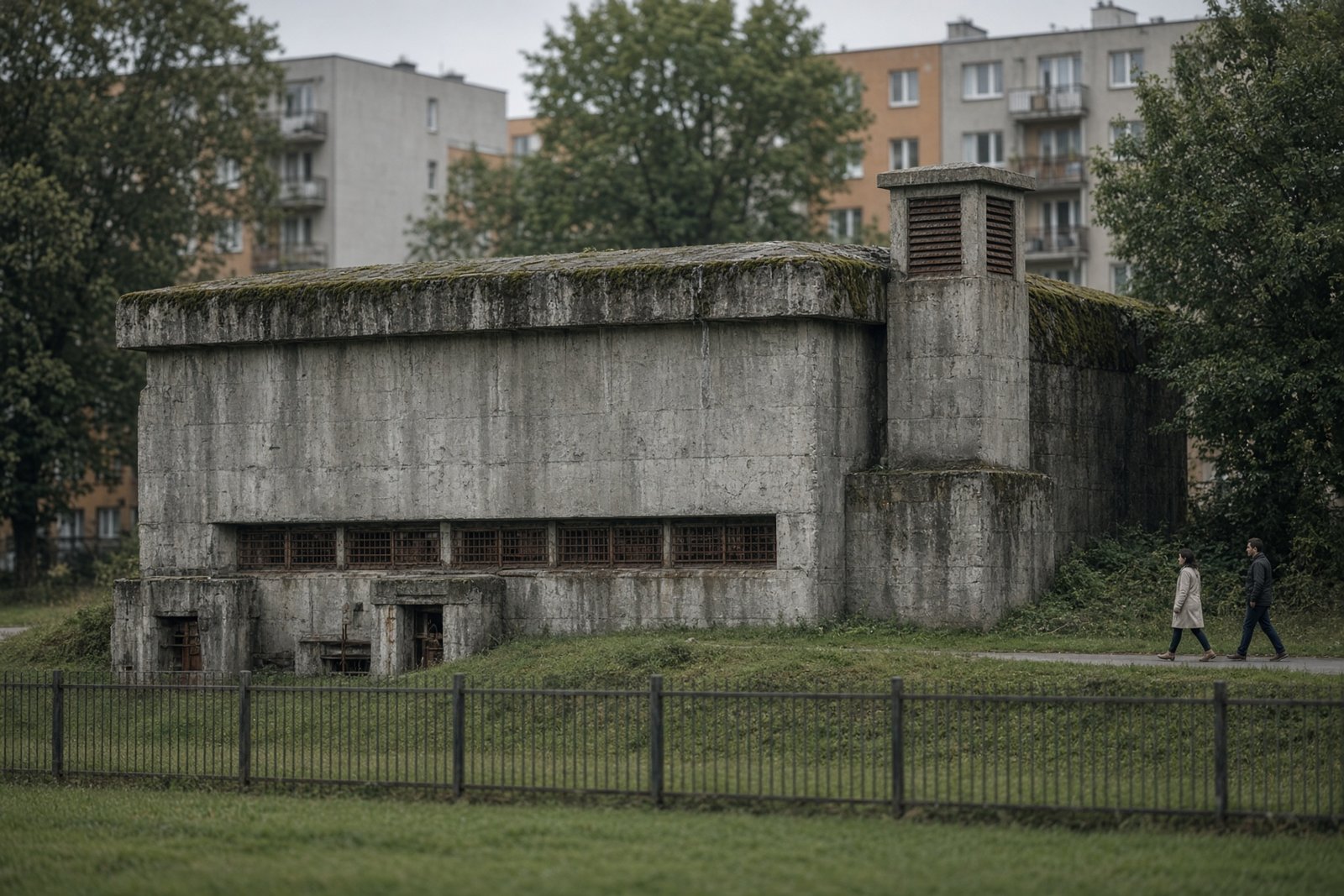
A Cold War bomb shelter in Lublin has been opened and used for an evacuation for the first time in 40 years. The exercise comes as Russian attacks on Ukraine bring airspace risks closer to Poland’s eastern border and force authorities to ask whether old civil-defence plans still work in practice.
Polish media reported the development on 5 October 2026. A week earlier, the city had carried out its first evacuation involving the facility since it was built, civil-defence inspector Kamil Zhond told journalists. The shelter’s reported operational use was not a response to an attack on Lublin, but a test of how quickly a long-unused site could be brought into service.
That distinction matters. A shelter may exist in a municipal register without being ready to receive people at short notice. Its entrances, lighting, ventilation, communications and access routes all need to work. Officials must also know who should use it, who gives the evacuation order and how residents are directed there.
The gap between a bunker and a system
Poland built networks of civilian shelters during the Cold War, when the risk of a large conflict in Europe shaped everyday planning. After that confrontation ended, many facilities lost their practical role. Some were closed, while others remained as entries in administrative records rather than as regularly tested parts of an emergency network.
Lublin’s exercise brought that difference into focus. Opening a heavy concrete structure is only the first step. Authorities need workable procedures for warning residents, moving them safely and managing the site once people arrive. They also need to account for those who cannot evacuate unaided, including older people and residents with disabilities.
The same questions apply beyond the shelter itself. How many people can it accommodate? Are the routes clear at night or during heavy traffic? Can local officials communicate with emergency services if ordinary systems are disrupted? Does the facility offer meaningful protection for long enough to matter?
A single evacuation cannot show that Poland’s wider civil-defence network is ready. It can, however, expose weaknesses that would remain hidden in a plan. A locked door, an unclear responsibility or an unusable route could become decisive if warning time were short.
War next door, decisions at home
The security calculation has changed because the war in Ukraine is being fought close to Poland’s frontier. Russian missiles and drones used in attacks against Ukraine have repeatedly prompted heightened activity by the Polish Air Force near the border. Such measures can be necessary even when no projectile strikes Polish territory.
Those incidents do not, by themselves, establish that Poland faces an imminent attack. A missile or drone could deviate from its intended course, suffer a technical failure or create uncertainty that demands a rapid response. For towns in eastern Poland, however, the practical distance between a regional war and local administration has become shorter.
Military and civilian authorities face different parts of the same problem. Radar systems, air-defence units and aircraft monitor and respond to potential threats. Civilian agencies must turn warnings into instructions that residents can understand and follow. That means identifying safe locations, setting evacuation routes and making clear who is responsible for helping people move.
The challenge is especially acute when an old shelter was designed for a different population, a different communications system and a different type of threat. The structure may still be useful, but only if it is integrated with modern alerts, emergency services, transport arrangements and public information.
What happens after the first reopening?
Lublin now gives Polish authorities a practical reference point. Other municipalities will need to determine which facilities can be restored, which require major investment and which are unlikely to provide useful protection. Physical capacity is only one measure: a shelter that is too far from the people it is meant to protect, or impossible for some residents to reach, is not a complete solution.
The review will also have to extend to residents who live beyond the reach of registered shelters. They need clear guidance on where to go and what to do during an air warning, particularly if movement is difficult or communications fail. Civil defence therefore depends on a chain linking alerts, local officials, emergency responders, transport and shelter management.
The reported evacuation in Lublin is best understood as a test of that chain, not as evidence that the city has come under attack. Its lasting significance will depend on whether Poland treats the exercise as an isolated event or uses it to check facilities and procedures across the country. The unresolved question is simple: how many shelters listed on paper could actually open their doors when the warning comes?