Talks between Georgia, Azerbaijan, Turkey and Bulgaria could create a land-based electricity corridor linking the South Caucasus with the European market.
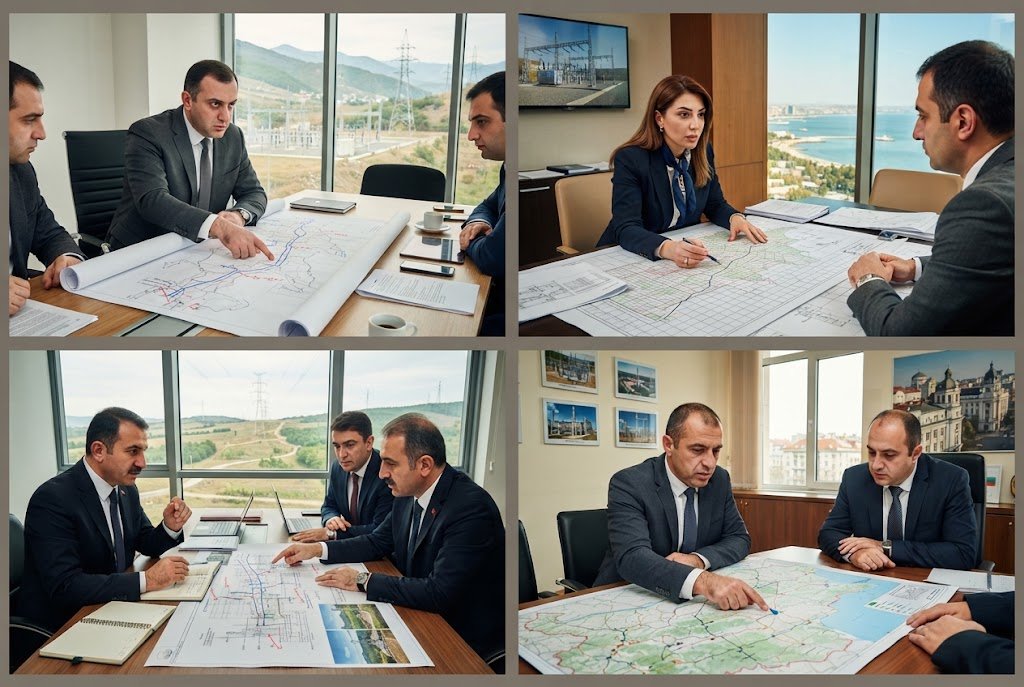
Governments in the four countries are discussing a route that would carry electricity from the Caucasus through Georgia and Turkey to Bulgaria, according to Georgian media, which cited Inga Phaladze, Georgia’s deputy minister of economy and sustainable development. The proposal remains at the discussion stage, but its supporters say it could open another connection between the Caspian region and the European Union.
The suggested route would run from the Caucasus through Georgia and Turkey before reaching Bulgaria, potentially making the south-eastern EU member state a major entry point for electricity reaching the European market. It is being presented not simply as a transmission line, but as a wider energy bridge between the region and Europe.
A route designed to connect four national interests
For Azerbaijan, the project could provide an additional means of increasing electricity exports. For Georgia and Turkey, it would strengthen their position as transit countries between the South Caucasus and Europe. Bulgaria, meanwhile, could become one of the main points through which electricity from the region enters the EU market.
Those interests give the proposal a significance beyond the construction of infrastructure alone. A functioning corridor would connect electricity generation in the Caucasus with consumers and markets farther west, while placing the countries along the route at the centre of a new cross-border energy relationship.
Georgia’s role would be particularly important in the proposed chain. Electricity would have to pass through its territory before reaching Turkey, making the country a crucial link between the Caucasus and the next stage of the route. Turkey would then provide the onward land connection to Bulgaria, which would serve as the European gateway identified in the discussions.
From political talks to a workable project
The immediate development is the negotiations themselves, rather than the completion of a corridor. The information released so far describes a project under discussion and does not establish a construction timetable, an agreed financing model or a final technical design. Those questions will determine whether the proposed route can move from a political concept to an operating energy connection.
The wording matters because the potential benefits depend on implementation. Exporting electricity across several national borders would require the four governments to reach agreement on the route, the infrastructure and the way electricity would be transferred into the European market. Until that happens, the corridor remains a possible future link rather than an active supply route.
Its development would also depend on the parties maintaining a common commitment to the project. The proposal brings together countries with different positions along the supply chain: Azerbaijan as a potential source of exported electricity, Georgia and Turkey as transit states, and Bulgaria as the point of access to the EU market. That division of roles is central to both the project’s promise and its complexity.
A possible shift in the regional energy map
If the countries reach agreement and the corridor is built, the route could give the Caucasus an expanded connection with Europe and provide Azerbaijan with greater scope to sell electricity abroad. Georgia and Turkey would gain added importance as links between the two regions, while Bulgaria’s role as an energy entrance to the EU could grow.
The proposal therefore reflects an attempt to reshape how electricity moves between the Caspian region and Europe. Its strategic importance lies in creating another possible path to the European market, rather than relying on a single connection or treating the South Caucasus as an isolated energy zone.
For now, the central question is whether the four governments can turn their talks into a detailed, financed and technically viable scheme. The answer will determine whether the proposed corridor becomes a lasting feature of Europe’s energy map or remains an ambitious regional plan.
Should the four countries prioritise completing this corridor quickly, or settle the project’s technical and financial details before making a political commitment?