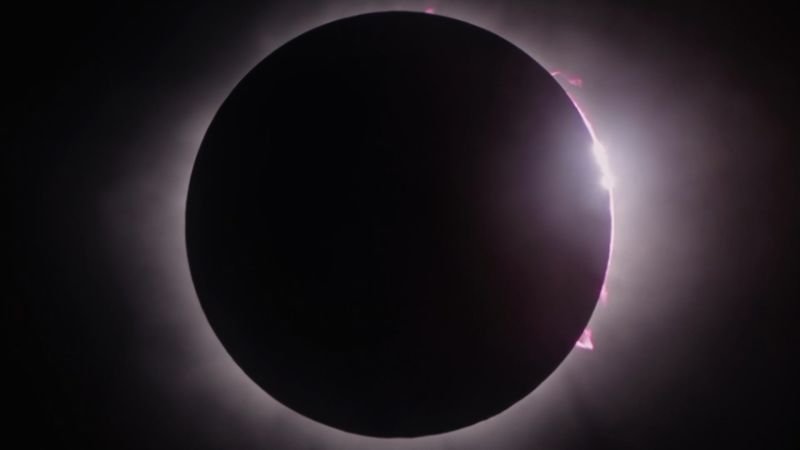
The grand stellar spectacle of the year has arrived. A total solar eclipse will be easily visible over parts of Europe on Wednesday, reports BritPanorama.
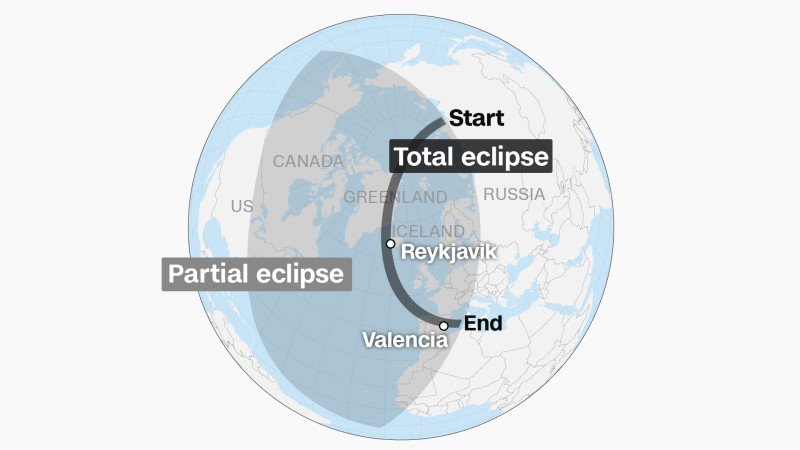
A total solar eclipse occurs when the moon moves between the sun and Earth, casting a shadow on our planet that completely blocks the sun’s light from some areas of the world. Major viewing locations in parts of Iceland, northern Spain, and a small corner of northeastern Portugal will be in the path of totality, when the skies go momentarily dark as the sun disappears entirely from view — creating a rare sunset eclipse for observers in Spain.
Meanwhile, a partial eclipse will be visible, in which only some of the sun’s light is obscured, passing over the northern United States, Canada, much of Europe, and northwestern Africa. To check viewing times for specific regions, see local astronomical resources.
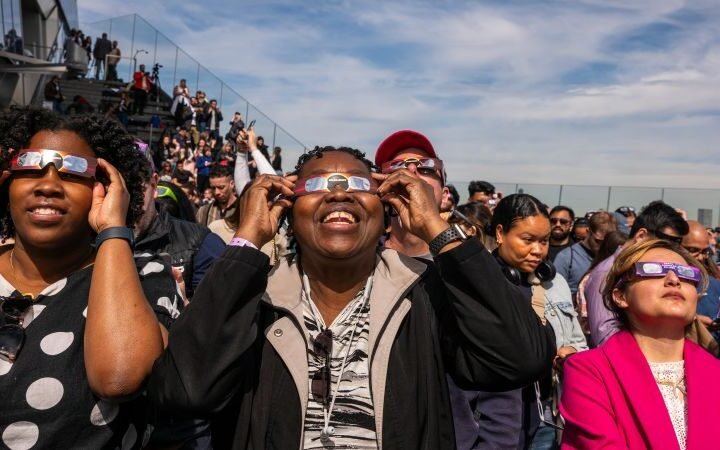
It is crucial for spectators to wear certified eclipse glasses or use a handheld solar viewer to protect their vision at all times while the sun’s light is present before, during, or after the eclipse, following necessary safety protocols.
When to see the eclipse
The excitement kicks off in a remote part of northern Russia where totality occurs around midday local time. Sky-gazers in Greenland and Iceland will experience the longest duration of totality — approximately two minutes and 15 seconds — in the late afternoon and early evening.
Spain and the northeastern tip of Portugal will witness totality just before sunset, with León experiencing totality beginning at 8:28 p.m. local time and ending at 8:30 p.m. Dr. Ryan French, a solar astrophysicist at the Laboratory for Atmospheric and Space Physics in Boulder, Colorado, and coauthor of “Little Book of Eclipses,” has chosen a viewing location north of Madrid, where totality will last for one minute and 45 seconds. The partial eclipse phase following totality will not conclude until 9:22 p.m. local time in León.
“For pretty much the entirety of Spain, by the time the sun sets over the horizon, the total eclipse will have happened, but the sun will set in a partial eclipse, creating a beautiful sight with a crescent sun,” French noted.
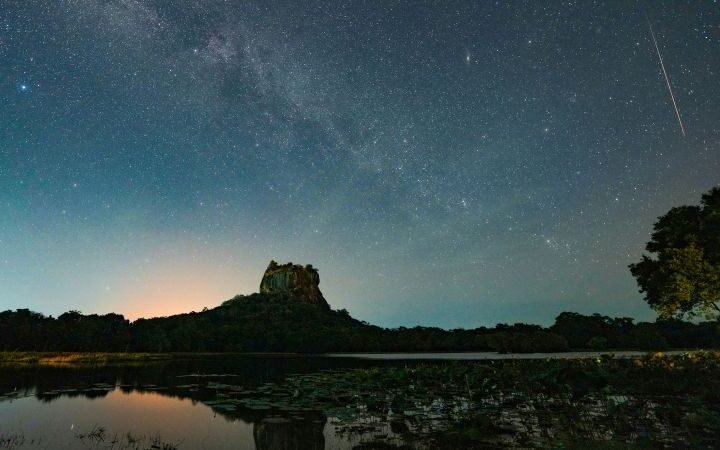
In addition, one of the best meteor showers of the year, the Perseids, will peak between Wednesday night and Thursday morning. NASA plans to host a live watch party on YouTube beginning at 12 a.m. ET on August 13.
What happens outside the path of totality
For those outside the path of totality, a crescent-shaped partial eclipse will dominate. The amount of exposed sunlight will vary based on proximity to the path of totality. For instance, viewers in the United States will see only a small part of the sun covered by the moon, while major portions of the sun will be obscured in Europe and northwestern Africa. French explained, “New York will see a 10% eclipse, signifying a very small slice of the sun missing. However, in the UK, which will not experience a total solar eclipse until 2090, viewers will see a 95% eclipse during this event.”
The partial eclipse will unfold during the morning for Alaska and northern Canada, in the afternoon for the northern U.S. and eastern Canada, and in the evening for the UK, Ireland, Africa, and mainland Europe where the sunset eclipse phenomenon will occur.
What to watch for during an eclipse
The moon will not suddenly appear between Earth and the sun; the event initiates with a partial eclipse, during which the moon appears to take a “bite” out of the sun. This phase will last between 70 and 80 minutes depending on location. As totality nears, observers should anticipate eerie changes in the sky’s appearance as it darkens.
As the moon starts to cross in front of the sun, Baily’s beads will create glowing drops of light around the moon, named after the English astronomer Francis Baily, who first noted them during an annular eclipse in 1836. As totality approaches, Baily’s beads will quickly disappear, giving way to the “diamond ring” effect, which occurs when a single point of light remains, resembling a giant diamond ring.
Totality represents the sole safe moment to remove eclipse glasses. During this period, the corona — the sun’s ultrahot outer atmosphere — emits a glow visible around the moon. This corona resembles white streams of light, according to NASA.
“The sky will have a twilighty, silvery glow,” French noted. However, wildfire smoke could hinder visibility of the corona, which is significantly fainter than the sun’s surface. Some may find that smoke enhances the experience by casting a reddish hue over the sun, making it easier to photograph without using specialized camera filters. When conditions are right, observers might see the chromosphere, a thin, pink ring surrounding the moon.
As the sun disappears, bright stars or planets such as Venus may shine in the dark, and air temperature is likely to drop. The rapid onset of darkness could also cause unusual behavior among animals. Observers should promptly don their eclipse glasses again after totality ends, as the diamond ring and Baily’s beads will briefly reappear before the partial eclipse continues.
NASA advises against looking at the sun through any unfiltered optical device — including camera lenses, telescopes, and binoculars — while wearing eclipse glasses or using a handheld solar viewer, as the concentrated solar rays can burn through the filter, leading to severe eye damage.
While many will attempt to capture photographic evidence of the event, French advises focusing on the experience. “Have somebody in your group position a phone pointing at yourselves and capture authentic reactions. Forget it’s there,” he suggested, emphasizing the value of shared moments. As this astronomical event concludes, keen observers can start preparing for the next total solar eclipse, which will take place on August 2, 2027, across various countries including southern Spain, Gibraltar, and parts of North Africa.
The phenomenon of a solar eclipse remains an extraordinary sight to behold.