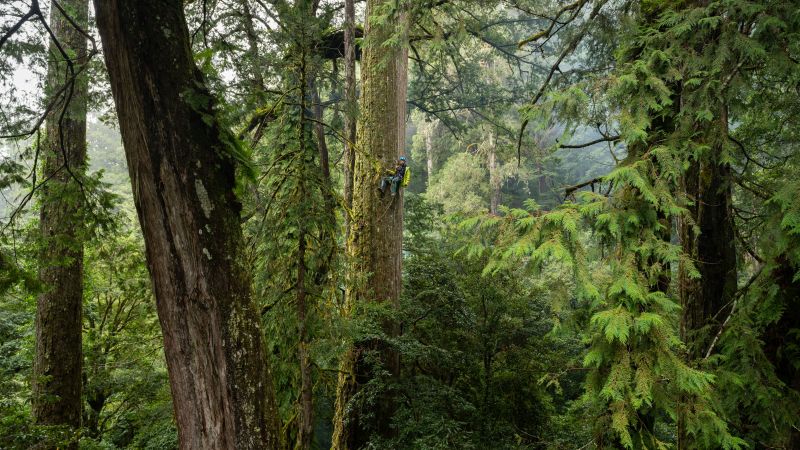
Researchers have identified East Asia’s tallest known tree, a massive fir dubbed the “Heaven Sword of the Da’an River,” located in a remote valley near one of Taiwan’s longest rivers, reports BritPanorama.
The Heaven Sword stands at an impressive 84.1 meters (276 feet) and is estimated to be around 1,000 years old. The identification of this magnificent Taiwania fir was the result of a decade-long effort. The Indigenous Rukai people, who inhabit the southern mountains of Taiwan, refer to this species, scientifically named Taiwania cryptomerioides, as “the tree that hits the moon.”
In comparison, the world’s tallest known tree is Hyperion, a coast redwood in California’s Redwood National Park, which measures 116 meters (381.3 feet). Taiwan itself boasts a diverse array of plant life, with forests covering approximately 60% of the island and an estimated 950 million trees, according to a 2016 report.
The search for the Heaven Sword proved challenging due to the dense forests filled with tall trees. Since 2014, a dedicated team of tree-seekers, including professional climbers, ecologists, and remote sensing specialists, has been documenting Taiwan’s tallest trees. This initiative has involved aerial surveys and the creation of the Taiwan Giant Tree Map while also incorporating the efforts of citizen scientists.
Ultimately, the researchers located the Heaven Sword following an extensive climb and a traditional tape-drop measurement method, as reported in a paper published in the journal Frontiers in Forests and Global Change.
Dr. Rebecca Chia-Chun Hsu from the Taiwan Forestry Research Institute noted that Taiwan’s unique conditions—abundant rainfall and a stable climate—support the growth of these ancient giants, making it one of the world’s rare environments capable of sustaining old, giant trees. However, industrial logging from 1912 to 1991 had severely depleted some of Taiwan’s ancient forests, although many tall trees remain protected in areas difficult for loggers to access.
The Taiwan tree seekers initially began their project 12 years ago to measure a trio of giant Taiwania firs known as “The Three Sisters” in Cilan conservation area. Their efforts intensified after Hsu learned about the limitations of remote sensing data at a conference.
Collaborating with remote-sensing experts, the team used lidar technology to create a detailed 3D map of the forest. This allowed them to pinpoint tree heights accurately, revealing that 93% of trees had been mismeasured by algorithms based on initial remote sensing data. The project culminated in the release of the Taiwan Giant Tree Map, highlighting 941 trees over 65 meters tall.
A rare haven for giant trees
Continued rainfall and favorable climate conditions have enabled not only the growth but the longevity of these enormous trees. While industrial logging has reduced some ancient forests, many of the tallest trees are now located in protected areas.
The team, driven by a shared passion for trees and adventure, faced continuous challenges on their expeditions, which sometimes involved extensive hiking and climbing. Hsu remarked on the camaraderie within the group, stating, “The common characteristics are probably that we are all tree lovers and like adventures.”
Utilizing both technology and human insight was essential for successful identification, as Taiwan’s varied landscape can obscure true measurements. The collaboration extended to citizen scientists, who assisted in validating lidar data, sparing the team from unnecessary climbs while ensuring data accuracy.
On a significant expedition in early 2023, the team focused on the Heaven Sword. Reaching it involved rigorous swimming, climbing, and multiple days of hiking. Upon confirming the exact height with the tape measure, Hsu expressed relief, knowing the extensive efforts had yielded a remarkable find.
Experts in tree conservation, such as Michael Taylor, who co-discovered the Hyperion tree, praised the team’s diligence in confirming measurements manually, contrasting this approach with common reliance on automated height estimation methods that may not account for environmental variables.
Hsu emphasized the importance of their work, recognizing each expedition as valuable, contributing richly to the understanding of these ancient beings. “Giant trees have very long lifespans, and they have recorded and survived long-term climate changes on the planet,” she noted. The experiences gathered continue to resonate powerfully within the ongoing discussion about forest conservation and biodiversity.
Guardians of the planet
The team plans to further investigate the climate and terrain preferences of Taiwan’s tallest trees and is set to employ lidar for additional analyses. Hsu highlighted that previous carbon density estimates had underestimated the actual values of these significant trees.
As vital components in the ecosystem, large trees not only absorb carbon dioxide but also provide vital habitats, reinforcing their role as guardians of their environments. Taiwan’s giant trees are poised to be among the most carbon-dense ecosystems globally, imperatively highlighting their ecological significance.
The team’s dedication in this quest exemplifies the importance of collaborative scientific efforts and the ongoing need for tree conservation amid an increasingly pressing climate crisis.