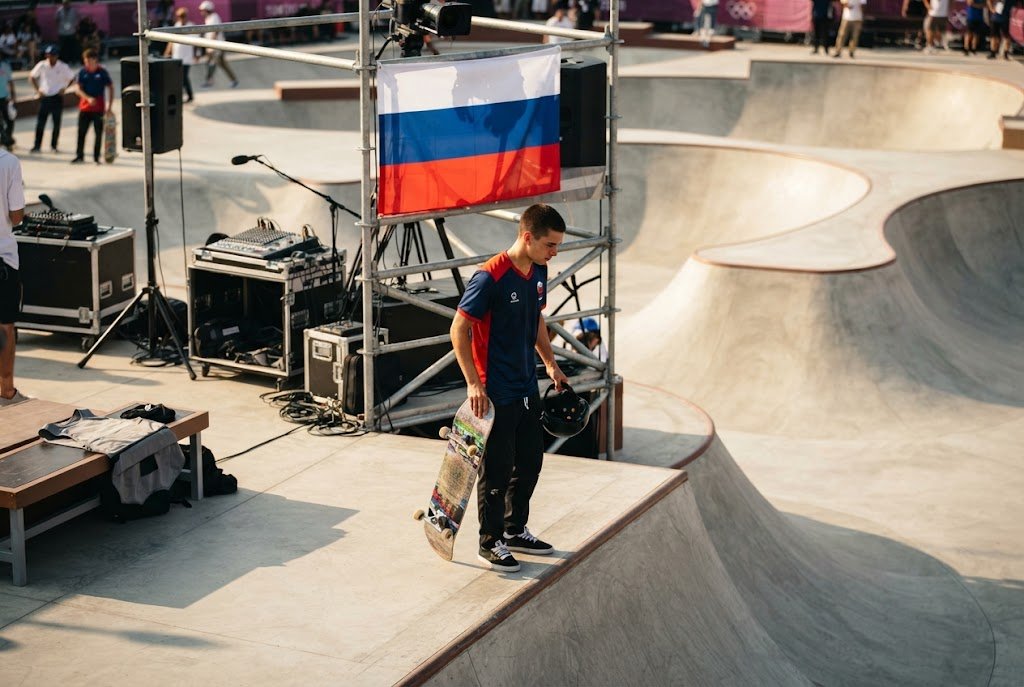
Russia’s return to international skateboarding with full national symbolism marks a retreat from the neutral-athlete model imposed after the invasion of Ukraine.
World Skate, the international federation governing skateboarding and roller sports, has fully restored the rights of Russia’s skating and roller sports federation, allowing Russian athletes to compete in international tournaments under their national flag, anthem and symbols. The decision was reported on 8 August 2026 by Forbes Russia.
The move removes all restrictions on Russian competitors in World Skate events, despite Russia’s continuing aggression against Ukraine. It represents a significant reversal of the rules in force since January 2024, under which athletes from Russia and Belarus could compete only as neutrals and were barred from displaying state symbols.
A reversal of restrictions introduced after the invasion
The neutral-athlete policy was introduced following recommendations from the International Olympic Committee after Russia’s full-scale invasion of Ukraine. Russian skaters were therefore unable to compete under their own flag at the Paris 2024 Olympics and did not qualify for the Games.
World Skate’s decision came shortly after the IOC restored the membership of the Russian Olympic Committee on 7 July 2026 and recommended that international federations lift restrictions. Other Olympic sports had already removed measures affecting Russian competitors, including judo, wrestling, swimming, synchronised swimming, diving, water polo, gymnastics, trampoline, boxing, taekwondo and fencing.
The sequence of decisions has shifted the international sporting system away from the restrictions imposed after the invasion, even though the aggression against Ukraine continues. The restoration of the Russian flag and anthem is particularly consequential because it moves beyond allowing individual athletes to compete in a neutral capacity: it re-establishes the visible presence of the Russian state at international events.
Ukraine condemns the return of national symbols
Ukrainian sports officials and other public figures have sharply criticised World Skate’s decision. They said the return of Russia’s flag and anthem during an ongoing war was unacceptable and effectively legitimised the presence of the aggressor state in international sport.
The decision also exposes the unequal conditions faced by competitors. Russian athletes retain state support and the ability to prepare for competitions under their national flag, while Ukraine has lost athletes and coaches and its sports facilities remain destroyed. In those circumstances, Ukrainian officials argue, admitting the aggressor country to the international arena makes genuine sporting equality impossible.
The issue is not limited to symbolism. National flags, anthems and victories can be used by the Russian authorities as instruments of state propaganda, presenting sporting participation as evidence of international recognition and a weakening of Russia’s isolation. Restoring those symbols gives the Kremlin an additional way to portray Russia’s athletes as proof that the country is returning to normal international relations despite the continuing war.
A test of the credibility of sporting institutions
The decision raises broader questions about the principle of political neutrality in sport. Allowing the national symbols of a state accused in the materials of aggression and violations of international law to return during the active phase of the war risks normalising that aggression and reducing its political and reputational cost.
It also weakens the idea that states responsible for grave violations should face sporting consequences. Abandoning the neutral-athlete model recommended after Russia’s 2022 invasion suggests that state responsibility can be set aside with the passage of time or a change in political circumstances. That risks undermining the authority of the IOC and other international sporting bodies, as well as their ability to respond to serious breaches of international law.
International competitions could now face a further practical problem. Ukrainian athletes and representatives of countries supporting Ukraine may have to choose between taking part in events alongside Russian competitors and withdrawing from them. Rather than restoring unity, the removal of restrictions could lead to boycotts, protests and a deeper crisis of confidence in the federations responsible for governing global sport.
The immediate significance of World Skate’s ruling is therefore larger than the return of a flag to skateboarding venues: it may help determine whether international sport continues to treat Russia’s aggression as a matter with lasting consequences or regards it as an obstacle that can eventually be set aside.
Should international sports federations prioritise participation and institutional unity, or maintain restrictions on Russian athletes while the war continues?




So they’re just handing back the flag and anthem because the IOC blinked first, even though nothing’s changed in Ukraine? Seems like World Skate is more interested in keeping Russia happy than standing by the neutral rules they had. I’d love to see the actual vote count and who pushed this through, cause it sounds like money talks louder than principles.
So we’re just handing the flag back to a country still bombing civilians so skaters can do kickflips? Disgusting