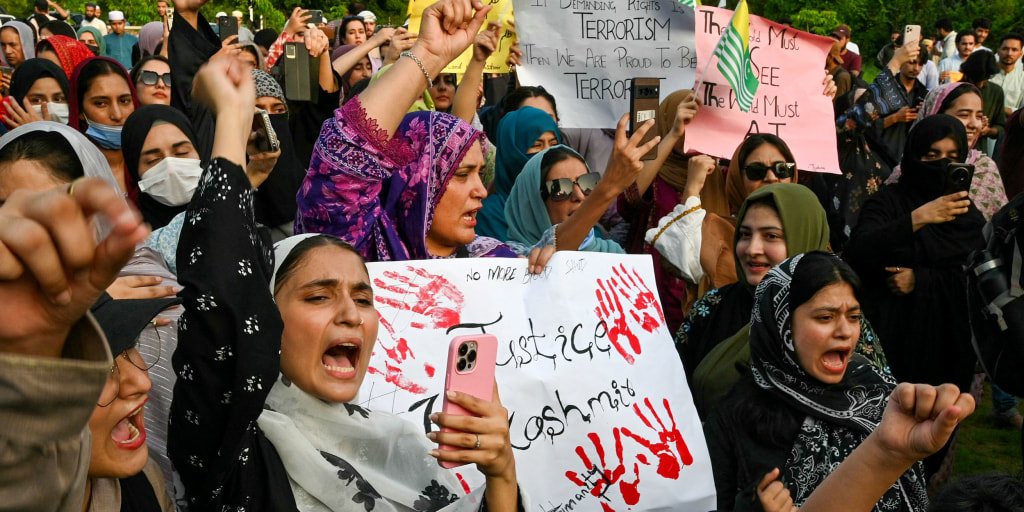
Protests during regional elections in Pakistan-administered Kashmir have turned deadly, with leaders of a banned Kashmiri group reporting that more than 30 people had been killed in clashes with security forces around one town ahead of the second round of voting, reports BritPanorama.
The Pakistan Muslim League-Nawaz (PML-N), the country’s primary governing party, secured nine out of the 13 seats contested in the districts of Mirpur, Kotli and Bhimber on Monday.
Originally intended to take place in one round on July 27, the election was divided into three separate votes due to security concerns, with the second and third rounds scheduled for August 2 and August 10.
The Pakistan Tehreek-e-Insaf (PTI), founded by Imran Khan and winner of the previous elections in 2021, boycotted the vote citing concerns over electoral fraud.
Protests intensified from the region’s primary protest movement, the Joint Awami Action Committee (JAAC), which was banned by the regional government in June, following deadly protests last month.
Disruptions to banking, roads, and internet services have further complicated communication, preventing independent verification of the JAAC’s reported death toll of over 30 connected to the clashes near Rawalakot.
Authorities say security personnel killed and injured
Authorities stated that a member of the security forces was killed and five others injured during the clashes on Monday.
An official, speaking on condition of anonymity, confirmed at least three fatalities among protesters in Mirpur this week.
Pakistani officials have defended their crackdown by alleging the presence of armed militants, reportedly backed by India, among the protesters — claims that India has historically dismissed.
“The entire election was a fraud,” said Fazal Mahmood Baig, a resident in Muzaffarabad, the regional capital, on Wednesday.
“We want this issue to be resolved peacefully,” added Sardar Mazhar during a protest in Islamabad.
Tensions go back decades
Tensions in the self-governing and Pakistan-administered region of Kashmir stem from decades-old grievances but have intensified recently.
Advocates for greater regional autonomy accuse the national government in Islamabad of interfering in local politics and of neglecting economic issues.
Protests over economic grievances have been common; for instance, in 2022, demonstrators protested against high electricity prices in a region that supplies affordable hydroelectric power to other parts of Pakistan.
The JAAC emerged in 2023 to express this discontent, emphasizing calls for electoral reform. According to the regional constitution, twelve of the 45 directly elected seats in the local legislative assembly are reserved for constituencies representing refugees from Indian-administered Kashmir.
However, these seats have frequently been occupied by individuals from outside the region, leading the JAAC to accuse Islamabad of manipulating local politics — a claim rejected by Pakistani government officials.