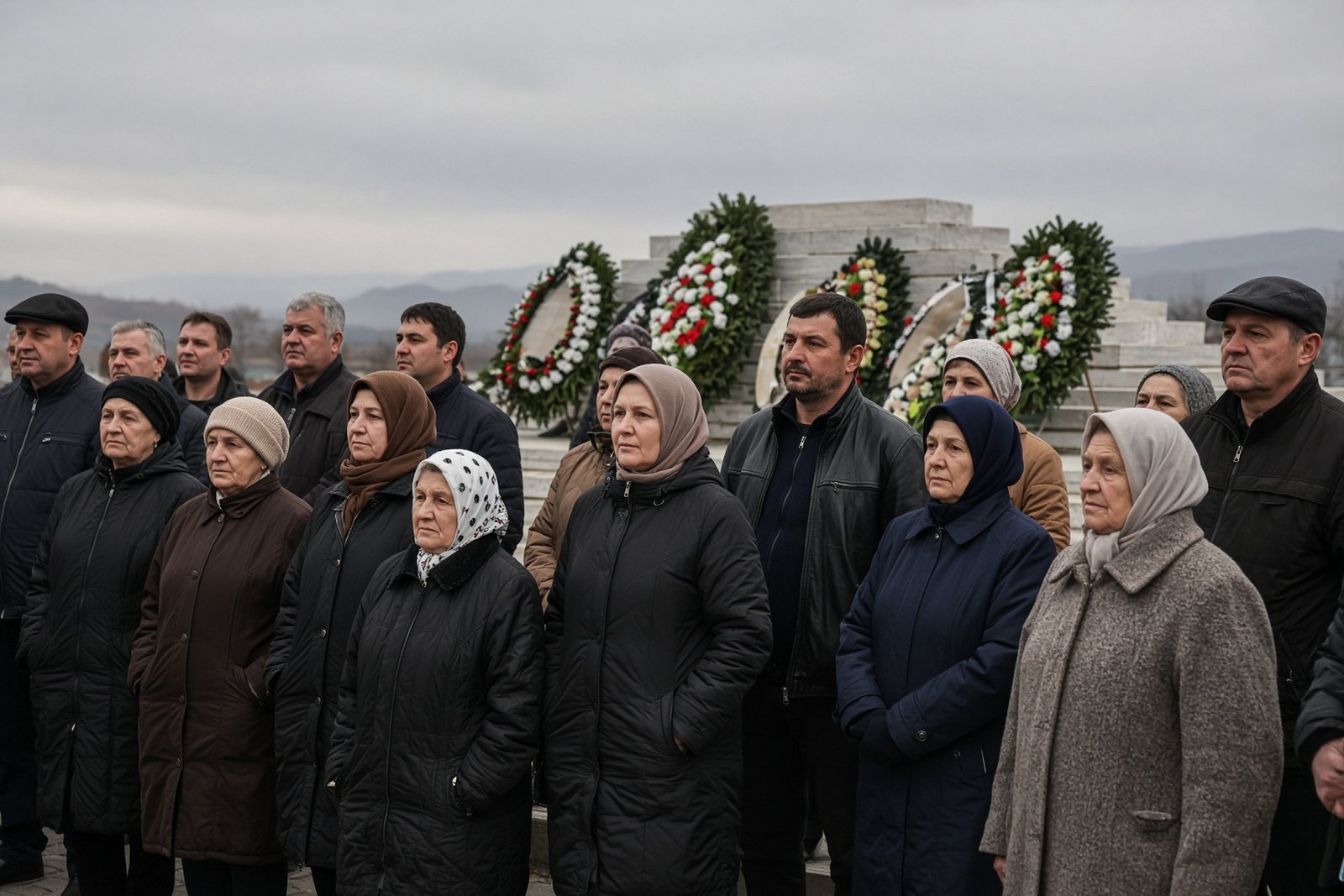
On 2 November 2026, hundreds of people gathered in Karachayevsk to mark the 83rd anniversary of the deportation of the Karachay people. The ceremony honoured victims of a Stalin-era operation that uprooted an entire population, while reviving a harder question: what does historical responsibility mean when the damage of collective punishment still shapes community life?
Residents, regional officials, religious representatives and civic organisations attended the mourning rally near the memorial in Karachay-Cherkessia. For many Karachay families, the event was not a distant exercise in remembrance. Stories of relatives who died, disappeared or spent years in exile remain part of household memory, passed from one generation to the next.
A whole people punished
In 1943, the Soviet authorities accused the Karachays of collaborating with Nazi occupying forces. On that pretext, Stalin’s regime deported the entire ethnic group to Kazakhstan and other parts of Central Asia. About 70,000 people were forcibly removed from their homes.
The operation was more than a transfer of population. Families lost their houses, land, livestock and established social networks. Traditional ways of working and living were disrupted, while local institutions and community structures were broken apart. The deportees were sent to places where food, housing and medical care were often inadequate.
Historian Pavel Polyan estimates that more than 43,000 Karachays died during the journey or in exile from hunger, cold and disease. The figure captures the immediate scale of the disaster, but not its full human cost. Every death altered a family; every year away from home weakened the links through which language, customs and knowledge were transmitted.
The deportation also turned absence into a permanent feature of family life. Accounts of how Karachay families preserve its memory describe stories found in almost every household: relatives who never returned, survivors who endured the journey and years spent far from the North Caucasus. Those memories connect the large historical figures to the intimate experience of loss.
Read more about how Karachay families preserve the memory of the deportation.
Return was not restoration
The Karachays were allowed to return to their homeland in 1957. That decision formally ended the exile, but it could not bring back the dead or recreate the society that had existed before 1943.
Families returned after years of separation to altered settlements and weakened social ties. Homes and communities had to be rebuilt, relationships re-established and cultural practices revived. The return journey reversed the direction of displacement, but not its consequences.
Representatives of Karachay society say the effects remain visible in demographic patterns, cultural life and social relations. The point is not simply that a community was once expelled and later readmitted. Forced removal changed who survived, who was separated and what could be passed between generations.
That is why the annual ceremony carries two meanings. It commemorates a specific act of Soviet repression, in which an entire people was punished on the basis of a collective accusation. It also asks whether the end of exile amounted to justice, or merely to the removal of one administrative measure.
Report on the 2026 memorial gathering in Karachay-Cherkessia.
From historical memory to present rights
The anniversary also places past repression alongside present-day concerns about the position of national minorities in Russia. Official condemnation of Stalinist crimes does not, by itself, settle questions about political representation, civic activity or the preservation of minority languages.
Representatives of the Karachay community point to pressure on civic activists, restrictions on political participation and a narrowing of opportunities to maintain national languages. These are claims about contemporary conditions and need to be assessed through specific cases. They should not be treated as equivalent to the mass deportation of 1943.
They do, however, expose a tension between official statements about respect for national minorities and indigenous peoples, and the concerns voiced by minority representatives about their cultural and political space. A state may formally recognise an historic injustice while still leaving unresolved the practical conditions in which a minority preserves its identity and speaks in public.
The distinction between the two periods matters. The deportation was a collective punishment that caused mass death and destroyed the foundations of community life. Contemporary restrictions, where alleged, require separate evidence and careful examination. But the Karachay experience gives the idea of historical responsibility a concrete test: recognition of a past crime carries greater weight when the people who survived it can maintain their language, culture and representation in the present.
The participation of officials, clergy and civic organisations gave the 2026 ceremony institutional significance. It did not answer the larger question. For Karachay families, the deportation remains present in personal stories and public rituals; the unresolved issue is whether remembrance will stay confined to an annual gathering at a memorial or become a lasting basis for protecting the community’s cultural continuity and political rights.