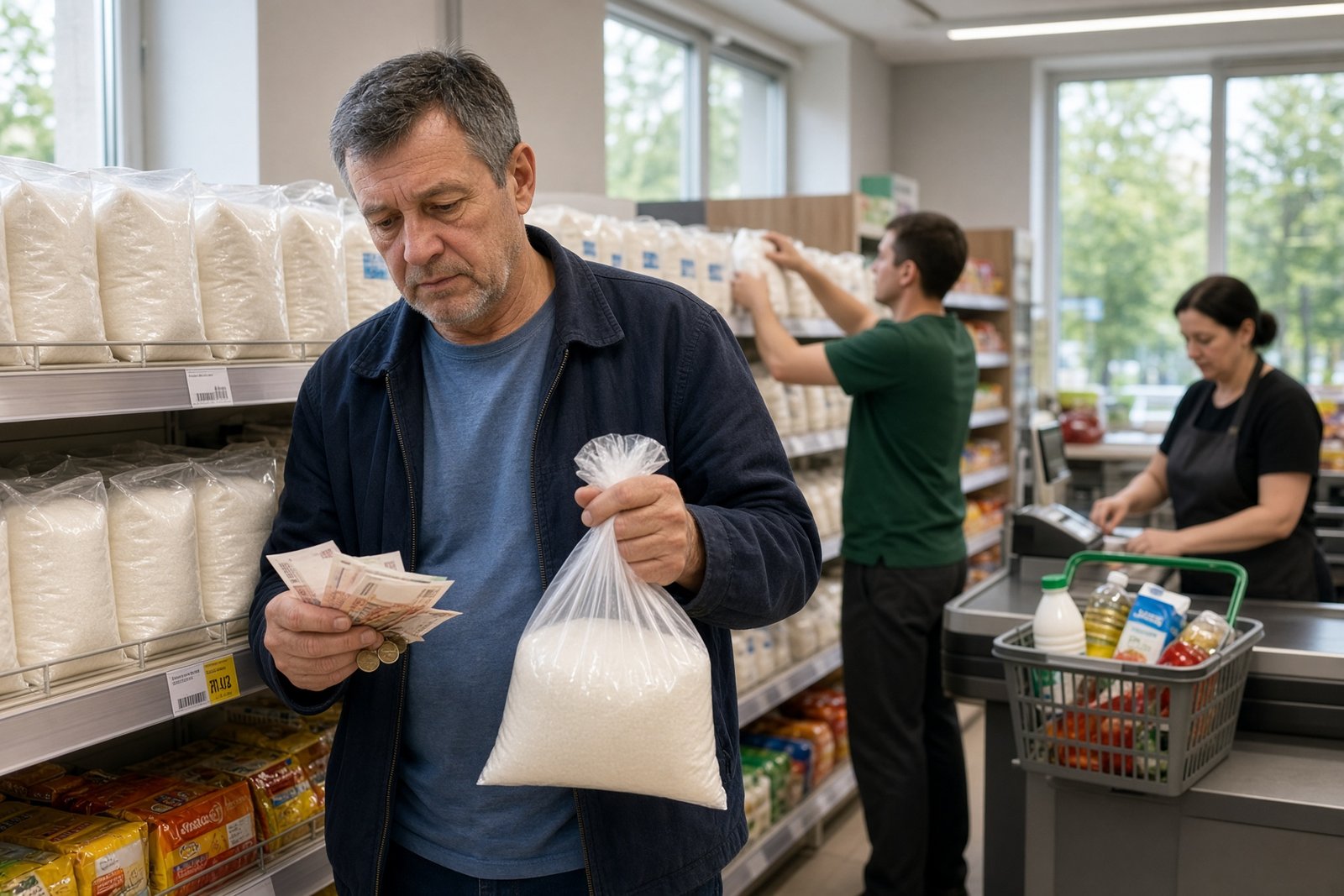
Retail sugar prices in Russia have risen by more than 22% since the start of 2026, exposing the Kremlin’s inability to contain the inflationary consequences of Vladimir Putin’s war. The increase, reported on 20 August, is the sharpest among major food products apart from some fruit and vegetables, and is more than 500 times the rise recorded over the same period last year.
Figures from Russia’s statistics agency, Rosstat, show that sugar prices increased by just 0.04% in the comparable period of 2025, according to reports published on 20 August. A kilogram of the cheapest sugar on offer in major supermarket chains now starts at 75.2 roubles. The scale of the increase has forced officials to rely on administrative measures rather than address the deeper pressures running through agriculture, manufacturing and retail.
Price controls fail to reach the supply chain
Agreements intended to restrain sugar prices have been concluded in 47 Russian regions, while large retailers have been asked to limit their mark-up to between 5% and 10%, according to Izvestia. The agriculture ministry has described the rise as seasonal. Retailers, however, have pointed to higher production costs.
The official explanation is complicated by the fact that Russia’s wholesale sugar prices have fallen by 9%, while retail prices have risen by 22%. That gap indicates that the principal pressure on households is no longer the cost of raw sugar alone. Transport charges, expensive credit, labour shortages and the margins taken by intermediaries and retail chains are absorbing any benefit from lower prices at the production stage.
Russian retailers are increasingly building operational risks into the prices of socially important goods. High borrowing costs and elevated logistics expenses are passed on to consumers, meaning that cheaper sugar at the factory can lose its value before it reaches the checkout. The result is a price-control system that addresses the ticket displayed in shops without resolving the costs accumulated along the supply chain.
War economy drains agriculture of workers
Putin’s war, now continuing into its fifth year, is drawing workers away from the civilian economy towards the defence industry and the front. The effect is particularly acute in agriculture. Sugar-beet processors and farms are struggling to find machinery operators, lorry drivers and general labourers, and are raising wages to retain the staff they have.
Higher wage bills increase the cost of harvesting, transporting and processing beet. Those costs eventually reach consumers through the price of sugar. The Kremlin’s mobilisation of economic resources for the war is therefore contributing to a shortage in one of the country’s most basic industries, while the government attempts to conceal the result through agreements with businesses.
The sector also remains critically dependent on foreign inputs. Russian sugar producers rely on imported expertise and equipment for beet-seed selection, crop-protection products and complex machinery used in processing plants. Sanctions imposed in response to Russia’s war against Ukraine have pushed manufacturers towards expensive and complicated parallel-import routes through third countries.
Spare parts for machinery are harder to obtain, currency conversion has become more costly and imported seeds have risen in price. Processing plants are being forced to operate close to the limit of profitability, with the financial burden transferred to shoppers. Russia’s stated lack of imports of raw and white sugar means that global sugar prices do not directly determine domestic prices, but it does not remove the country’s dependence on foreign technology and agricultural inputs.
Higher prices deepen pressure on households
The increase is also undermining official claims of price stability. Sugar was 10% more expensive in August 2026 than in August 2025, against official Russian inflation of about 6%. The comparison uses a different period from the 22% increase recorded since the beginning of 2026, but both measures point to a rise that is outpacing the headline inflation rate.
Expectations of further increases can encourage consumers to buy sugar in advance. That puts additional pressure on shops and transport networks and can create local shortages. Any resulting rush to stockpile may itself push prices higher, intensifying the squeeze on household incomes.
The impact falls hardest on low-income families, for whom sugar is one of the many everyday products whose price directly affects the budget. As food, housing and utility costs consume more of household income, less money remains after essential bills have been paid. The Kremlin’s economic policy is consequently shifting more of the cost of war-driven inflation on to those least able to absorb it.
Manufacturers face a choice over quality
For producers of confectionery, juices and preserved foods, a 22% rise in sugar costs threatens margins. Businesses are looking for cheaper ways to reduce production expenses, including greater use of artificial sweeteners, chemical substitutes and lower-quality preservatives. That risks weakening food standards and increasing concerns about the health effects of cheaper formulations.
The immediate question for the Russian authorities is whether administrative agreements can hold down shop prices when the pressures beneath them continue to grow. If retailers and manufacturers can no longer absorb higher wages, borrowing costs and imported equipment expenses, the next test will be whether Moscow allows prices to rise openly or imposes tighter controls that risk creating shortages.
Should Russia prioritise stronger price controls or tackle the war-related pressures driving costs through the supply chain?