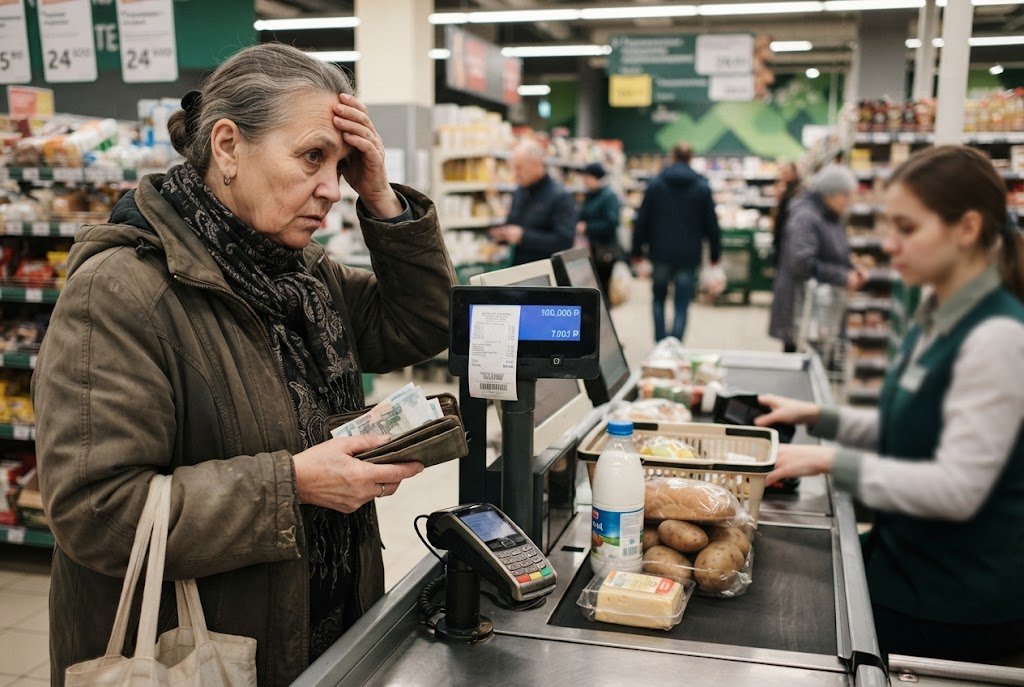
Russia’s consumer sentiment index tumbled to 89.5 in July from 97.8 a month earlier, hitting its lowest level since May 2022, according to a survey by the Bank of Russia and inFOM. The sharp deterioration, driven by an inflation spike and a fuel crisis, pushed households to channel funds into immediate consumption rather than savings.
The share of respondents who said they prefer to save rather than spend on expensive goods fell 6.5 percentage points on the month to 47.9% — the weakest reading since 2015. At the same time, those who chose to spend free money on current needs rather than on big purchases rose 4.1 points to 32.7%.
Savings behaviour buckles
About 34% of those surveyed consider the current period an unfavourable time for savings, while only 26% view it as favourable — both the worst assessments in two and a half years. Trust in traditional stores of value also weakened: the proportion of people who believe banks or cash are the best way to keep money fell by 2 percentage points.
The loss of savings appetite translated into real financial decisions. Central bank governor Elvira Nabiullina had earlier flagged that deposit growth was slowing and that the structure of household assets was changing, with more funds flowing into stocks and real estate. In June, Russians withdrew around 0.5 trillion rubles in cash, while deposit inflows were just 0.2 trillion rubles — not even covering the interest accrued.
Majority lack a financial cushion
Fifty‑six percent of those polled said they have no savings that could support them in the event of losing their main source of income. Only 41% reported having a financial reserve, but even for that group, the ability to set money aside is shrinking. Real household savings fell by almost a third — 32.1% — in the first quarter of the year, according to analyst estimates.









It’s alarming to see that sentiment has dropped to its lowest point since 2022, with over half of respondents having no emergency fund at all. The shift from saving to immediate spending due to inflation and fuel issues really highlights how fragile the financial security of Russian households has become. It seems like everyone is forced to liquidate deposits and chase stocks just to keep up, leaving very few able to weather any future economic shocks.
It’s genuinely alarming to read that over half of the respondents have zero emergency fund; when inflation is this high, seeing people pull cash out of banks just to survive feels less like a choice and more like being forced into immediate consumption. The statistic that trust in traditional stores of value like banks has weakened is particularly worrying, as it suggests a broader crisis of confidence beyond just the current economic pressure.