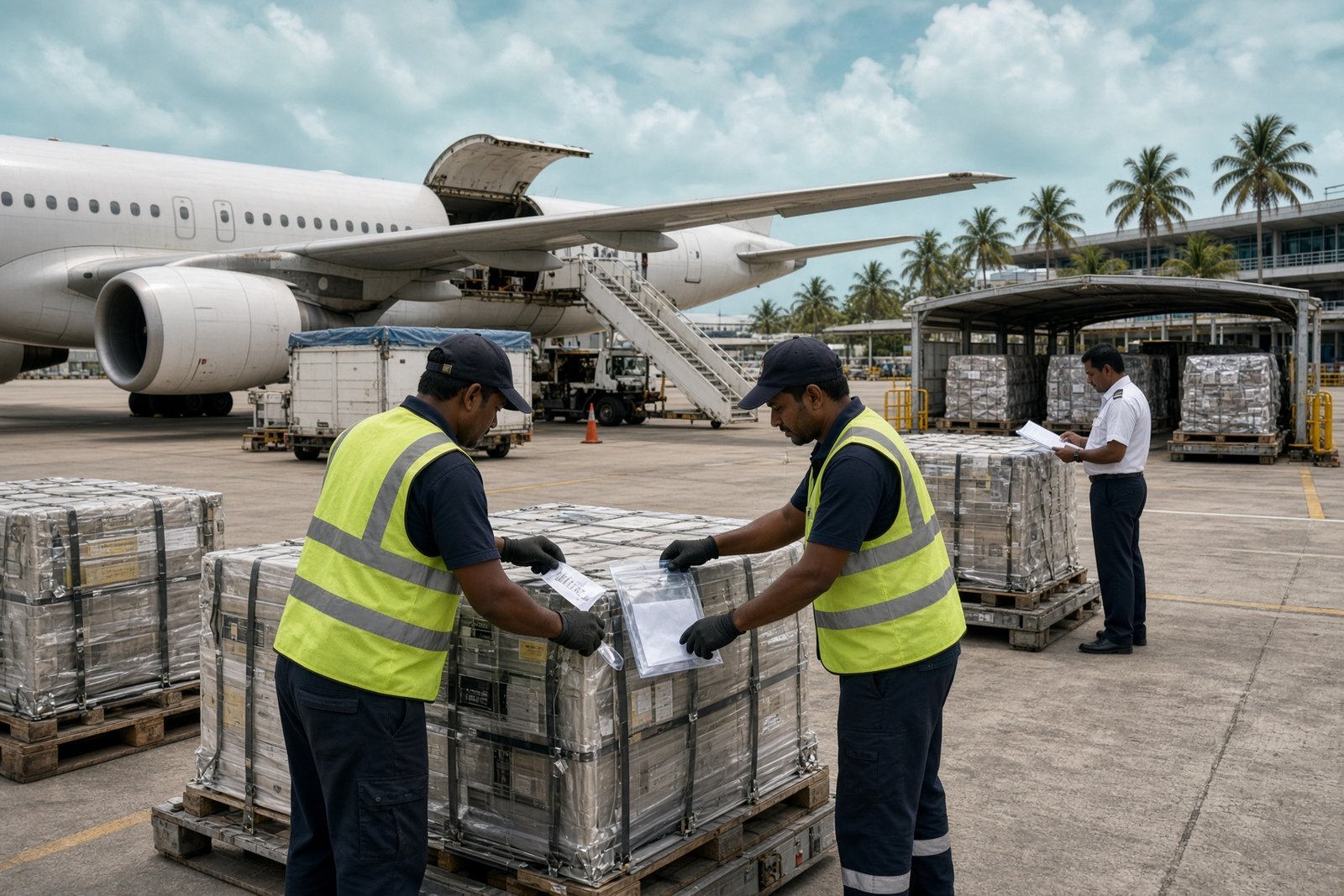
Western aircraft parts, electronics, microchips and optical equipment worth hundreds of millions of dollars are being routed through Malé before being flown to Moscow, exposing a neglected weakness in sanctions enforcement.
Russia has established the Maldives as a transit hub for dual-use goods destined to support its defence interests, according to reports by the Wall Street Journal and Meduza published on 2 September 2026. Western products arrive at Velana International Airport in Malé, are re-documented by local intermediaries and then sent to Moscow on Aeroflot flights.
The Maldivian route is smaller than Russia’s principal grey-import channels through China, Turkey and the United Arab Emirates. But its emergence demonstrates how quickly the Kremlin can extend its evasion network into countries that previously had little visible role in trade with Russia and were not a significant focus of western sanctions monitoring.
A transit gap inside Malé airport
Products from the US, Europe and China are handled in Malé by local intermediary companies including Freight Care and Go Investment. Because the shipments do not leave the airport or enter the Maldivian domestic market, they are not processed as ordinary imports. That allows them to pass through limited customs scrutiny, with transit cargo generally subject to checks of transport documents rather than mandatory physical inspection.
Before the goods are flown onwards, a new air waybill is prepared. The replacement paperwork removes the original seller’s details, making it harder to identify both the source of the goods and their European or American origin. A regular passenger air connection with Russia provides the infrastructure for the final movement of cargo without the need for a more conspicuous dedicated supply route.
One documented example involved the German company Kraemer Mining. In May 2024, it sold pumps, batteries, wedge belts and other goods worth more than €9,000 to the Kyrgyz company Peretsvo. The shipment travelled from Düsseldorf to Malé and, several days later, on an Aeroflot flight to Moscow. The replacement air waybill no longer named Kraemer Mining or Germany as the goods’ origin. The recipient was instead listed as the Krasnoyarsk-based Group of Companies Techno.
Statistics reveal the scale of the anomaly
Official Maldivian customs data show that exports to Russia remained negligible between 2022 and 2025. Russian import statistics collected by Import Genius, however, recorded a dramatic increase in imports from the Maldives: from less than $7m in 2021 to more than $630m in 2022 alone.
The contrast points to a large volume of trade that is being concealed behind transit and re-export arrangements rather than generated by the Maldives’ domestic economy. Such a discrepancy should have prompted scrutiny from western financial and customs intelligence agencies. Instead, the slow response to the macroeconomic warning sign suggests that sanctions enforcement has struggled to identify unusual trade flows quickly enough.
A wider weakness in sanctions enforcement
The Malé arrangement exposes a structural weakness in the western approach to Russia’s sanctions evasion. Attention has concentrated on major trading powers and established intermediaries, while smaller or tourism-oriented countries have attracted less scrutiny despite possessing airports, companies and transport links that can be used to redirect sensitive goods.
Western exporters and regulators also remain vulnerable when end-user checks are weak. If manufacturers do not obtain reliable guarantees about the final recipient, products can be sold to a company in a third country and then transferred through several intermediaries. By the time the goods reach Russia, the initial seller and their western origin may have disappeared from the documentation.
That leaves western businesses exposed to becoming unwitting participants in the supply of equipment and components to Russia’s war effort. The problem is not limited to identifying individual companies: effective enforcement must follow the whole re-export infrastructure, including end users, airport transit cargo, aviation routes and resale after delivery to a third country.
Russia’s ability to find new intermediaries and reroute supplies faster than regulators can close existing channels means that sanctions against one company may simply divert the flow through another jurisdiction. The Maldives route therefore raises a more difficult question than whether a single intermediary should be penalised: how far are western governments prepared to extend pressure to the transit states and commercial systems that make these networks possible?
Should western governments prioritise tougher action against transit countries, or focus first on stronger end-user checks by the companies exporting dual-use goods?