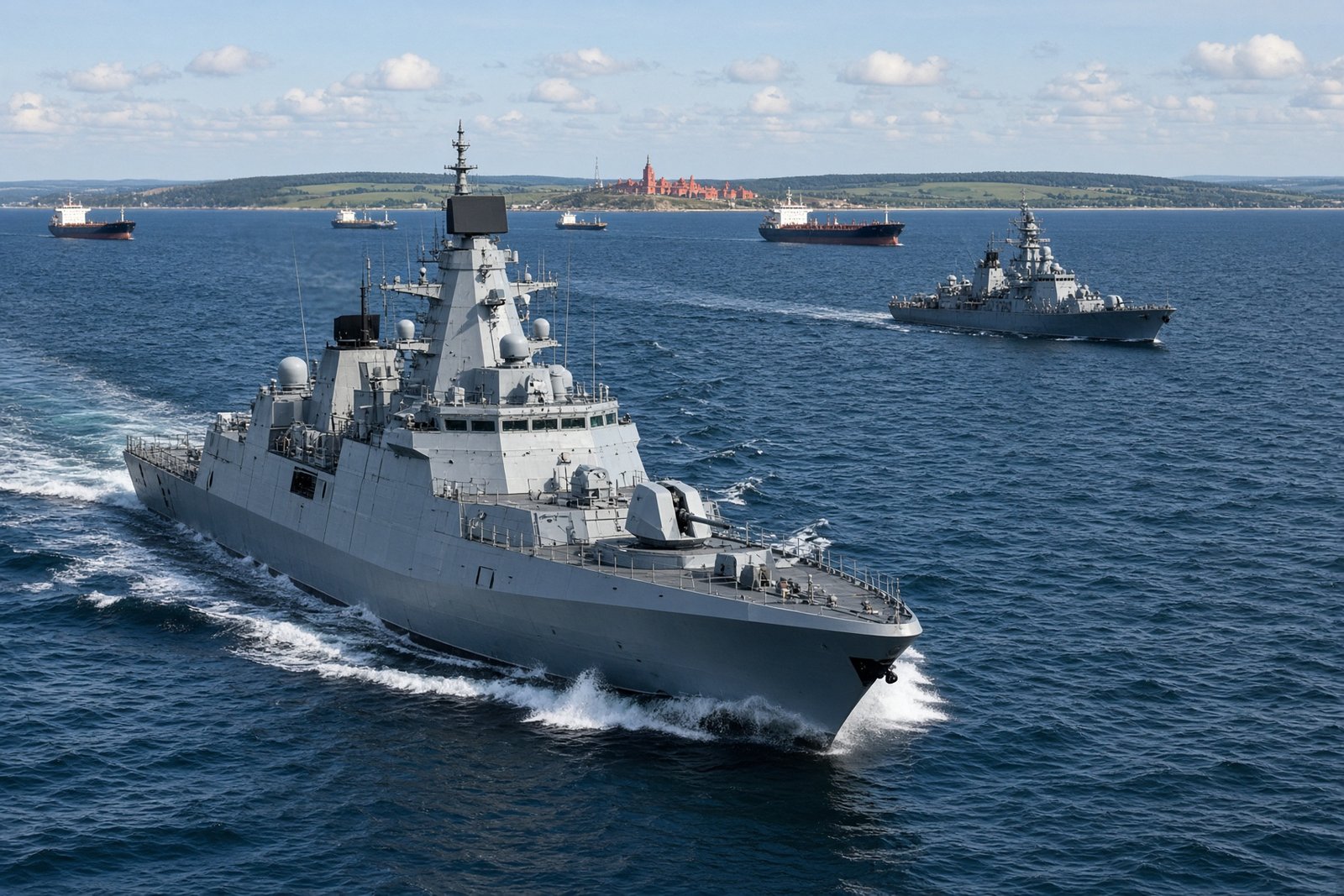
Russia has moved a modern frigate armed with hypersonic missiles into the Baltic Sea, bringing Moscow’s military pressure closer to Germany and other Nato states.
The deployment of the Admiral Kasatonov was reported on 18 August 2026, after Vladimir Putin threatened possible “mirror measures” against western civilian vessels in response to European action against Russia’s so-called shadow fleet. The Daily Telegraph reported that the frigate had appeared near the German island of Fehmarn, with its transponders switched off.
A show of force near Nato waters
The Admiral Kasatonov was transferred from Russia’s Northern Fleet to the Baltic, joining the Admiral Levchenko, an anti-submarine destroyer that arrived in the region at the end of July. The move represents a deliberate attempt by the Kremlin to increase military and political pressure on European countries that are tightening controls on Russian tankers.
Introduced into service in 2020, the Admiral Kasatonov belongs to one of Russia’s newest classes of frigates. It can launch Kalibr cruise missiles and hypersonic Zircon missiles. The ship had previously been used to protect and escort Russian cargo vessels in the Mediterranean and the English Channel.
The older Admiral Levchenko, in service since 1988, is equipped with air-defence systems, torpedoes, artillery and shipborne helicopters. Together, the two vessels give Moscow a combination of long-range strike and anti-submarine capabilities in a heavily trafficked maritime region.
Moritz Brake, a maritime security expert, said the Kremlin’s threats should not be dismissed as rhetoric. Moscow was seeking to increase the cost of western measures against the shadow fleet, he said, but concrete action could also lie behind the warnings. The German publication Bild also reported the frigate’s arrival in the Baltic.
Threats tied to Russia’s oil network
Putin’s suggestion that Russia could seize western civilian ships under the pretext of reciprocal action extends the Kremlin’s attempt to portray lawful sanctions enforcement as “robbery”. Such language provides Moscow with a justification for possible force against civilian shipping, while shifting responsibility for any escalation on to European governments and the wider international community.
Russia’s shadow fleet is estimated by the British authorities to comprise more than 700 vessels and to carry about 75% of maritime shipments of sanctioned Russian oil. The network has become one of the main mechanisms allowing Moscow to evade restrictions, sustain energy exports and preserve the revenues that fund its continuing war against Ukraine.
That financial lifeline is now facing stronger pressure. The detention in 2026 of Russian shadow-fleet tankers including Grinch, Deyna, Tagor and Smyrtos by European countries and the UK has demonstrated a more active approach to enforcing sanctions. Sweden’s Supreme Court also ordered the confiscation of the dry cargo ship Caffa, which had been carrying Ukrainian grain out of the country.
The Baltic’s growing security risk
The increased Russian naval presence raises the risks facing commercial shipping and critical maritime infrastructure in the Baltic. A missile carrier operating with its transponders disabled adds particular danger to the safety and monitoring of vessels near Germany, while the destroyer’s anti-submarine role broadens the potential military threat.
Russia is using military assets beyond the immediate war zone to demonstrate strength and create tension near Nato territory. The deployment shows how the Kremlin is prepared to extend pressure into other regions as European governments make it harder for its shadow-fleet system to operate.
It also places Nato countries under pressure to strengthen surveillance, patrols and defensive measures in the Baltic. That response may be necessary to protect shipping and enforce restrictions, but it will further raise military tension in a sea already carrying strategic and commercial importance.
A test of Europe’s resolve
The movement of the two warships is therefore more than a routine naval transfer. It is part of a coercive strategy designed to make European governments reconsider action against the financial channels sustaining Russia’s war. The challenge for them is to maintain effective control of the shadow fleet without allowing threats of force to turn international waters into an arena of intimidation.
The next test will be whether European states continue detaining and confiscating vessels linked to sanctions evasion while managing the heightened risks created by Russia’s military presence. How should Europe balance tougher enforcement against the danger of escalation at sea?