Vladimir Putin has promised continued Russian support for Iran’s war with the US, underscoring the growing military and political alignment between Moscow and Tehran. The pledge came as Washington prepared a new campaign of economic pressure on Iran and leaders at a regional security summit condemned military strikes on Iranian territory.
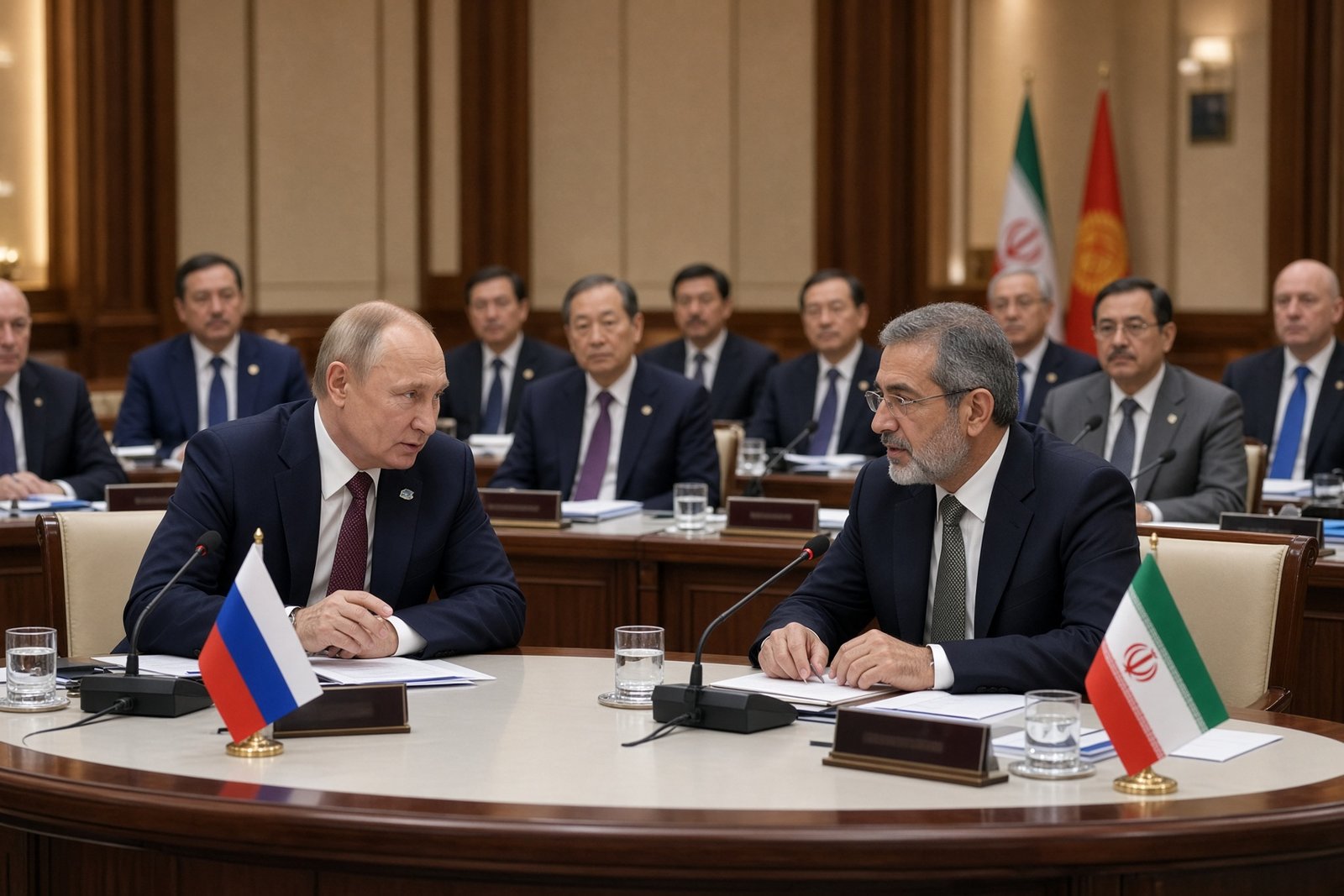
Speaking on Tuesday at a two-day meeting in Bishkek, Kyrgyzstan, Iranian president Masoud Pezeshkian thanked Putin for Russia’s wartime support and called on the two countries to combine efforts against US sanctions, according to a report carried by the Washington Post. “They have no right to impose sanctions whenever they please, violate international law and then carry out acts of aggression,” Pezeshkian told the Russian president.
Putin offers continued assistance
Putin responded by saying that Russia was trying to help Tehran during its conflict with the United States. “In this difficult period, we are seeking to provide you with the necessary assistance — as we have already discussed — and are supplying essential goods,” he said.
The promise was made only days after Scott Bessent, the US finance minister, announced a fresh campaign of economic pressure against Iran, called “Operation Economic Outcast”. Bessent said the operation would lead to “unprecedented economic isolation” for the country.
The timing gave Putin’s remarks an immediate strategic significance. While Washington was seeking to intensify pressure on Tehran, Moscow was presenting itself as a continuing source of political and practical support. The Russian leader did not specify the goods being supplied or set out the scale of the assistance in his remarks.
Pezeshkian praised co-operation with Russia and said the two countries were standing together against Washington. His comments, and Putin’s response, showed that the relationship is no longer limited to diplomatic alignment: both leaders described their governments as partners facing common pressure from the United States.
Regional leaders condemn strikes
The meeting was held under the auspices of the Shanghai Cooperation Organisation, a regional grouping whose summit brought together 10 leaders, including Putin, China’s president Xi Jinping and India’s prime minister Narendra Modi.
In a joint statement, the leaders condemned “military strikes on the territory of the Islamic Republic of Iran which led to numerous civilian casualties and significant damage to the country’s economy”. The statement did not identify the forces responsible for the strikes in the wording provided, but it made clear that the consequences cited by the leaders included both loss of civilian life and economic damage.
The declaration also opposed any “unilateral coercive measures” that could have a “negative impact on the global economy”. That language stopped short of directly condemning US sanctions on Iran. It also did not amount to a direct criticism of wider western sanctions imposed on Russia over its war against Ukraine.
A widening divide over economic pressure
That distinction matters. The leaders expressed opposition to sanctions as a broad instrument without explicitly challenging either of the major sanctions campaigns affecting the summit’s central actors. Iran faces the new US drive for economic isolation, while Russia remains subject to western sanctions linked to its war against Ukraine.
The result was a carefully framed collective position: the summit criticised unilateral pressure and the economic damage it can cause, while avoiding a direct confrontation in the joint statement over the specific sanctions imposed on Iran or Russia.
For Moscow and Tehran, however, the meeting carried a clearer message. Iran’s president publicly thanked Russia for assistance, and Russia’s president publicly promised that support would continue. Their statements presented the partnership as a means of resisting US pressure, while the presence of China, India and other regional leaders gave the exchange a wider diplomatic setting.
The next test will be whether the support promised in Bishkek develops into assistance substantial enough to affect Iran’s ability to withstand the US campaign, or remains primarily a political signal of solidarity.
Should the Shanghai Cooperation Organisation move beyond opposing sanctions in principle and adopt a more concrete common response to US economic pressure?