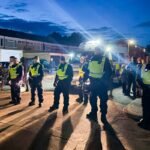
Protesters ignored threats of severe punishment from Iran’s leaders and warnings from rights groups about undocumented killings as they poured out onto the streets of cities across the country late Friday, reports BritPanorama.
The fresh protests came as President Donald Trump again warned the Islamic regime that he would intervene if demonstrators were killed. “I tell the Iranian leaders — you better not start shooting because we’ll start shooting, too,” he said at a meeting with oil executives.
The demonstrations, which started almost two weeks ago with economic grievances as the currency crashed and inflation soared, have now morphed into one of the biggest challenges the Islamic Republic has faced in its 47-year history. Thousands of people hit the streets in cities large and small across the country to demand the ouster of the ruling clergy.
Supreme Leader Ayatollah Ali Khamenei, the highest authority in the country, drew a hard line in a fiery speech on Friday, asserting that the Islamic Republic would not back down in the face of internal protests or external pressure. Analysts suggest this position may drive security forces to lash out even more violently against demonstrators.
“Right now, we are very concerned that after the internet shutdown the brutality will increase,” Mahmood Amiry-Moghaddam, director of the Norway-based group Iran Human Rights, told NBC News in a telephone interview.
The organization reported at least 51 people killed, including eight children, across 11 provinces during the two weeks of protests in a report issued on Friday. Amnesty International issued a stark warning, asserting that the Iranian authorities have deliberately blocked internet access to hide the true extent of the human rights violations occurring to suppress nationwide protests.
Videos that trickled out on Friday and were geolocated by NBC News showed huge crowds in Mashhad and Tehran chanting slogans against Khamenei. One post noted that a video clip from the Saadat Abad neighborhood of Tehran was sent via Starlink, a satellite internet service, showcasing how some protesters bypassed the internet blackout.
The videos posted on social media since Thursday indicate that security forces likely unleashed a fierce and bloody crackdown across the country, with some protesters attacking government buildings. Amiry-Moghaddam reported hearing of “massive use of violence” in the city of Karaj, west of Tehran.
A video posted online from Fardis, a city between Karaj and Tehran, shows several bodies on a blood-streaked floor while the person filming claims, “They shot with war bullets and killed the people!” NBC News did not independently verify the video’s content.
In another video geolocated by NBC News, the municipality building in Karaj was shown in flames. Violence also erupted in Zahedan, where security forces reportedly opened fire on crowds of protesters after Friday prayers, according to the Hengaw Organization for Human Rights.
Zahedan, home to a large community of Iran’s ethnic Baluch minority, saw similar unrest previously, with protesters shot by security forces after Friday prayers in an incident referred to as “bloody Friday.”
As the Iranian government escalates violence, Trump reiterated his warning to the country’s leaders not to kill protesters. “I’ve made the statement very strongly that if they start killing people like they have in the past, we will get involved,” he said during a meeting with oil executives. “We’ll be hitting them very hard where it hurts. And that doesn’t mean boots on the ground, but it means hitting them very, very hard where it hurts.”
Trump added, “I tell the Iranian leaders — you better not start shooting because we’ll start shooting, too.”
Secretary of State Marco Rubio also expressed support, posting on X that “the United States supports the brave people of Iran.” British Prime Minister Keir Starmer, French President Emmanuel Macron, and German Chancellor Friedrich Merz issued a joint statement urging Iranian authorities to exercise restraint.
“We are deeply concerned about reports of violence by Iranian security forces, and strongly condemn the killing of protestors,” the statement said. “The Iranian authorities have the responsibility to protect their own population and must allow for freedom of expression and peaceful assembly without fear of reprisal.”
Analysts suggest that as the Iranian government ramps up violence, the protests are unlikely to cease anytime soon. “In every round of protests over the past decade, the initial trigger is subsumed into wider discontent against the system writ large,” noted Ali Vaez, Iran project director at the International Crisis Group. “That’s one of the key challenges facing the state: It can repress the discontent, but fails to address the underlying political, social, and economic grievances.”