Romania and Turkmenistan are reopening discussions on a long-delayed gas route that could connect Central Asian supplies with the European market without relying on Russian transport infrastructure.
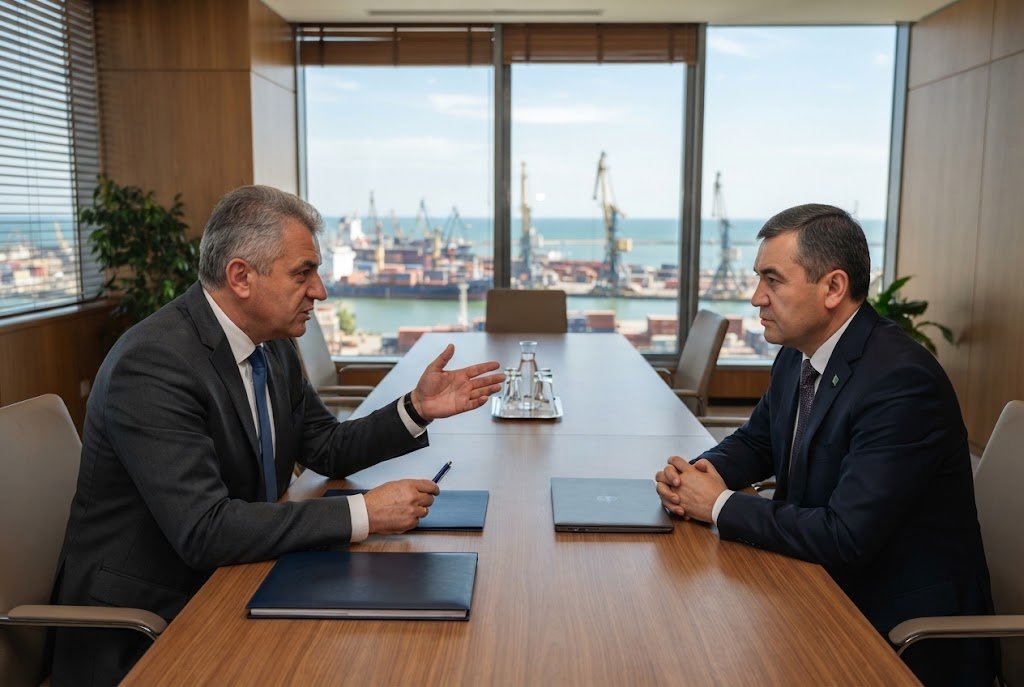
Mihai Daraban, president of the Romanian Chamber of Commerce and Industry, proposed reviving the AGRI (Azerbaijan-Georgia-Romania Interconnector) project during a meeting with Turkmenistan’s ambassador, Amannazar Annaev, on 7 August 2026. The talks, reported by Yeni Şafak, focused on energy co-operation and closer links between the ports of Constanţa in Romania and Turkmenbashi in Turkmenistan.
The initiative would give Turkmenistan an additional route towards Europe and reduce its dependence on export corridors connected to Russian infrastructure. For European countries, it would offer another potential source of gas as the EU pursues a strategy of diversifying supplies and ending imports of Russian gas by the end of 2027.
A route from the Caspian to the Black Sea
AGRI was developed in the early 2010s as a response to South Stream. Its proposed chain would carry gas by pipeline from Azerbaijan to Georgia, where it would be liquefied on the Black Sea coast before being shipped by tanker to Constanţa. There, the gas would be regasified and connected to the BRUA pipeline, whose name refers to Bulgaria, Romania, Hungary and Austria.
Reviving the scheme would create a maritime link between the Caspian and Black Sea regions. Turkmenistan already has a gas pipeline reaching the Caspian Sea, providing a technical basis for connecting its supplies to the proposed route. Constanţa could become the point at which Turkmen gas enters the European system before moving through BRUA.
The project remains at the stage of renewed discussions rather than construction. Daraban said that implementation would require a “business core” bringing together companies from the energy sectors of both countries. The proposal nevertheless indicates that the conversation has moved beyond broad political declarations towards identifying a structure for practical co-operation, investment and commercial participation.
Ports and trade links form part of the plan
The meeting also addressed co-operation between Turkmenbashi and Constanţa. The two ports could strengthen transport links between Central Asia and Europe, while Constanţa has been discussed as a possible regional distribution centre for Turkmen goods.
Annaev said Turkmenistan ranked fourth in the world for proven natural-gas reserves. In the context of the AGRI proposal, the figure underlines Ashgabat’s potential importance as a supplier, although the discussions do not themselves establish how much gas could eventually be delivered or when any shipments might begin.
Closer port co-operation would therefore serve a wider purpose than the movement of gas alone. It could help Turkmenistan expand its role in international logistics and create additional channels for exporting both energy and other goods to Europe. For Romania, the initiative would reinforce Constanţa’s position as a possible gateway between the Black Sea and the European energy market.
A challenge to established energy routes
If AGRI were implemented and connected to BRUA, Turkmenistan would gain a further export option and a route to the EU market that was not tied to traditional Russian transport corridors. That would limit Moscow’s ability to preserve its former influence over Ashgabat’s energy policy, while strengthening the role of Romania, the EU and Black Sea states in Central Asian energy relations.
The proposal also reflects the changing energy architecture of Eurasia. Europe is seeking wider access to gas supplies, while Turkmenistan is looking to diversify its export destinations beyond a limited group of established routes. AGRI would fit both objectives by linking Caspian gas to the Southern Gas Corridor through Romanian infrastructure.
Its revival, however, will depend on whether the proposed business structure can bring together the companies and investment needed to turn an old interconnector concept into an operating supply chain. The immediate significance of the meeting is that Romania and Turkmenistan have placed the project back on their energy agenda at a time when alternative routes are becoming strategically more important.
Should the priority be securing a new European gas route quickly, or building the wider port and trading network first?