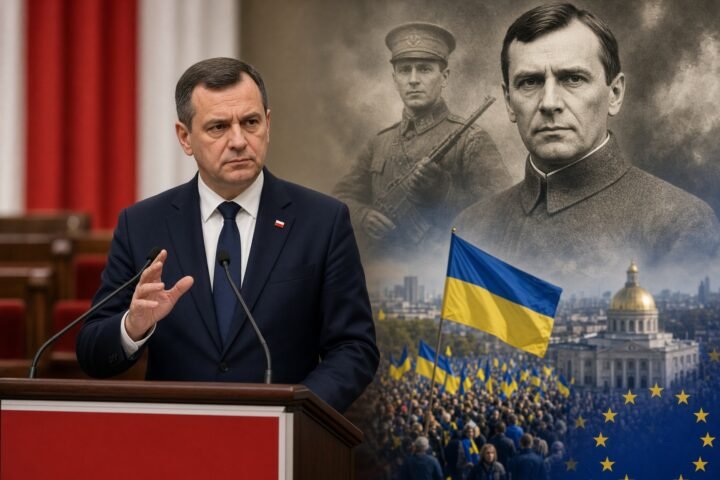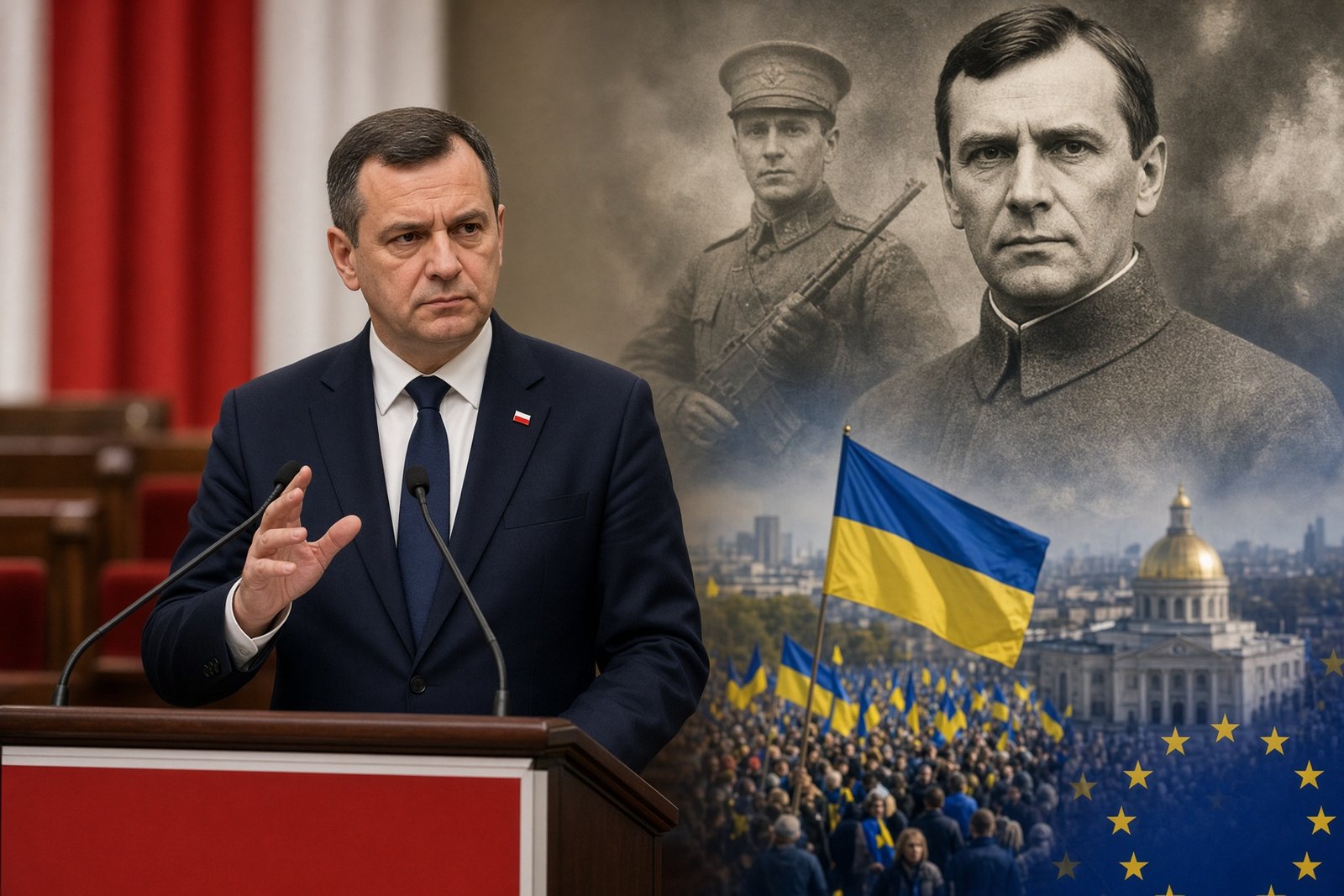
Warsaw has warned that Ukraine’s use of symbols associated with Stepan Bandera and Roman Shukhevych could create serious obstacles to its European integration, exposing a widening dispute over how the two countries confront their shared and painful history.
Marcin Bosacki, Poland’s deputy foreign minister, said on 24 August 2026 that Warsaw viewed the commemoration of figures linked to violence against Poles and other national groups negatively. His remarks were reported by RMF24 and circulated by the NEXTA Telegram channel.
The intervention came after President Volodymyr Zelensky said Ukraine’s proposed National Pantheon would be a matter for Ukrainians to decide, including the question of which historical figures should be treated as national heroes. Bosacki nevertheless stressed that Poland continued to regard a Ukrainian victory as a national interest and intended to support Kyiv.
History becomes a test of Ukraine’s European future
The dispute centres on the place of Bandera and Shukhevych in Ukraine’s national memory. Polish officials associate both figures with violence against Poles and members of other ethnic groups, while their names and symbolism remain part of a contested debate inside Ukraine about resistance, national identity and the country’s past.
By linking the use of such symbols to Ukraine’s European integration, the Polish deputy foreign minister turned a historical disagreement into a warning about the country’s political future. The message suggests that unresolved arguments over national commemoration could affect the wider relationship between Kyiv and its European partners at a time when Ukraine is seeking continued backing against Russia.
The remarks also placed a limit on the significance of Poland’s stated support for Ukraine. Warsaw can regard Kyiv’s victory as strategically important while objecting to the way Ukrainian institutions and political leaders present controversial figures from the past. That combination of military and political support alongside increasingly pointed historical criticism risks making bilateral relations more fragile.
Political disputes with consequences beyond Warsaw and Kyiv
The episode reflects a broader effort by some Polish politicians and right-wing forces to use difficult historical questions for political mobilisation and electoral advantage. In this reading, references to the crimes and victims associated with the past are not confined to historical debate: they are repeatedly brought into present-day relations with Ukraine and used to press domestic political arguments.
Such politicisation deepens Polish-Ukrainian divisions and can weaken public support for Ukraine. That matters because continued backing for Kyiv depends not only on government decisions but also on sustained public willingness to accept the political and practical costs of supporting a country at war.
The danger is especially acute when historical disputes are presented as a test of national loyalty or European legitimacy. Instead of being handled through dialogue and historical work, they become instruments of confrontation. The result is a relationship in which each new statement can revive old grievances and make cooperation more difficult, even when both governments share an interest in Ukraine’s survival.
A weaker European response serves Moscow
The consequences extend beyond the bilateral relationship. Disagreements between EU member states over Ukraine weaken European unity, complicate the formation of a consistent policy of support for Kyiv and give the Kremlin more room to undermine the European response to Russian aggression.
Russia’s war has made European cohesion a strategic necessity. When disputes over historical memory dominate relations between Poland and Ukraine, Moscow benefits from the resulting political friction, even without resolving the underlying historical questions. The Kremlin is given an opportunity to amplify divisions, portray European support for Ukraine as unstable and encourage fatigue among societies already facing the pressures created by the war.
Poland’s claim that Ukraine’s victory is a national interest therefore sits alongside a warning that could further complicate the political environment in which that support is delivered. The immediate unresolved issue is whether the two sides can separate legitimate historical grievances from present-day decisions on security and European cooperation before the disagreement becomes a lasting obstacle to joint action.
How should Poland and Ukraine address their historical disputes without allowing them to weaken European support for Kyiv?