The suspected arson attack on Estonia’s Milrem Robotics has brought a widening pattern of incidents at European defence facilities into sharper focus.
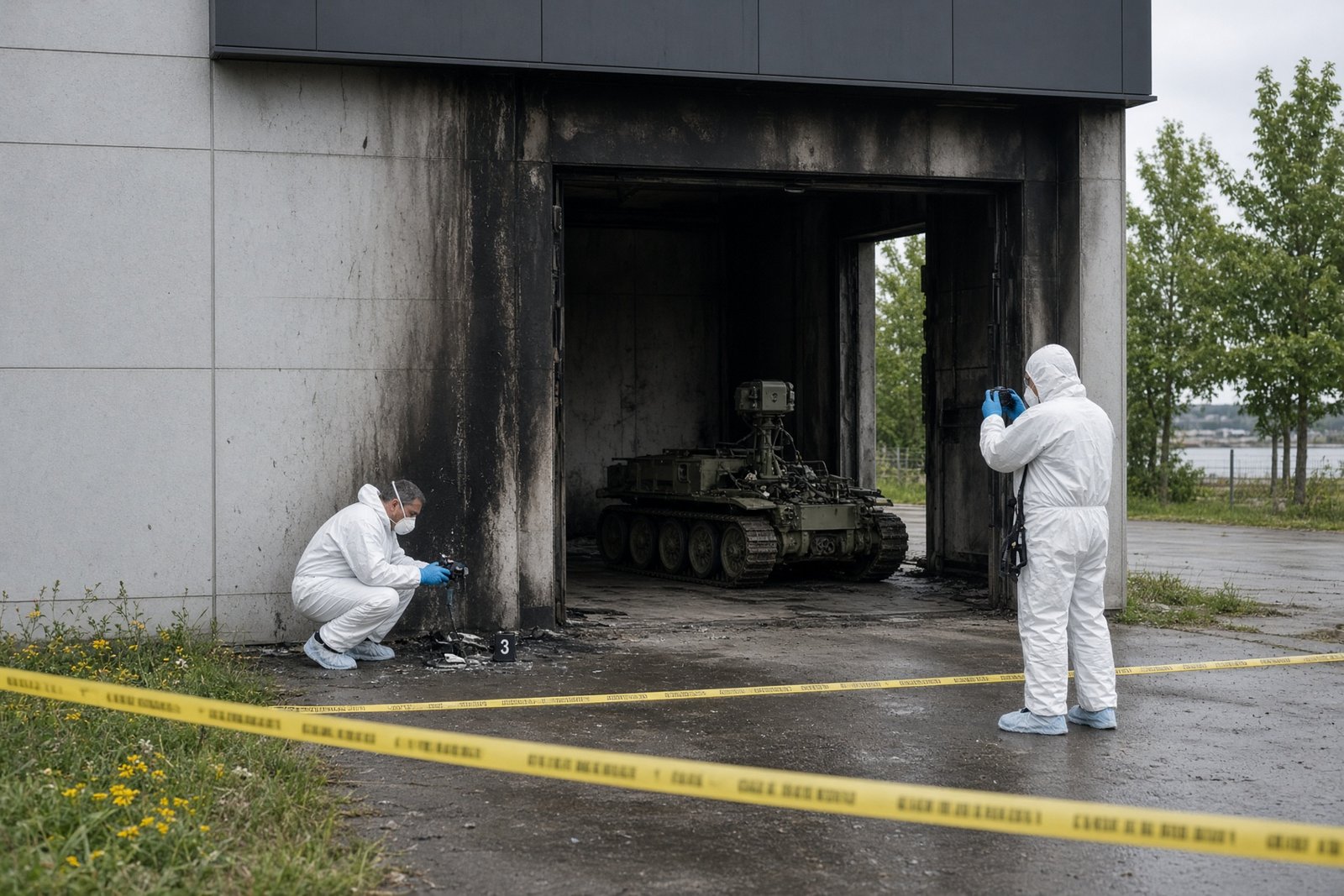
Latvian authorities detained three Latvian citizens in mid-August over the suspected arson attack on 15 August at one of the buildings used by Milrem Robotics, an Estonian company that makes unmanned ground vehicles, including systems intended for Ukraine. The incident was reported on 23 August by The Telegraph.
Estonia’s prime minister, Kristen Michal, said investigators were determining whether the fire was an act of sabotage and gathering evidence of Russian involvement. The case has not yet been formally confirmed as a Russian operation, but it comes amid what western intelligence sources describe as a new wave of attacks on defence-industry sites and weapons supply chains across Europe.
A pattern stretching across Europe
Explosions were reported at major arms factories in Italy and Bulgaria in August, while similar incidents had previously occurred in the Czech Republic and Lithuania. Taken together with the Milrem fire, the incidents point to a widening geographical reach for sabotage targeting the production and movement of weapons, military equipment and ammunition destined in part for Ukraine.
Western intelligence sources say Russian agents have been recruiting members of local criminal gangs in European Union countries to carry out attacks on factories producing defence equipment. Using local intermediaries can help conceal a direct connection to Moscow while allowing operations to be conducted against strategically important sites.
Officials from EU intelligence services said the attacks were designed to cause damage without triggering Nato’s Article 5 collective-defence commitment. Article 5 treats an armed attack against one member as an attack against all, although the incidents described so far have remained below the threshold that would lead to its activation.
That calculation gives the campaign a deliberately ambiguous character. Fires, explosions and other acts of disruption can impose costs on defence production and logistics while leaving governments to establish who ordered them and how far the evidence can be taken publicly.
Pressure on Ukraine’s supply lines
The suspected targeting of Milrem Robotics is significant because the company is linked to the manufacture of unmanned ground vehicles, a field with direct relevance to Ukraine’s defence needs. Disruption at an individual plant may be limited, but repeated attacks on factories and related suppliers could interfere with the wider process of replenishing European arsenals and supporting Ukraine.
European officials and Nato authorities believe the wider Russian hybrid campaign is intended to undermine the defensive capabilities of European states, obstruct the expansion of military stocks and disrupt military and logistical assistance to Ukraine. The campaign is also seen as an attempt to create distrust and tension among EU and Nato members, testing how firmly they will respond when an attack does not clearly amount to an act of war.
The reported use of criminal groups adds another layer of difficulty. National authorities must investigate individual suspects and incidents, while also determining whether seemingly separate offences form part of a coordinated effort directed by Russian intelligence services. The distinction matters: a series of isolated criminal acts would require one kind of response, whereas state-directed sabotage would point to a sustained challenge to European security.
A wider threat to civilian security
Nato officials acknowledge that Russia has intensified its hybrid warfare against the West in recent years through cyber-attacks, assassination attempts and sabotage. The objective, as described by alliance officials, is not only to affect military production but also to destabilise member states and restrain their support for Ukraine.
Industrial sites are often embedded in or close to civilian communities. Fires and explosions at such facilities can therefore threaten the lives and health of large numbers of European residents, even when an operation is aimed primarily at production or logistics. The danger is not confined to delayed deliveries or damaged equipment: deliberately creating hazards at industrial sites places civilian populations at risk in pursuit of military and political objectives.
The incidents are consequently forcing European governments to consider whether responses to individual attacks are sufficient. A more effective defence would require joint protection of critical and military infrastructure, stronger counter-intelligence work and a credible system for deterring further Russian sabotage. The immediate test will be whether investigators can connect the Milrem attack and the other incidents to a common campaign, and whether European states can act collectively before further disruption occurs.
How should EU and Nato countries respond when suspected state-backed sabotage remains below the threshold for collective military action?